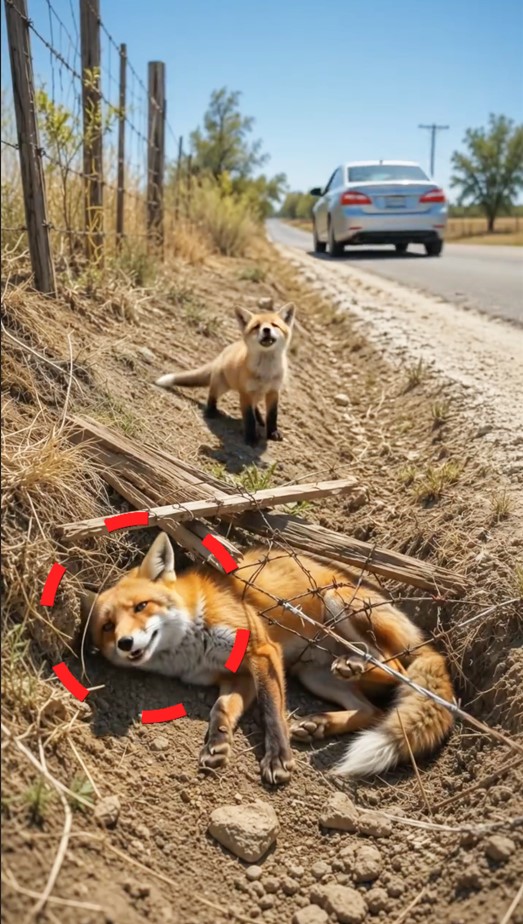
The morning mist drifted between the trees as a mother fox guided her young cub along a narrow path at the edge of the forest.
The little cub followed closely, stopping every few steps to sniff the damp leaves and fallen branches.
Its mother moved with practiced caution, her reddish coat blending into the brown woodland floor.
Beyond the trees, an old wire fence separated the forest from an overgrown field.
The fence had stood there for years, partly hidden by brambles and climbing vines.
As the mother fox squeezed through a gap near the ground, one of her legs caught in a loose section of wire.
She twisted to pull free, but the wire tightened around her fur and held her in place.
Her sudden movement startled the cub.
The little fox jumped backward, then hurried toward its mother again.
She struggled once more, making the wire rattle against the fence.
The cub remained close, watching every movement with frightened, uncertain eyes.
Neither animal could understand how an ordinary walk through familiar woodland had become so dangerous.
The Cub Refuses to Leave Its Mother
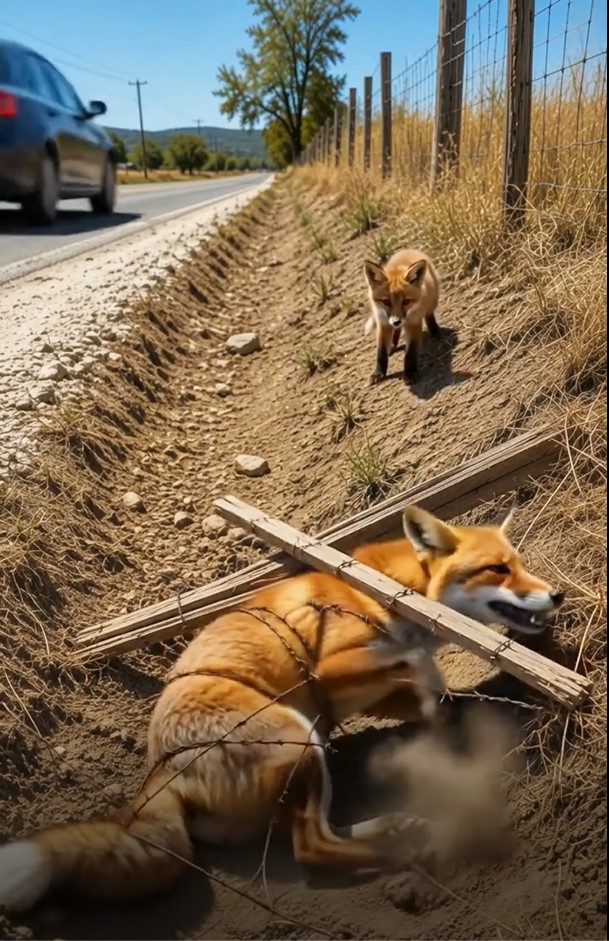
The mother fox tried to turn sideways, hoping to slip through the gap.
Instead, the wire caught more tightly against her coat.
She stopped struggling for a moment, breathing quickly as she assessed the unfamiliar restraint.
The cub circled behind her, searching for another way to reach her.
Whenever it came close, the mother lowered her head and made a soft, warning sound.
She was frightened, but her attention remained fixed on the cub.
The little fox backed away, then returned almost immediately.
It nudged its mother’s shoulder with its nose before looking toward the trees.
The woodland around them remained quiet except for birds calling from the branches overhead.
A light breeze moved through the brambles, making the old fence tremble.
The mother pulled gently at her trapped leg again.
The wire scraped against the fence post, but she could not free herself.
Her movements grew smaller as she tried to avoid making the situation worse.
The cub sat beside a patch of grass, ears raised and body tense.
Every few seconds, it stood and approached its mother.
The distance between them was only a few feet, yet the wire had created a barrier the cub could not overcome.
For the first time that morning, the young fox wandered toward the open field.
It paused, turned back, and hurried to its mother’s side again.
A Strange Sound Reaches the Footpath
Several minutes later, a man named Thomas walked along a nearby footpath with his dog on a leash.
He had taken the route many times, usually hearing nothing more unusual than birdsong and rustling leaves.
That morning, however, a sharp metallic rattle came from beyond the brambles.
Thomas stopped and listened.
The sound came again, followed by a faint animal cry.
He shortened his dog’s leash and carefully moved toward the fence.
Through a gap in the vegetation, he spotted the mother fox struggling against the wire.
The cub stood beside her, watching him with wide, alert eyes.
Thomas immediately stopped advancing.
He knew that a frightened wild animal might bite or injure itself if someone approached too quickly.
He also understood that the cub could become distressed if he moved directly toward its mother.
Instead, he kept his dog well back and called the local wildlife rescue service.
He described the wire fence, the trapped fox, and the cub that had remained nearby.
The dispatcher advised him not to pull the wire or attempt to handle either animal.
A trained responder would arrive with suitable equipment.
Thomas provided the location and stayed where he could observe the situation without crowding the foxes.
As he waited, the cub moved into the grass beside its mother.
The mother fox turned her head toward it, then looked toward Thomas.
He remained still, hoping his presence would not add to their fear.
The Wildlife Rescuers Assess the Fence
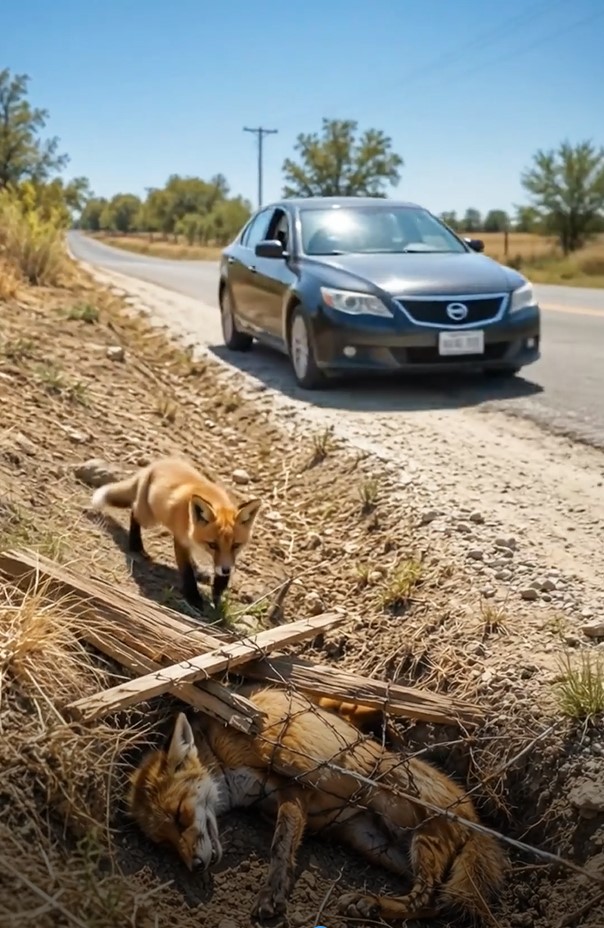
A wildlife responder named Sarah arrived with protective equipment and tools for safely cutting the wire.
She parked away from the fence and approached on foot, stopping several yards from the mother fox.
Thomas explained how the animal had become trapped and pointed out the loose section hidden beneath the brambles.
Sarah first examined the fence without touching it.
The wire had twisted around the mother’s lower leg and caught in the surrounding vegetation.
Pulling it free without controlling the tension could worsen the injury.
Sarah also considered the cub’s position, making sure it had a clear route into the nearby undergrowth.
She asked Thomas to remain farther back while she prepared her equipment.
The mother fox watched every movement, her ears shifting toward the sounds around her.
When Sarah approached, the fox struggled briefly, causing the wire to vibrate.
Sarah stopped immediately and waited until the animal became still.
She worked slowly, choosing a point where the wire could be cut without pulling against the trapped leg.
The cub disappeared behind a clump of grass but remained close enough to watch.
Sarah knew that freeing the mother was only one part of the challenge.
She also needed to minimize stress and assess whether the fox could move safely afterward.
With the equipment ready, she positioned herself carefully beside the fence.
The next few moments would require patience, precision, and steady hands.
The Moment the Wire Finally Gives Way
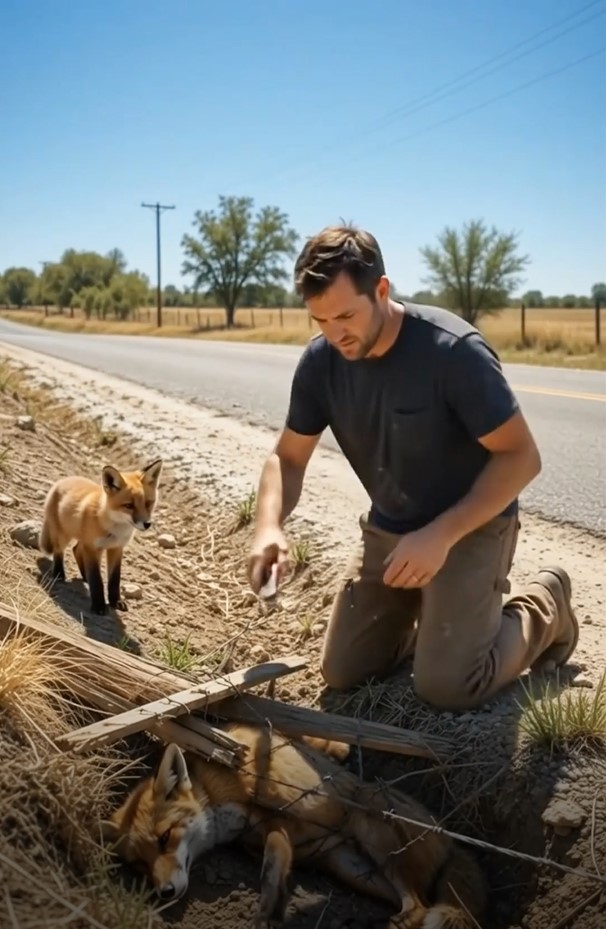
Sarah used a protective barrier to limit the fox’s movement while she worked on the twisted wire.
She made the first cut, removing a loose section that had been pressing against the animal’s fur.
The mother fox tensed but remained in place.
Sarah adjusted her position and cut the remaining strand that held the leg against the fence.
As the tension released, the fox pulled backward.
For one brief moment, her leg remained caught among the brambles.
Sarah carefully separated the vegetation and opened a clear path away from the fence.
The mother fox stumbled free and moved several feet into the grass.
She stopped immediately, holding the affected leg slightly above the ground.
The cub emerged from its hiding place and hurried toward her.
It pressed close against its mother’s side, then stepped back as she turned toward the trees.
Sarah remained still, allowing the foxes space while she watched the mother’s movement.
The animal took several cautious steps, placing weight on the leg before pausing again.
Sarah could see that the fox was frightened and might be injured, so she did not assume that freedom from the wire meant the danger had passed.
She contacted the wildlife clinic for guidance and arranged a closer assessment by trained staff.
The mother fox moved a short distance into the undergrowth, with the cub following closely behind.
Thomas watched silently as the pair disappeared between the trees.
The old fence stood empty, its loose wire now secured so another animal would be less likely to become trapped.
Mother fox gets stuck in wire while her cub waits for help https://t.co/tQ7mbvx9k0
— Animal Rescue Stories (@AnimalStory5) October 13, 2026
A Quiet Return to the Forest
Wildlife staff later assessed the mother fox from a safe distance and determined the appropriate next steps based on her condition.
Because wild foxes can become highly stressed during handling, the team avoided unnecessary contact and followed professional wildlife-care procedures.
They monitored the area for signs that the mother and cub had settled nearby.
By late afternoon, fresh tracks appeared in the soft earth beyond the fence.
The prints followed the woodland path before turning toward a sheltered area beneath a cluster of trees.
Sarah checked the site without entering the animals’ immediate space.
There were no signs of another entanglement, and the repaired section of fence remained secure.
Thomas returned to the footpath the next morning.
He brought his dog along, keeping it close as he passed the place where he had first heard the wire rattling.
The fence looked ordinary again, but he noticed a narrow trail through the grass leading back toward the forest.
He could not know exactly where the foxes had gone or how their story would unfold.
Still, he felt grateful that someone had noticed their distress before the situation became worse.
The encounter also prompted the local landowner to inspect other damaged sections of fencing near the woodland.
Several loose strands were removed or repaired to reduce the risk to wildlife.
For Thomas, the most memorable sight remained the cub waiting beside its trapped mother.
The little fox had been too young to solve the problem, yet it had stayed close while help was on its way.
And for the mother fox, a dangerous tangle of wire had become a reminder of how easily ordinary woodland paths can hide unexpected hazards.
Sometimes, the smallest creature waiting nearby gives us the clearest reminder that compassion means protecting those who cannot ask for help.