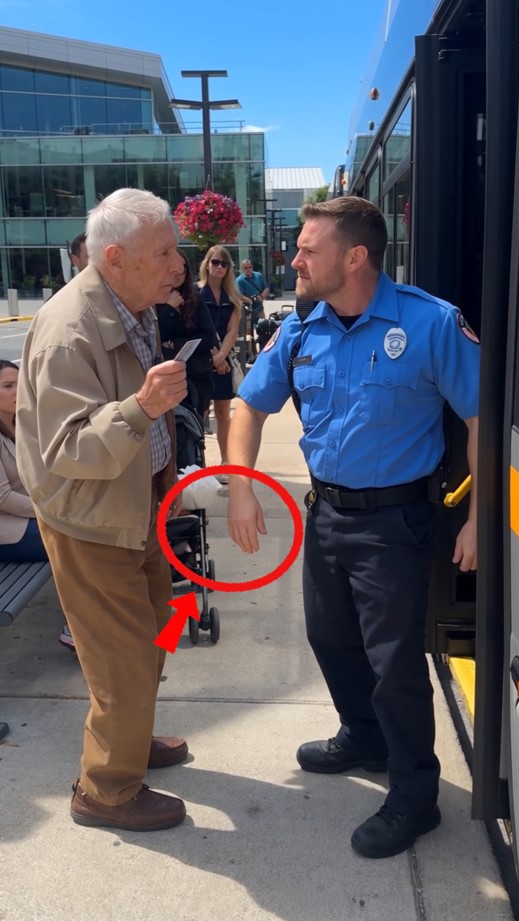
The morning was cold, and a light drizzle covered the pavement at the busy city bus stop.
An elderly man named George Miller stood near the curb, holding a worn leather briefcase in one hand and a folded umbrella in the other.
His gray coat had faded with age, and his shoes showed signs of years of daily use.
Despite the chilly weather, he waited patiently for the number twelve bus.
He had an important appointment that morning and had left home early to avoid being late.
When the bus finally arrived, George carefully approached the front doors.
“Good morning,” he said politely to the driver.
The driver, a broad-shouldered man named Derek, glanced at George before looking back at the road.
“Where do you think you’re going?”
George appeared confused by the question.
“To the city center, please. I have my pass.”
He reached into his coat pocket and pulled out his travel card.
Derek barely glanced at it.
“I’m not letting you on this bus.”
George stared at him, unsure whether he had heard correctly.
“I’m sorry. Is there a problem with my pass?”
Derek sighed impatiently.
“Look at the time. I don’t have all morning to deal with this.”
Several passengers turned toward the front of the bus.
George tightened his grip on his briefcase.
“I only need to get to the city center,” he explained. “I’ll take a seat and stay out of everyone’s way.”
Derek shook his head.
“Find another bus.”
The doors remained open, but the elderly man stood outside in the drizzle, wondering why he was being treated like he had done something wrong.
The Driver Refuses to Listen
George stepped closer to the entrance, hoping to explain himself.
“Sir, my travel card is valid. I’ve used this route for years.”
Derek leaned toward the open doorway.
“And I’ve told you that you can’t board.”
“Could you please tell me why?”
“Because I said so.”
The blunt response left George speechless.
Behind Derek, a young mother holding a small child frowned.
“Why won’t you let him on?” she asked.
Derek glanced toward her through the open doors.
“Please stay out of this. I’m trying to keep the service moving.”
“But he has a pass,” she replied.
George looked down at the card in his hand.
He had renewed it only a few weeks earlier, and there was nothing unusual about it.
“I can show you the receipt,” he offered.
Derek waved his hand dismissively.
“I don’t need to see anything.”
The elderly man took a slow breath.
He had spent forty years working as a maintenance supervisor for the city’s public transport department before retiring.
He understood that drivers had schedules to maintain and rules to follow.
He had never expected anyone to make an exception for him.
He only wanted to understand which rule he had supposedly broken.
“I’m not asking for special treatment,” George said. “I’m asking to use the service I’ve paid for.”
Derek’s expression hardened.
“Then you should have thought about that before coming here.”
A passenger near the front stood up.
“That’s enough. Just let the man show you his card.”
Derek turned toward the passengers.
“If anyone doesn’t like how I operate this bus, they’re welcome to get off.”
The atmosphere became tense.
George stepped back from the doors, embarrassed that his simple journey had turned into a public argument.
He considered walking away, even though the city center was several miles from the stop.
Then he remembered his appointment and the documents inside his briefcase.
He couldn’t afford to arrive late.
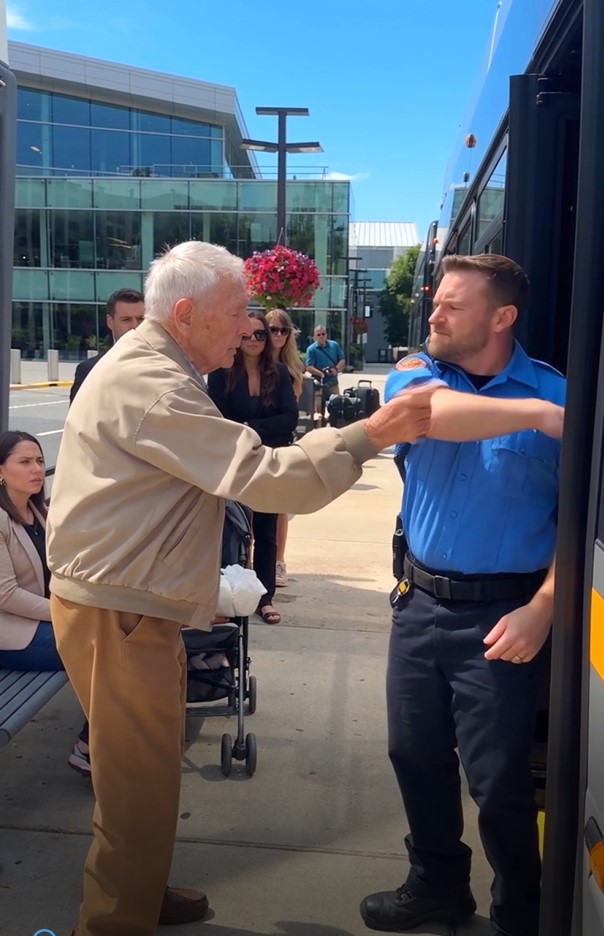
An Entire Bus Watches in Silence
Derek finally looked toward the clock above the dashboard.
“We’re already behind schedule,” he announced. “Everyone needs to stop interfering.”
He reached for the door controls.
George hurried forward one last time.
“Please, sir. Just check the card. If there’s a problem, I’ll understand.”
Derek looked at him with visible irritation.
“I’m not discussing this anymore.”
The doors began to close.
George stepped away from the curb, his shoulders sinking.
The young mother shook her head in disbelief.
An older passenger near the back called out that the driver was treating George unfairly.
Derek ignored the complaints and prepared to pull away.
Then another voice came from the pavement.
“Keep those doors open!”
A man wearing a dark transport-authority jacket approached the bus.
He carried a tablet in one hand and an identification badge clipped to his chest.
His name was Martin Lewis, a regional operations supervisor who had been checking services along the route that morning.
He had witnessed the final part of the confrontation while approaching the stop.
Derek recognized the uniform and immediately straightened in his seat.
“Morning, Martin,” he said, attempting to sound casual.
Martin didn’t return the greeting immediately.
Instead, he looked toward George.
“Sir, are you trying to board this bus?”
“Yes,” George replied. “But the driver says I can’t.”
Martin turned toward Derek.
“Why not?”
Derek shifted uncomfortably.
“There was an issue with his travel pass.”
Martin held out his hand.
“Then show me the issue.”
Derek hesitated.
“I haven’t checked it.”
Martin’s expression changed.
“You refused a passenger boarding without even checking his valid travel card?”
The passengers exchanged surprised looks.
For the first time that morning, Derek had nothing ready to say.
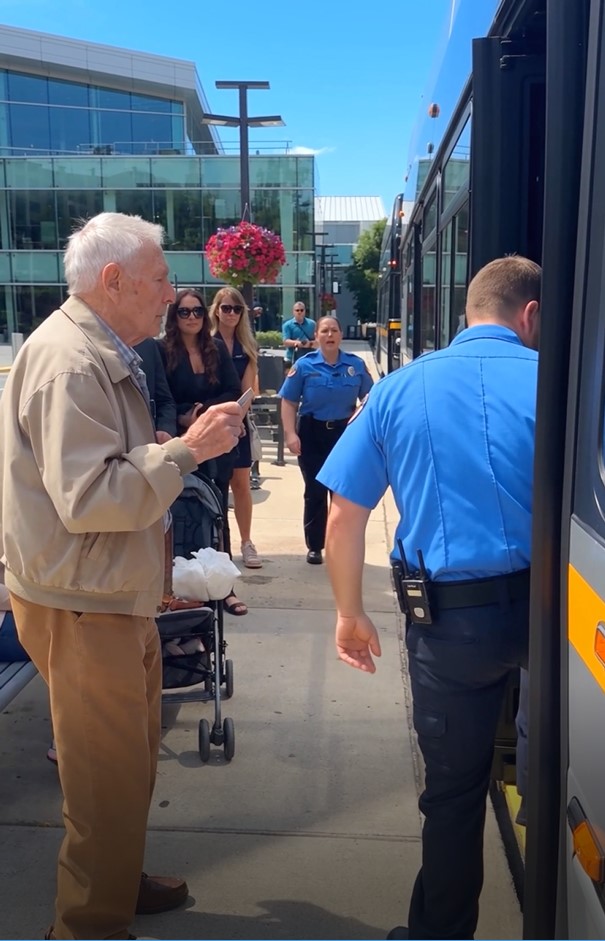
The Supervisor Steps In
Martin stepped onto the bus and asked George to show him his travel card.
George handed it over carefully.
Martin scanned the card using his handheld device.
A moment later, he nodded.
“The pass is valid,” he announced. “There’s no restriction preventing this passenger from boarding.”
He returned the card to George.
“You’re entitled to travel on this service, sir.”
“Thank you,” George replied quietly.
Martin then turned toward Derek.
“Would you like to explain why you refused him?”
Derek cleared his throat.
“I thought he might cause a delay. He seemed confused, and I was trying to keep the schedule.”
Martin glanced at the passengers.
“Did he threaten you? Did he behave aggressively? Did he refuse a safety instruction?”
Derek shook his head.
“No.”
“Then what exactly justified refusing him?”
Derek looked down at the dashboard.
Martin kept his voice professional.
“Our procedures require drivers to check travel documents when there is a genuine concern. They do not allow you to reject passengers simply because you’re impatient.”
The supervisor asked George whether he had experienced any difficulty with his card before.
“Never,” George answered. “I’ve used it on this route many times.”
Martin nodded.
“Then let’s get you on board.”
He stepped aside and gestured toward the entrance.
George climbed the steps slowly, thanking Martin as he passed.
Several passengers smiled at him.
The young mother offered him the empty seat beside her.
“Here you go, sir.”
“That’s very kind of you,” George replied.
He settled into the seat and placed his briefcase carefully between his feet.
Martin remained near the driver’s cabin.
“This incident will be documented and reviewed according to our procedures,” he told Derek. “For now, follow the route and complete your service professionally.”
Derek nodded, his earlier confidence replaced by embarrassment.
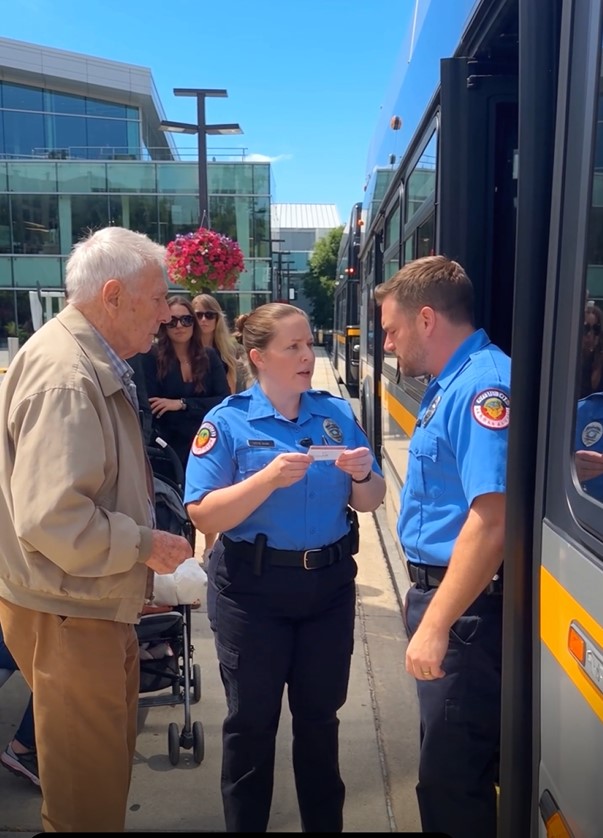
A Familiar Face Behind the Briefcase
Before Martin stepped off the bus, he noticed the documents protruding slightly from George’s briefcase.
One page displayed an old public transport department emblem.
Martin looked at him again.
“Excuse me, sir. Did you used to work for the transport authority?”
George smiled faintly.
“Yes. I retired about eight years ago.”
“What was your position?”
“I was a maintenance supervisor. Mostly depot inspections, vehicle safety reports, and training new staff.”
Martin’s expression brightened with recognition.
“George Miller?”
The elderly man looked surprised.
“You know me?”
Martin laughed softly.
“I never met you personally, but your name appears in some of our older training records. My former manager often talked about the maintenance reforms introduced during your time.”
George shook his head modestly.
“We had a good team. Nobody accomplishes much alone.”
Martin glanced toward Derek, who was listening from the driver’s seat.
“That’s an important point,” he said. “Public transport only works when every employee remembers who they’re serving.”
George looked through the window at the passing streets.
“I always told the younger staff that a timetable matters, but people matter too.”
Martin nodded.
“That’s still true today.”
He thanked George for his years of service before stepping off the bus.
As the doors closed, the passengers watched Martin move toward the next stop.
The bus pulled away, finally continuing its journey.
George sat quietly, holding his briefcase on his lap.
He hadn’t mentioned his former position to get anyone into trouble.
He hadn’t even considered that his work history might be recognized.
He had simply wanted to reach his appointment without being humiliated.
Bus Driver Questions an Elderly Man Trying to Board Before the Supervisor Arrives https://t.co/wMwBC5yJFt
— Animal Rescue Stories (@AnimalStory5) October 14, 2026
A Lesson That Stayed With the Driver
At the end of the route, Derek was instructed to meet Martin at the depot office.
The supervisor reviewed the incident report and listened to Derek’s explanation.
Derek admitted that he had become impatient and had made assumptions instead of checking the travel card.
Martin explained that the complaint would be handled through the company’s normal review process, including Derek’s previous performance record and the applicable disciplinary policy.
“This isn’t about whether the passenger was important or whether he used to work here,” Martin said. “It’s about the standard we expect from every driver.”
Derek nodded slowly.
“I understand.”
“Then demonstrate it. Every passenger deserves professional treatment, regardless of age, appearance, or occupation.”
The company arranged additional customer-service guidance for Derek and reinforced its boarding and passenger-assistance procedures.
The incident was recorded, and the appropriate follow-up was completed.
Meanwhile, George arrived at the city center with enough time to attend his appointment.
Later that afternoon, he received a call from the transport authority.
Martin wanted to make sure he had reached his destination safely and to apologize again for the experience.
George thanked him.
“I appreciate you stepping in,” he said. “I just hope the next person doesn’t have to go through the same thing.”
“That is exactly what we’re working to prevent,” Martin replied.
A few weeks later, George boarded the same bus route again.
This time, Derek was not driving.
The new driver greeted George, checked his pass without fuss, and welcomed him aboard.
George took a seat near the window and watched the city move past.
He thought about how easily an ordinary journey could become an unpleasant memory when someone forgot the importance of respect.
He also remembered the passengers who had spoken up and the supervisor who had refused to ignore what happened.
George had spent decades helping maintain the transport system.
That day, he was reminded that its most important responsibility was not simply moving buses on time.
It was making sure the people inside them were treated with dignity.
A uniform may give someone authority, but only fairness and respect show whether they deserve it.