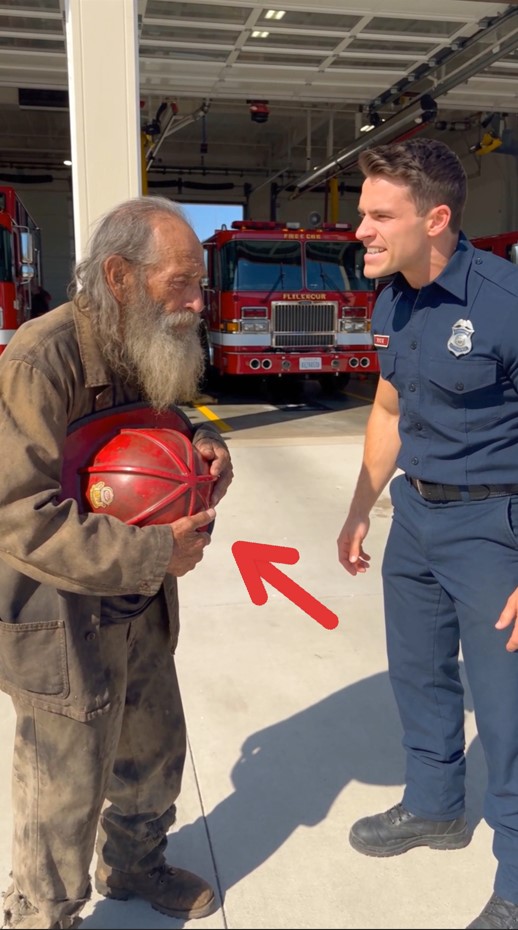
Cold rain swept across the city as an elderly man approached the entrance of Fire Station 14, clutching a worn backpack against his chest.
His gray coat was soaked, his shoes were falling apart, and his hands trembled beneath the chilly evening air.
Inside, firefighter Ryan Mitchell was finishing his shift preparations when he noticed the man standing near the entrance.
Ryan, twenty-six, had recently earned a reputation for being confident, ambitious, and impatient with anyone who disrupted his routine.
He opened the door just enough to speak.
“Can I help you?”
The elderly man nodded hesitantly.
“My name is Arthur. I was wondering if I could sit somewhere warm for a few minutes. I won’t be any trouble.”
Ryan glanced at the backpack, then at the man’s muddy shoes.
“This isn’t a shelter,” he replied. “You can’t just walk into a fire station because you’re cold.”
Arthur lowered his eyes.
“I understand. I just need somewhere to rest until the rain passes.”
Ryan shook his head and pointed toward the sidewalk.
“I’m sorry, but you need to leave.”
Arthur turned slowly toward the door, unaware that someone inside had witnessed the entire exchange.
The Elderly Man Asks for One Small Favor
Arthur stepped away from the entrance, pulling his thin coat tighter around his shoulders.
He had spent the previous night beneath the awning of a closed storefront. Earlier that morning, he had visited a public library to warm himself, but it had closed before the evening rain began.
The fire station had been the only building nearby with lights still shining through its windows.
Arthur had not expected a meal or a place to sleep.
He simply wanted a chair, a little warmth, and a chance to dry his clothes.
Before leaving, he turned back toward Ryan.
“Son, could I at least fill my water bottle? The drinking fountain outside has stopped working.”
Ryan sighed impatiently.
“I already told you that you can’t stay here.”
“Just the water, then,” Arthur said quietly.
Ryan stepped into the doorway, blocking the entrance.
“Sir, please don’t make this difficult.”
Arthur’s shoulders dropped.
“I wasn’t trying to cause trouble.”
He reached into his backpack to retrieve the empty bottle, revealing a carefully folded photograph tucked inside a plastic sleeve.
Ryan noticed the photograph but paid little attention to it.
“There’s a public building several blocks away,” he said. “You can try there.”
Arthur nodded and began walking toward the street.
At that moment, a fire engine returned from a routine inspection, its headlights cutting through the rain.
The driver parked beside the station, and the crew stepped out.
Among them was Captain Daniel Brooks, a respected firefighter who had served the department for more than twenty years.
Daniel noticed the elderly man moving away from the entrance.
Then he saw Ryan standing in the doorway with his arms crossed.
“What’s going on here?” Daniel asked.
Ryan answered without hesitation.
“Nothing serious, Captain. This man wanted to come inside, and I explained that he couldn’t.”
Daniel looked toward Arthur.
The old man’s wet clothing and unsteady steps told him that something about the situation deserved a closer look.
A Decision That Catches the Chief’s Attention
Daniel approached Arthur and called gently after him.
“Sir, would you mind waiting a moment?”
Arthur stopped and turned around.
“Of course.”
Daniel introduced himself, then asked whether the man needed immediate assistance.
Arthur explained that he was cold, exhausted, and hoping to find somewhere dry until the rain stopped.
Daniel listened without interrupting.
When Arthur mentioned that he had nowhere permanent to stay, the captain’s expression softened.
“Let’s get you out of the rain first,” Daniel said.
He escorted Arthur into the station’s common room and offered him a clean towel.
Ryan watched from the doorway, visibly uncomfortable.
“Captain, we’re not supposed to let people wander into the station,” he protested.
Daniel turned toward him.
“There’s a difference between letting someone wander around and helping someone who needs assistance.”
He asked another firefighter to bring a warm drink and checked whether Arthur required medical attention.
Arthur insisted that he was not seriously ill, although his hands were still shaking.
Daniel offered him a chair near the heater.
As Arthur settled down, he carefully placed his backpack beside his feet and checked that the plastic sleeve containing his photograph remained dry.
Daniel noticed the protective covering.
“Is that a family picture?” he asked.
Arthur looked down at it.
“Something like that.”
He seemed reluctant to explain further, so Daniel did not press him.
Instead, he contacted the department’s community liaison to ask about available emergency shelter services.
Ryan stood silently nearby, watching the captain treat the stranger with patience and respect.
He still believed he had been following the rules.
What he did not understand was how much a person’s dignity could depend on the way those rules were applied.
The Photograph Reveals an Unexpected Connection
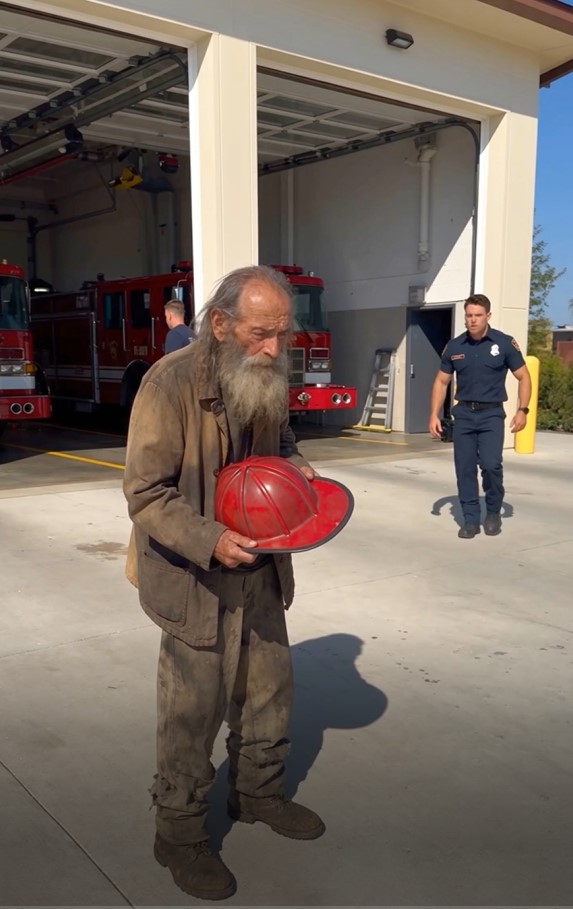
While waiting for a response from the community liaison, Arthur removed the photograph from his backpack.
He held it carefully between his fingers, studying the faded image.
Daniel happened to glance over and noticed a group of firefighters standing beside an old red fire engine.
The photograph appeared to have been taken decades earlier.
“That’s an old department uniform,” Daniel remarked.
Arthur looked up.
“Yes. It was taken in 1987.”
Daniel leaned slightly closer.
“Were you a firefighter?”
Arthur nodded slowly.
“For thirty-one years. I retired as a lieutenant.”
The room fell quiet.
Ryan looked at Arthur again, this time with surprise.
Arthur explained that he had worked at several stations throughout the city and had spent much of his career responding to fires, traffic collisions, and emergencies involving families in danger.
He had once lived in a small house with his wife, Margaret, and their daughter.
After Margaret died, Arthur struggled to manage the household alone. Several years later, mounting financial difficulties forced him to leave his home.
He had spent months moving between temporary accommodations before losing access to his last room.
Yet he had kept very little from his former life.
The photograph was one of the few things he refused to part with.
Daniel studied the image again.
One firefighter standing near the old engine wore a distinctive captain’s badge.
Daniel recognized the man immediately.
It was his own father, Thomas Brooks, photographed during the early years of his career.
“My father worked at this station,” Daniel said, his voice suddenly quieter.
Arthur looked closely at him.
“Thomas Brooks?”
Daniel nodded.
Arthur’s face changed as he examined Daniel’s features.
“Then you must be Daniel. Your father spoke about you all the time.”
Daniel stared at the photograph, stunned by the connection.
The elderly stranger Ryan had just sent into the rain had once worked alongside Daniel’s father.
The Fire Chief Steps Into the Room
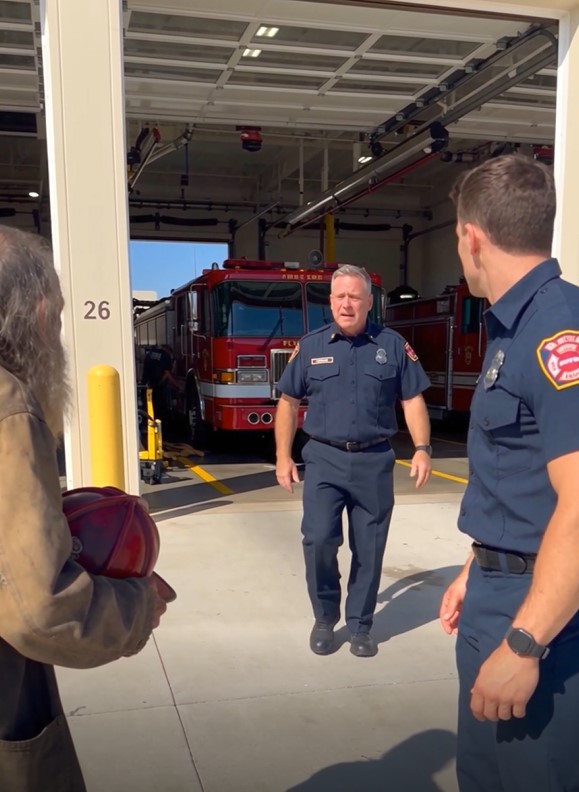
Before Daniel could ask another question, the station’s chief, Margaret Collins, entered the common room.
She had returned from a department meeting and immediately noticed the gathering around Arthur.
“What happened?” she asked.
Daniel briefly explained the situation, including the photograph and Arthur’s years of service.
Chief Collins approached the elderly man and asked permission to see the picture.
Arthur handed it to her.
She recognized several faces from the department’s historical records, including former officers who had served during the 1980s.
Then she noticed Arthur’s name written on the back in faded ink.
“Arthur Bennett,” she said. “You were stationed here before the building was renovated.”
Arthur smiled faintly.
“That was a long time ago.”
Chief Collins pulled up a chair and sat beside him.
“Your service records are still in our archives. My predecessor spoke about the crews who helped establish this station.”
Arthur looked embarrassed by the attention.
“I only did my job.”
The chief shook her head.
“You did more than that. You served this city for three decades.”
She turned toward Ryan.
“Did you know who he was when you told him to leave?”
Ryan shook his head.
“No, Chief.”
“Would that have changed how you treated him?”
Ryan opened his mouth, then stopped.
He had no answer that made him feel comfortable.
Chief Collins continued calmly.
“People don’t need a uniform, a title, or a history of service to deserve basic respect. He asked for warmth and water. We could have helped him without compromising station security.”
Ryan lowered his eyes.
For the first time, he understood that the problem had never been Arthur’s appearance or lack of a home.
It had been his own assumption that the man standing outside was not worth his time.
A Chance to Make Things Right
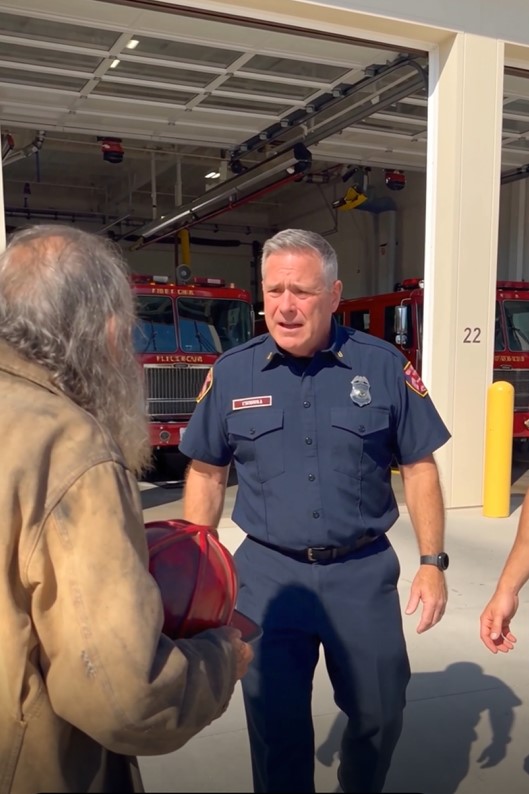
Chief Collins asked Daniel to arrange temporary accommodation for Arthur through the city’s emergency housing network.
She also contacted a veterans’ support organization that helped former public-service workers facing financial hardship.
Within the hour, the community liaison confirmed that a suitable emergency placement was available.
Arthur listened quietly as the arrangements were explained.
He seemed relieved, but he also appeared overwhelmed by the attention.
“I didn’t come here expecting special treatment,” he said.
“You aren’t receiving special treatment,” Chief Collins replied. “You’re receiving help that should have been offered with courtesy from the beginning.”
Ryan approached Arthur after the chief finished speaking.
For several seconds, he struggled to find the right words.
“Mr. Bennett, I’m sorry,” he finally said. “I judged you before I understood your situation. You asked for a little warmth, and I treated you like you were doing something wrong.”
Arthur looked at the young firefighter.
“Everyone makes mistakes,” he replied. “What matters is what you do after you realize you’ve made one.”
Ryan nodded, accepting the words without trying to defend himself.
Before Arthur left, Daniel made a copy of the photograph with his permission.
He promised to find the department’s archived records and see whether any of Arthur’s former colleagues could be contacted.
Chief Collins also arranged a formal review of the station’s procedures for assisting vulnerable members of the public while maintaining safety.
She did not excuse Ryan’s behavior, but she made it clear that the purpose of the review was to improve judgment, not simply assign blame.
Firefighter Asks an Elderly Man to Leave Before the Chief Arrives https://t.co/vjJ2K2loi1
— Animal Rescue Stories (@AnimalStory5) October 14, 2026
The Lesson Ryan Never Forgot
Over the following weeks, Daniel helped the department reconnect Arthur with several former colleagues.
One retired firefighter remembered serving beside him during a warehouse fire. Another recalled how Arthur had once stayed behind after a long shift to help a family whose home had been destroyed.
The stories gradually rebuilt a connection Arthur thought he had lost.
With assistance from the support organization, he began receiving help with housing applications, medical appointments, and financial counseling.
His circumstances did not change overnight, but he was no longer facing every difficulty alone.
The department later invited Arthur to visit the station during a small gathering honoring retired firefighters.
He arrived wearing a clean jacket and carrying the same photograph, now placed in a simple frame.
Chief Collins welcomed him personally.
Daniel introduced him to younger crew members, explaining that Arthur had served the city long before many of them had joined the department.
Ryan stood near the back, listening.
When Arthur finished sharing a few memories, Ryan approached him again.
“I’ve thought a lot about what happened that night,” he admitted. “I used to think being professional meant enforcing rules without making exceptions.”
Arthur smiled.
“Rules matter. But you still have to use your judgment.”
Ryan nodded.