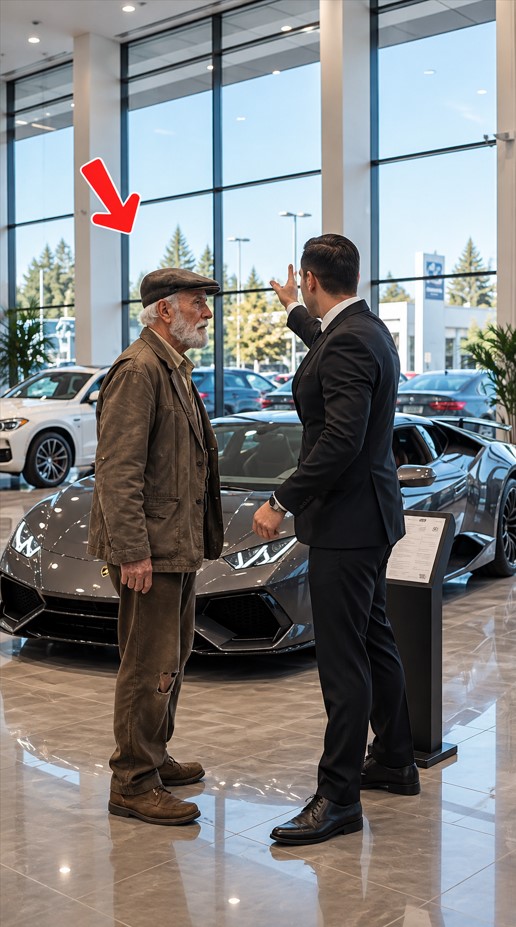
The showroom gleamed beneath rows of polished lights, illuminating luxury cars worth more than most people earned in a decade.
Customers in tailored suits walked between the vehicles while salespeople greeted them with practiced smiles.
Behind his desk stood Jason Miller, a confident thirty-year-old salesman who believed appearances revealed everything about a person.
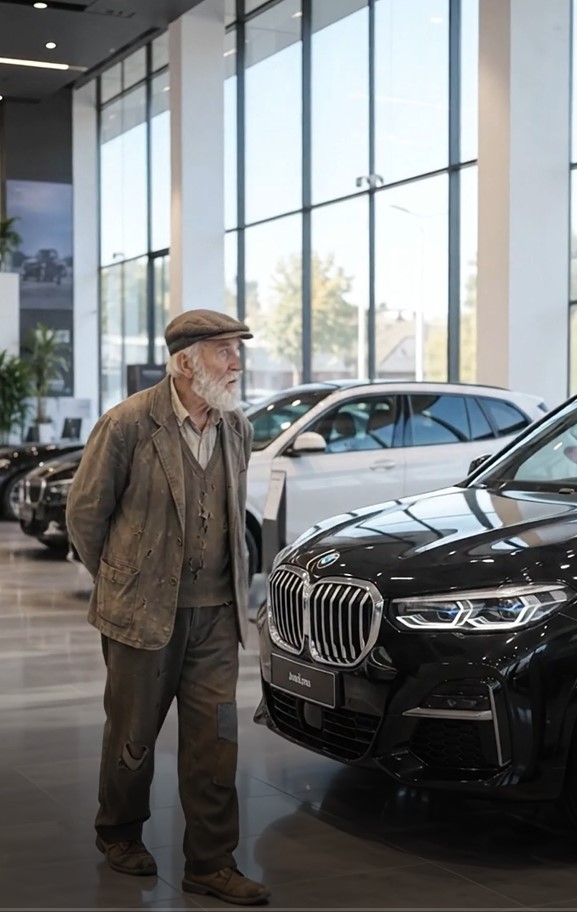
That morning, an elderly man entered wearing a faded brown jacket, worn trousers, and scuffed shoes.
His silver hair was neatly combed, but his clothing looked out of place among the expensive cars.
The man paused beside a black luxury sedan and examined its interior through the window.
Jason glanced at him before returning to his computer.
When the elderly visitor opened the driver’s door, Jason immediately stood up.
“Sir, please don’t touch that vehicle,” he called across the showroom.
The man turned calmly.
“I’m sorry. I was only looking at the interior.”
Jason approached, his eyes moving dismissively over the man’s clothes.
“These vehicles are extremely expensive. If you’re interested in something within your budget, I can direct you to a used-car lot.”
The elderly man looked at him for a moment.
“Actually, I’m interested in purchasing a vehicle today.”
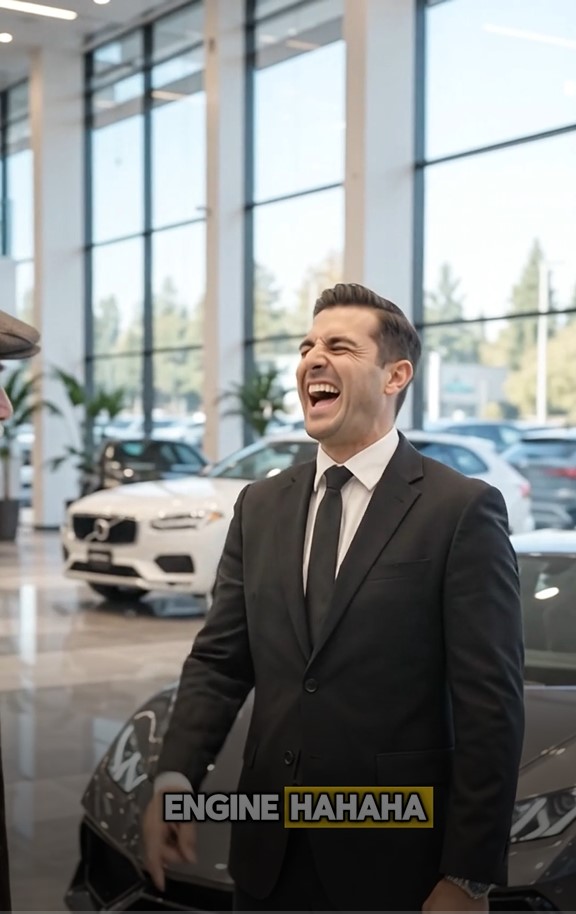
Jason laughed under his breath.
“Of course you are.”
Neither man realized that the showroom’s manager had just stepped out of his office and heard every word.
The Salesman Makes a Costly Assumption
The elderly man introduced himself as Henry Walker.
He explained that he wanted a comfortable sedan with enough space for his family and good safety features.
Jason barely listened.
Instead, he gestured toward a row of smaller vehicles near the showroom’s rear entrance.
“We have some more affordable options over there,” he said. “Those might be more appropriate for someone looking for basic transportation.”
Henry glanced toward the cars Jason had indicated.
“I appreciate the suggestion, but I’d prefer to see the black sedan.”
Jason folded his arms.
“That particular model starts at nearly ninety thousand dollars. I don’t want to waste your time showing you something you won’t purchase.”
Henry remained composed.
“Have you asked how I intend to pay for it?”
Jason smirked.
“Sir, I work with customers like you every day. People come in, look around, and then discover these vehicles are outside their price range.”
A young couple examining a nearby sports car exchanged uncomfortable looks.
Henry noticed their reaction but did not respond angrily.
He simply asked whether another salesperson might be available.
Jason’s expression hardened.
“I’m the senior sales consultant here. If you want assistance, you’ll need to listen to me.”
Henry slowly removed a small notebook from his jacket pocket.
“I see,” he said. “And is this how you normally speak to people who visit your showroom?”
Jason shrugged.
“Only when I need to be realistic with them.”
Henry closed the notebook.
“Then perhaps we should speak with your manager.”
Jason pointed toward the office.
“Gladly. But don’t expect him to give you a discount just because you’re upset.”
Henry walked toward the manager’s office without another word.
Jason returned to his desk, convinced he had handled an inconvenient visitor.
He had no idea how seriously his behavior would soon be questioned.
The Manager Recognizes the Name
The showroom manager, David Collins, was reviewing inventory reports when Henry knocked on his open office door.
“Good morning,” David said. “How can I help you?”
Henry introduced himself and explained that he had come to discuss purchasing a vehicle.
He also described the conversation with Jason, repeating the salesman’s remarks as accurately as he could.
David’s expression grew increasingly uncomfortable.
He knew Jason had a reputation for being aggressive with customers, but he had not expected such an openly dismissive exchange.
“I sincerely apologize for the way you were treated,” David said. “That is not how we expect our customers to be welcomed.”
Henry nodded.
“I understand that selling expensive vehicles requires experience. But judging someone before asking a single question seems rather different.”
David agreed.
Then Henry placed his notebook on the desk and opened it to a page containing several vehicle specifications.
David glanced at the notes, then at the name written across the top.
“Henry Walker?” he repeated.
“Yes.”
David sat up straighter.
“Are you the Henry Walker associated with Walker Automotive Holdings?”
Henry gave a small smile.
“I am.”
David had heard the name many times during company meetings.
Walker Automotive Holdings owned several dealerships across the region, including the very dealership where they were sitting.
Henry had founded the business decades earlier and gradually expanded it into a successful automotive group.
Several years ago, he had stepped back from daily operations but retained ownership of the company.
David stood immediately.
“Mr. Walker, I had no idea you were visiting today.”
Henry’s expression remained calm.
“That appears to be the point. You should not need to know who someone is before treating them respectfully.”
David lowered his eyes.
Outside the office, Jason noticed the manager standing beside Henry with a completely different expression.
His confidence began to fade.
The Truth Reaches the Showroom Floor
David invited Henry to sit down, but Henry preferred to remain standing.
He asked David a simple question.
“If I had been an ordinary customer with limited money, would the way I was treated have been acceptable?”
David hesitated.
“No, sir. It would not.”
Henry continued.
“Then my ownership has nothing to do with the problem.”
David nodded, recognizing the distinction.
Henry explained that he had deliberately arrived without an appointment or an introduction.
He wanted to experience the showroom as an ordinary visitor would.
He had expected professional assistance, not special treatment.
David apologized again and promised to review the incident.
Then he asked Henry whether he wanted Jason brought into the office.
“Yes,” Henry replied. “I’d rather discuss this honestly than allow rumors to spread.”
David called Jason inside.
The salesman entered wearing a confident smile that disappeared when he saw Henry sitting beside the manager.
“Mr. Walker,” David began, “this is the owner of the dealership.”
Jason froze.
He looked at Henry’s worn jacket, then at the manager, seemingly struggling to reconcile the two.
“You own this dealership?” Jason asked.
Henry nodded.
“And the company that owns several others.”
Jason swallowed.
“Sir, I didn’t realize—”
Henry gently interrupted.
“You didn’t realize what? That I had money? That I could affect your career? Or that I deserved to be treated with courtesy?”
Jason’s face turned red.
“I made an assumption, and I was wrong.”
“You certainly were,” Henry replied. “But the mistake wasn’t failing to recognize me. It was deciding that my appearance made me unworthy of your time.”
For several seconds, nobody spoke.
Jason finally lowered his head.
“I’m sorry, Mr. Walker. I should never have spoken to you that way.”
Henry accepted the apology but did not pretend the incident was insignificant.
He asked David to review Jason’s conduct and the dealership’s customer-service practices.
He made it clear that the purpose was not revenge.
It was to ensure that the same treatment would not happen to another visitor.
A Decision That Surprises Everyone
After Jason left the office, David asked Henry what action he wanted the dealership to take.
Henry thought carefully before answering.
“I want the incident documented, and I want the sales team retrained. If someone cannot treat customers respectfully regardless of appearance, they should not be representing this business.”
David agreed to organize a review of customer interactions and introduce additional training focused on professional conduct.
Jason was removed from customer-facing duties while the incident was reviewed.
During that time, he was required to participate in the training and meet with David to discuss his behavior.
Some employees expected Henry to dismiss him immediately.
Instead, Henry insisted on a fair process that considered the facts, the seriousness of the conduct, and whether Jason could learn from the incident.
A few days later, Henry returned to the showroom for a scheduled meeting.
Jason approached him before the manager had a chance to intervene.
“I’ve been thinking about what you said,” Jason began. “I used to believe I could tell whether someone was a serious buyer by looking at them.”
Henry listened.
Jason continued, admitting that he had sometimes directed customers toward cheaper vehicles without asking what they actually wanted.
“I thought I was saving time,” he said. “Now I realize I was making decisions for people before giving them a chance.”
Henry nodded.
“Sales experience should help you understand customers, not convince you that you can judge them at a glance.”
Jason apologized once more, this time without mentioning Henry’s ownership.
Henry thanked him for acknowledging the problem.
He then asked David to make sure the training included real examples of how assumptions could drive customers away.
The review eventually concluded with a formal warning and a structured improvement plan for Jason.
He would return to sales only after completing the required training and demonstrating consistent professional conduct.
It was a serious consequence, but also an opportunity to change.
Car Salesman Judges an Elderly Man by His Appearance at a Luxury Dealership https://t.co/sembkZyB7B
— Animal Rescue Stories (@AnimalStory5) October 14, 2026
The Customer Nobody Expected
With the matter addressed, Henry finally returned to the black luxury sedan he had admired earlier.
David personally arranged a test drive, but Henry declined the offer of special treatment.
“I’d like the same process any customer would receive,” he said. “Show me the features, explain the warranty, and let me make my decision.”
A different sales consultant walked him through the vehicle’s safety systems, comfort features, and maintenance requirements.
Henry asked thoughtful questions and compared the sedan with two other models.
He took his time, examined the interior, and reviewed the financing and service options.
Eventually, he chose the black sedan.
The purchase was completed through the dealership’s standard procedures.
Before leaving, Henry thanked the consultant for being patient and answering his questions clearly.
He also spoke briefly with the showroom staff.
“I built this company because I believed people deserved honest service,” he said. “A beautiful showroom means very little if the people inside forget that customers are human beings first.”
Nobody interrupted.
Jason stood near the back, listening carefully.
Over the following months, the dealership began tracking customer feedback more closely and reviewing how visitors were greeted.
The changes were not dramatic or expensive, but they encouraged employees to ask questions rather than make assumptions.
Jason gradually improved his approach.
He learned to welcome visitors, understand their needs, and explain options without deciding what they could afford based on their clothes.
Not every interaction became perfect, but he began recognizing the difference between confidence and arrogance.
Several months later, Henry visited the dealership again.
Jason greeted him politely, just as he greeted the other customers entering behind him.
Henry noticed the change and offered a small nod of approval.
This time, Jason did not see a powerful owner in an ordinary jacket.
He saw a customer who deserved respect.
The greatest mistake a salesperson can make is judging a person’s worth by their appearance, because dignity should never depend on the size of someone’s bank account.