Morning mist drifted through the dense pine forest, settling over moss-covered stones and fallen branches.
A young white-tailed deer wandered beside its mother, following her through a narrow clearing where fresh grass grew between the trees.
The fawn was barely a few weeks old, with delicate legs and pale spots scattered across its reddish coat.
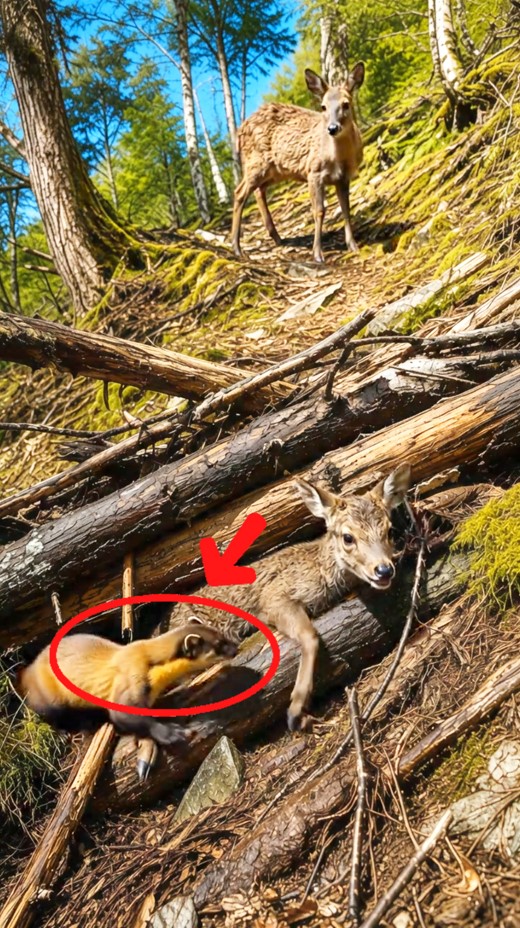
As its mother searched for tender leaves, the curious fawn stepped toward a pile of fallen logs left by an old winter storm.
It squeezed between two trunks, following the scent of wild plants growing beneath the damp wood.
Suddenly, a loose branch shifted under its weight.
The fawn stumbled forward, sliding into a narrow gap between the heavy logs.
It tried to turn around, but its hind legs became wedged beneath a crooked branch.
Frightened, it struggled harder, pressing its small body against the rough timber.
Its mother rushed back at the sound of its cries.
She nudged the fawn gently, searching for a way to free it, but the logs barely moved.
Then a dark shape appeared between the nearby tree trunks.
A pine marten emerged from the undergrowth, its slender body moving quickly over the moss.
The small predator paused, its eyes fixed on the trapped fawn.
The mother deer stamped her hooves and lowered her head.
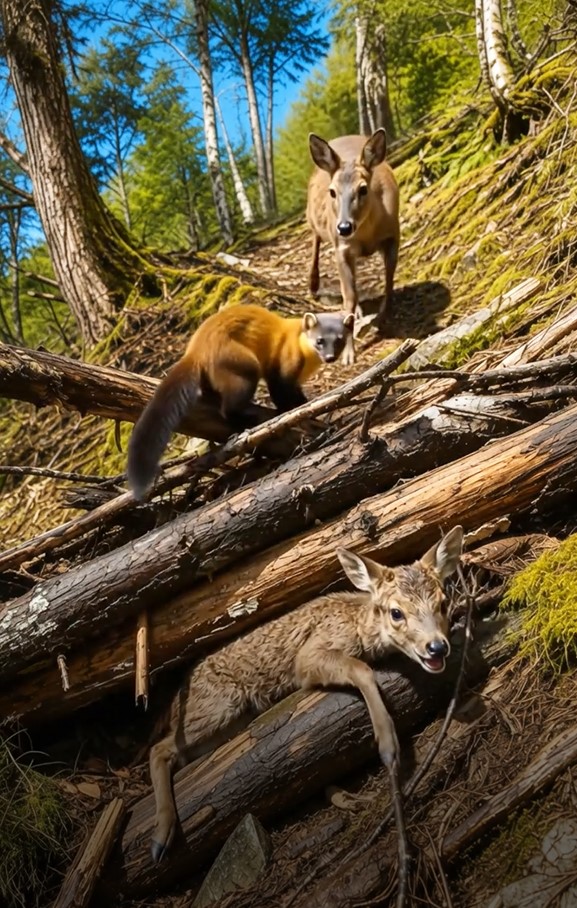
But the fawn could not escape, and the marten began moving closer.
The Predator Approaches
The pine marten crept around the fallen logs, using the uneven ground to approach without making much noise.
Its brown fur blended into the shadows beneath the trees, while its pale throat patch briefly caught the morning light.
The marten was a skilled forest hunter, usually pursuing small mammals, birds, and other available prey.
The trapped fawn’s movements had drawn its attention.
Unable to pull free, the young deer kicked weakly against the timber.
Its mother stepped between the predator and her offspring, shaking her head and stamping the damp earth.
The marten stopped several feet away.
For a moment, the animals watched each other in tense silence.
Then the marten darted toward an opening between the logs.
The mother deer lunged forward, forcing it to retreat behind a fallen trunk.
But she could not remain beside the fawn and chase the predator at the same time.
Every time she moved away, the marten cautiously returned.
The fawn continued struggling, its frightened cries echoing through the trees.
Its movements shifted a smaller branch, tightening the space around its hindquarters.
The mother nudged the wood, trying to lift it with her muzzle.
The branch barely budged.
She backed away, circled the pile, and tried another angle.
Nothing worked.
The marten appeared again on the opposite side, moving closer whenever the mother turned away.
The fawn pressed its ears against its head as the predator approached the narrow opening.
Then a distant sound carried through the forest.
Footsteps crunched across dry leaves, followed by the faint clatter of equipment.
Someone was approaching the clearing.
A Forest Ranger Hears the Cries
Ranger Daniel Brooks had been checking trail markers after a night of heavy rain.
He knew the forest well and regularly inspected areas where fallen trees created hazards for wildlife.
As he walked along a narrow path, a series of sharp animal cries caught his attention.
Daniel stopped and listened.
The sound came again, followed by the unmistakable stamping of a deer.
He left the trail and moved carefully through the undergrowth.
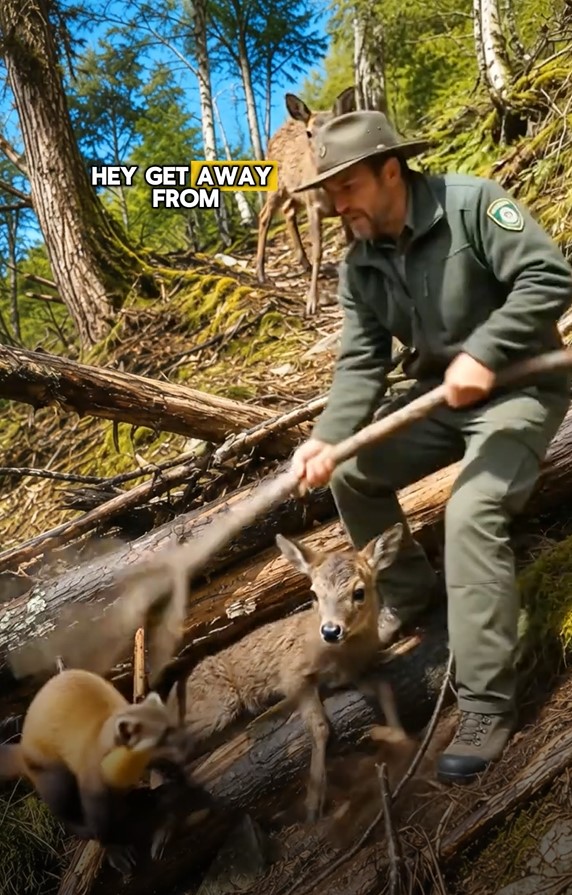
When he reached the clearing, he immediately understood the danger.
A fawn was trapped between two fallen logs, while its mother stood nearby, visibly distressed.
A pine marten watched from the opposite side of the timber.
Daniel kept his distance, avoiding sudden movements that might frighten the mother into bolting.
He also understood that the marten was a wild animal behaving according to instinct.
His priority was to free the fawn without unnecessarily injuring either animal.
Daniel set his equipment bag on the ground and assessed the position of the logs.
The heaviest trunk rested against a smaller branch, which had become wedged over the fawn’s hind legs.
Pulling the branch directly could increase the pressure on the animal.
He needed to stabilize the timber before attempting any movement.
Daniel slowly approached from an angle that gave the mother deer room to retreat.
She watched him cautiously but did not charge.
The marten slipped behind a nearby stump, disappearing into the shadows.
Daniel crouched several feet from the trapped fawn.
“Easy, little one,” he murmured, keeping his voice low.
The fawn trembled, but its struggles gradually weakened.
Daniel knew he had to work carefully.
The animal was frightened, the ground was slippery, and the fallen logs were heavier than they appeared.
The Dangerous Rescue Begins
Daniel returned to his equipment bag and removed a compact lifting jack, a wooden support block, and a pair of protective gloves.
He placed the support block on firm ground beside the lower trunk.
Before using the jack, he checked whether the wood could roll or slide under pressure.
The mother deer paced nearby, occasionally stepping forward when the fawn cried.
Daniel waited until she moved several feet away before positioning his equipment.
He placed the jack beneath a stable section of the upper log, avoiding any contact with the fawn’s body.
Then he began lifting the timber in small increments.
The wood creaked softly.
Daniel stopped immediately and checked the branch pressing against the fawn’s hindquarters.
The pressure had eased slightly, but the opening remained too narrow.
He adjusted the support block and continued lifting.
A few centimeters at a time, the gap widened.
The fawn attempted to pull its legs free, but one hoof remained caught beneath a twisted branch.
Daniel lowered himself closer to inspect the obstruction.
He could see that the hoof was wedged between two pieces of wood.
He resisted the urge to pull it free by force.
Instead, he used a small hand tool to shift loose bark and remove a thin branch blocking the opening.
The mother deer watched from behind a young pine tree, her ears turning toward every sound.
Daniel paused whenever the fawn struggled, allowing it to settle before continuing.
Then the lifting jack shifted slightly on the wet ground.
Daniel immediately stopped applying pressure.
He secured the equipment again and checked the wooden support for movement.
A sudden slip could have dropped the heavy trunk back onto the animal.
He needed another stable point before continuing.
After repositioning the support block, he tested the setup carefully.
The log remained secure.
Daniel took a steady breath and returned to the trapped hoof.
This time, he could reach the branch holding it in place.
The Moment the Fawn Breaks Free
Daniel gently moved the loose branch aside while keeping the upper log supported.
The fawn pulled its leg backward.
For one brief moment, its hoof remained caught.
Then the branch shifted, opening enough space for the small leg to slide free.
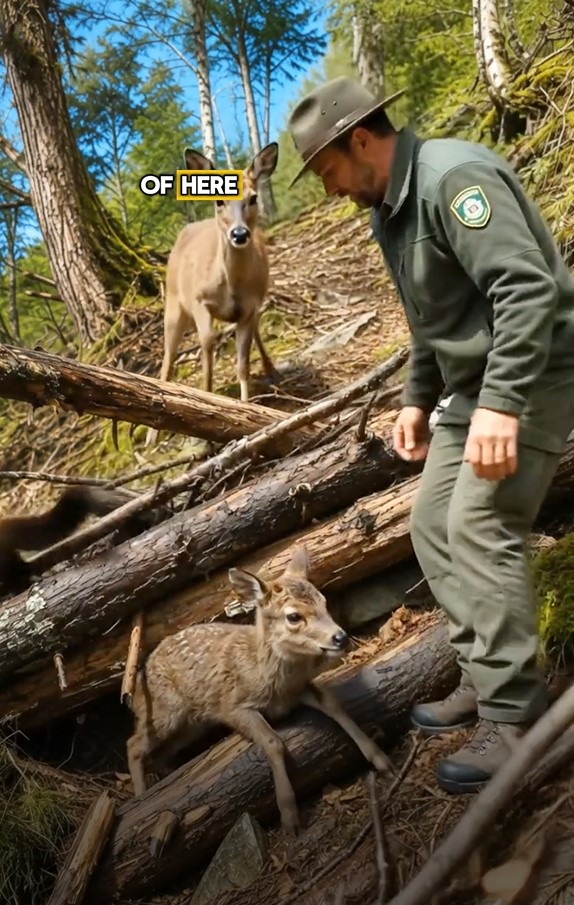
The fawn stumbled forward and collapsed onto the damp leaves.
Daniel immediately stopped working and moved back to give it room.
The young deer lay still for several seconds, breathing quickly.
Its mother approached cautiously, lowering her muzzle toward its head.
She sniffed the fawn’s face and gently nudged its shoulder.
The fawn lifted its head.
Daniel watched closely for signs of obvious injury, keeping his distance as the mother reunited with her offspring.
The pine marten remained hidden somewhere beyond the fallen timber.
Daniel did not chase it.
His attention stayed on the fawn, which was beginning to gather its legs beneath its body.
When the young deer tried to stand, its hindquarters wobbled.
It dropped back onto the leaves.
Daniel recognized that the animal needed time and possibly a closer assessment for injury.
He contacted the wildlife response team by radio and described the situation.
While waiting for guidance, he kept people and unnecessary noise away from the clearing.
The mother deer stayed beside her fawn, repeatedly licking its head and neck.
After several minutes, the fawn managed to stand.
Its legs trembled, but it remained upright.
It took one cautious step toward its mother, then another.
Daniel felt relief, though he knew that standing alone did not guarantee the animal was unharmed.
He continued observing from a respectful distance until the wildlife team responded.
The worst danger had passed, but the fawn still needed a careful assessment.
A Careful Check in the Forest
A wildlife specialist named Emma Lewis arrived with a small field kit after receiving Daniel’s report.
She approached the clearing slowly, keeping her movements calm and deliberate.
Daniel explained how the fawn had been trapped and described the steps he had taken to lift the timber.
Emma examined the animal from a distance first, looking for unusual posture, visible wounds, or difficulty bearing weight.
The fawn stayed close to its mother, occasionally shifting its legs beneath its body.
When it walked several steps across the clearing, Emma watched its gait carefully.
It appeared able to bear weight on all four legs, although it moved cautiously.
She explained that the fawn should be monitored for signs of worsening pain, swelling, or an inability to walk normally.
Because the mother remained attentive and the young deer was mobile, the specialists decided not to separate them unnecessarily.
Emma and Daniel moved away from the clearing, allowing the pair to settle.
Before leaving, Daniel checked the fallen logs to make sure they were stable and would not shift again.
He marked the hazardous area on his forest patrol map so the trail team could assess it later.
The pine marten eventually appeared on a distant log.
It paused, looked toward the clearing, then disappeared among the trees.
Daniel felt no anger toward the predator.
The encounter had been frightening, but the marten had simply responded to an opportunity in its environment.
The fawn’s survival had depended on the right intervention at the right moment.
As the sun climbed higher, the mother deer guided her offspring toward thicker cover.
The fawn followed slowly, stopping several times to rest.
Daniel remained nearby until the wildlife team was satisfied that the pair had moved away safely.
Then he collected his equipment and continued his patrol.
Baby Deer Is Trapped Between Fallen Logs — A Marten Is Already Closing In https://t.co/3TjMf7Mxuj
— Animal Rescue Stories (@AnimalStory5) October 14, 2026
A New Beginning Among the Trees
Three days later, Daniel returned to the area during his regular wildlife patrol.
He approached the marked clearing quietly, careful not to disturb any animals resting nearby.
The fallen logs remained stable, and the narrow gap where the fawn had been trapped was now clearly marked for further inspection.
Daniel scanned the surrounding trees and listened for movement.
Then he noticed two deer near a patch of young ferns.
The adult doe stood beneath the branches of a pine tree, calmly watching the forest.
Beside her was a small spotted fawn.
Daniel recognized the younger animal by the pale markings along its back.
The fawn stood more steadily than before.
It lowered its head to nibble at fresh vegetation, then followed its mother across the clearing.
Daniel watched without approaching.
The mother paused beside a fallen branch, waiting until her offspring caught up.
The fawn moved after her, its small legs carrying it across the uneven ground.
For a moment, the pair stopped in a shaft of sunlight filtering through the canopy.
Then they disappeared between the trees.
Daniel smiled quietly and recorded the sighting in his patrol notes.
He knew the forest remained unpredictable.
Predators would continue hunting, storms would bring down trees, and young animals would face dangers beyond anyone’s control.
But careful monitoring and responsible intervention could sometimes make the difference between tragedy and survival.
He slung his equipment bag over his shoulder and continued down the trail.
Behind him, the clearing returned to silence.
Somewhere beneath the pines, the young fawn stayed close to its mother, beginning another day in the wild.
Thanks to one forest ranger’s patience and courage, a frightened fawn escaped the fallen logs and received another chance to grow safely beside its mother.