An Ordinary Shopping Trip Takes a Painful Turn
Margaret Wilson had planned to spend only a few minutes at the neighborhood grocery store that afternoon.
At seventy-four, she still enjoyed doing her own shopping, choosing fresh vegetables, and greeting familiar faces along the way.
She carried a small shopping bag in one hand and her walking cane in the other.
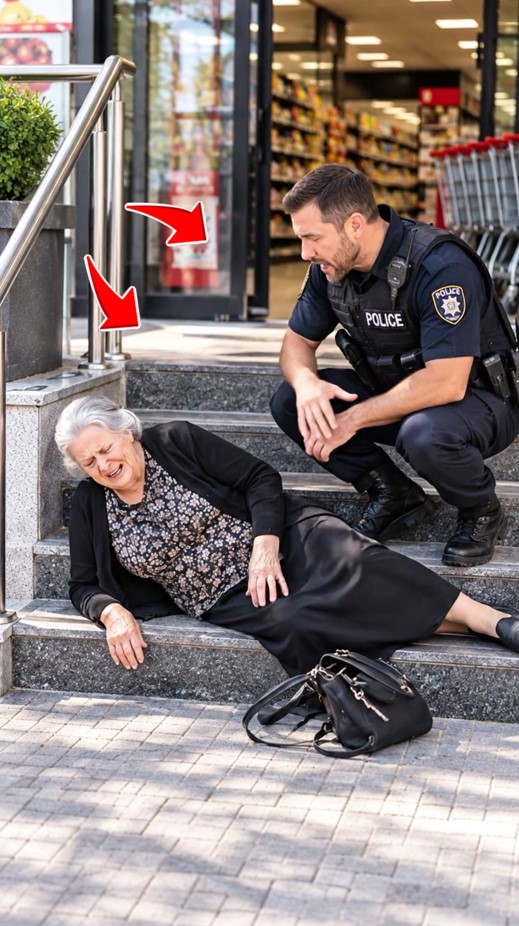
As Margaret approached the store entrance, her shoe caught the edge of an uneven pavement stone.
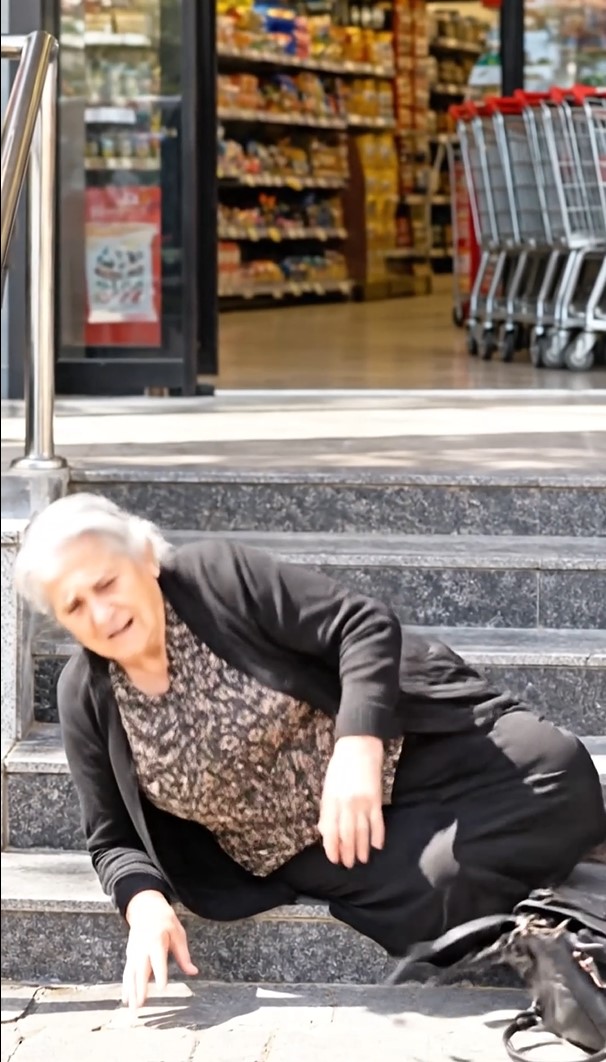
She stumbled forward, desperately trying to regain her balance, but fell hard onto the sidewalk.
A sharp pain shot through her leg, forcing a frightened cry from her lips.
Several shoppers stopped, while others hurried around her without knowing what to do.
Margaret tried to sit up, but the pain became unbearable whenever she moved her injured leg.
“I think something is terribly wrong,” she whispered, tears gathering in her eyes.
Across the parking lot, Officer Daniel Brooks had just finished speaking with a store employee.
When he heard the commotion, he immediately hurried toward the elderly woman.
The Officer Realizes How Serious the Fall Is
Daniel knelt beside Margaret and calmly introduced himself.
“Please don’t try to stand up, ma’am. I’m here to help you.”
Margaret nodded, clutching her handbag against her chest.
She explained that her leg hurt terribly and that she could not move without experiencing another wave of pain.
Daniel noticed swelling beginning around her lower leg, so he avoided touching the injured area.
He asked a nearby shopper to call emergency services while another employee brought a blanket from inside the store.
Margaret apologized repeatedly for causing a disturbance.
“I only came to buy some bread and milk,” she said, struggling to keep her voice steady.
Daniel reassured her that nobody was inconvenienced by needing help.
“You haven’t done anything wrong. Let’s make sure you’re safe.”
While waiting for the ambulance, he asked whether anyone could contact her family.
Margaret explained that her daughter lived several hours away, and her son worked long shifts at a local factory.
She lived alone in a modest apartment and managed most daily tasks herself.
Daniel listened carefully as she described how much she valued her independence.
“I don’t want to become a burden to anyone,” she admitted.
He looked at her kindly.
“Accepting help doesn’t make you a burden, Margaret. It means you’re human.”
When the paramedics arrived, they carefully assessed her injury and prepared her for transport to the hospital.
Daniel stayed nearby until she was safely inside the ambulance.
Before the doors closed, Margaret thanked him for stopping.
He promised to check on her once he learned where she had been taken.
A Difficult Diagnosis Changes Everything
At the hospital, X-rays confirmed that Margaret had fractured her leg.
The doctor explained that she would need treatment and a period of recovery before putting normal weight on the injured limb.
Although the fracture could heal, her immediate mobility would be severely limited.
Margaret listened quietly, thinking about the stairs leading to her apartment and the grocery store she visited every week.
Her daughter, Susan, arrived that evening after receiving the hospital’s call.
She held her mother’s hand and tried to reassure her that they would manage everything together.
However, both women understood that recovery would be difficult.
Margaret had no elevator in her apartment building, and the narrow entrance made ordinary mobility equipment challenging to use.
She would need help getting around safely, particularly after returning home.
Over the following days, the medical team arranged treatment and explained the importance of following her rehabilitation plan.
Susan offered to take time off work, but Margaret worried about the financial pressure it would create.
Her pension covered rent, utilities, groceries, and medication, leaving little room for unexpected expenses.
A suitable electric mobility scooter would cost far more than she could comfortably afford.
Margaret did not complain, but Susan noticed her mother becoming unusually quiet whenever they discussed life after discharge.
One afternoon, Margaret admitted what frightened her most.
“What if I can’t get outside on my own anymore?”
Susan hugged her tightly, promising they would find a solution.
Neither woman knew that the police officer who had helped Margaret outside the store was already thinking about that very problem.
Daniel Discovers What Margaret Needs
Officer Daniel Brooks contacted the hospital through the appropriate channels to ask how Margaret was recovering.
He had assisted many people during his years on patrol, but something about Margaret’s quiet determination stayed with him.
When he learned that she faced weeks of limited mobility, he wondered how she would manage after leaving the hospital.
Daniel arranged a visit during his time off duty.
Margaret was surprised to see him enter her hospital room carrying a small bouquet of flowers.
“You came all this way just to see me?” she asked.
“Of course,” Daniel replied. “I wanted to know how you were doing.”
Margaret thanked him for his kindness and explained her concerns about returning home.
She could rely on Susan for some assistance, but she did not want every shopping trip or medical appointment to become a major family arrangement.
Daniel asked whether her medical team had discussed mobility equipment for her recovery.
They had, but the cost and practical requirements remained significant obstacles.
He listened as Margaret explained that she hoped to regain her independence gradually, following her doctor’s advice.
Daniel did not make unrealistic promises about how quickly she would recover.
Instead, he asked whether a suitable electric mobility scooter might help once her medical team approved its use.
Margaret gave a small, uncertain smile.
“It would make a tremendous difference, but I could never afford one right now.”
Daniel thanked her for being honest.
Before leaving, he told her to concentrate on healing rather than worrying about every practical problem at once.
Afterward, he began researching local mobility equipment providers and checking what assistance might be available through community programs.
He wanted to find a safe, practical solution that would genuinely help Margaret.
An Unexpected Gift Awaits Her
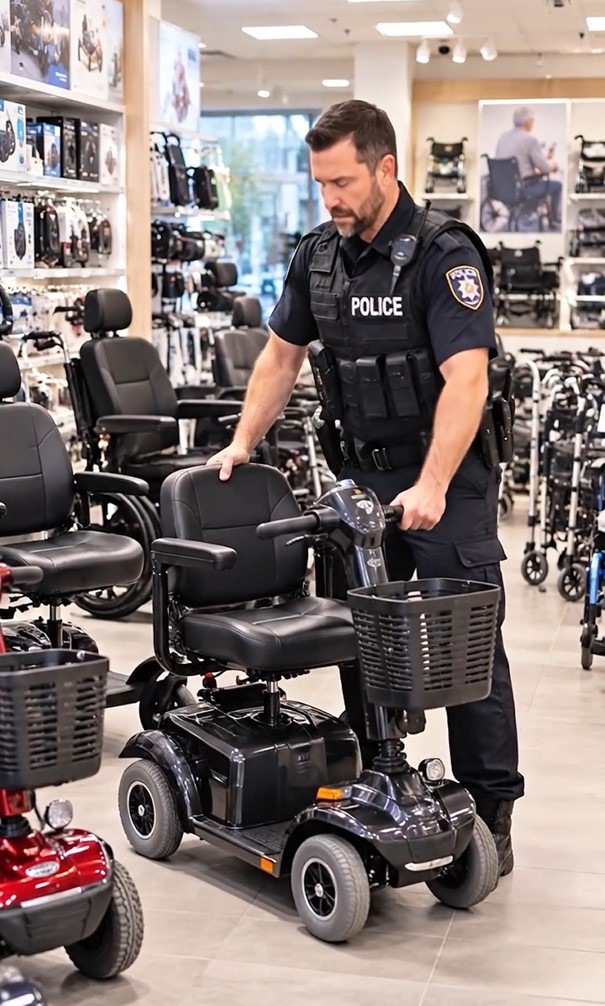
Over the next several days, Daniel contacted a local mobility equipment store and explained Margaret’s situation.
He asked about electric scooters suitable for older adults, including models with accessible controls, reliable brakes, and appropriate stability.
The store manager suggested that Margaret’s physical therapist should first assess her needs before any equipment was selected.
Daniel agreed, understanding that a thoughtful gift had to be useful as well as generous.
He also contacted a community support organization to ask about home accessibility and transport assistance.
With Margaret’s family’s involvement, the hospital team confirmed which mobility options could be considered during her recovery.
Daniel eventually found a suitable scooter that fit the agreed requirements and arranged to purchase it using his own savings.
He did not want publicity or recognition.
He simply remembered Margaret lying on the pavement, apologizing for needing help when she was the one who had been hurt.
When Margaret was preparing to leave the hospital, Daniel returned with Susan.
A store representative had arranged delivery after checking the equipment and explaining its operation to the family.
Margaret looked from Daniel to the neatly prepared mobility scooter beside the room’s entrance.
For several seconds, she could not find the words to speak.
“Is that really for me?” she finally asked.
Daniel nodded.
“I bought it for you. I hope it makes the next part of your recovery a little easier.”
Margaret covered her mouth, tears running down her cheeks.
“But you don’t even know me,” she whispered.
Daniel smiled gently.
“I know you deserve the chance to get around safely when your medical team says you’re ready.”
Susan embraced him, overwhelmed by the unexpected kindness.
Margaret reached for his hand and thanked him repeatedly.
Daniel reminded her that she did not owe him anything in return.
Elderly Woman Falls Outside a Store, Then a Police Officer Makes an Unexpected Gesture https://t.co/ZxuITZ0GWr
— Animal Rescue Stories (@AnimalStory5) October 15, 2026
Margaret Finds Hope Beyond Her Front Door
Before Margaret used the scooter independently, the equipment representative reviewed its controls and safety features with her and Susan.
Her rehabilitation team also explained when and how she could use it without interfering with her recovery.
Because her leg was still healing, Margaret followed their guidance carefully rather than attempting to rush back into her old routine.
The first few weeks were challenging.
She needed help with certain household tasks, attended follow-up appointments, and practiced the movements recommended by her therapist.
Yet knowing that a mobility option awaited her gave her something encouraging to work toward.
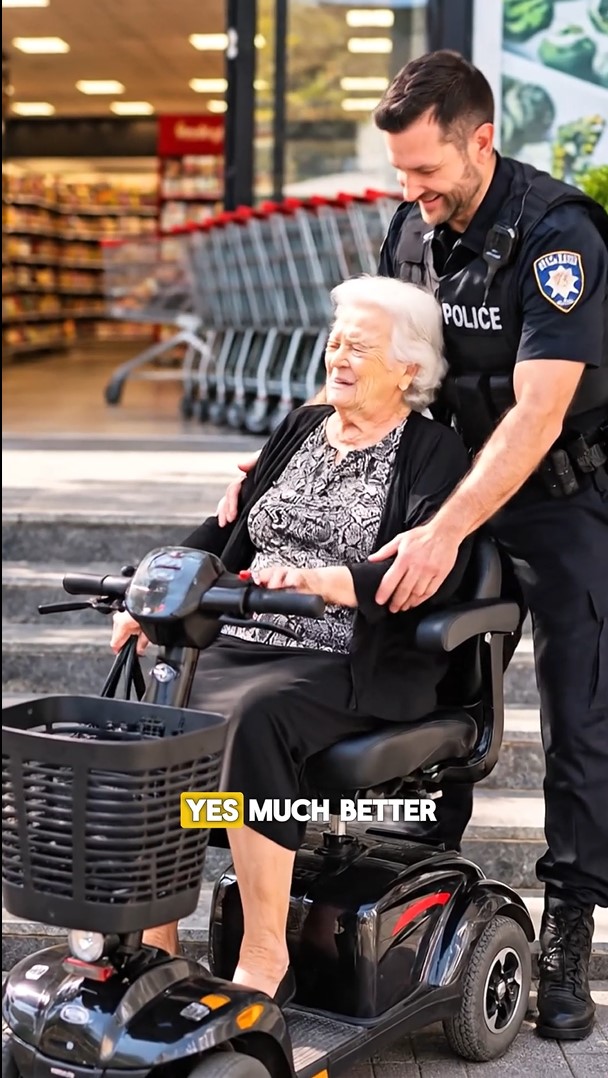
When her care team eventually approved appropriate scooter use, Susan accompanied her outside for a supervised practice session.
Margaret moved slowly, concentrating on the controls as she navigated the quiet pavement.
After a few minutes, she looked at her daughter with a smile she had not worn since the accident.
“I can go to the little garden again,” she said.
Later, when she was ready for a short outing, Susan accompanied her to the grocery store.
The uneven pavement where Margaret had fallen had been reported to the store manager, who arranged for the damaged section to be repaired.
As they approached the entrance, Margaret paused and looked around.
The memory of her fall remained painful, but the place no longer represented only fear.
She could now imagine returning to familiar routines as her recovery progressed.
A few days later, Daniel received a handwritten card at the police station.
Margaret thanked him for buying the scooter and for treating her with dignity when she felt frightened and helpless.
She included a small photograph of herself sitting outside her apartment, smiling beside the mobility scooter.
Daniel placed the card in his desk drawer, where he kept a few personal reminders of why he had chosen police work.
For Margaret, the gift was worth far more than its price.
It represented the possibility of regaining confidence, reconnecting with her neighborhood, and asking for help without feeling ashamed.
Her leg still needed time to heal, and she continued following her medical team’s instructions.
But with family support, appropriate equipment, and renewed hope, the road ahead no longer seemed quite so frightening.
One police officer’s kindness gave Margaret more than an electric mobility scooter—it helped her believe that independence and dignity could remain within reach, even after an unexpected fall.