A Cry for Help in a Busy Hospital
The hospital corridor was crowded that Tuesday morning, filled with hurried footsteps, ringing phones, and anxious families waiting for news.
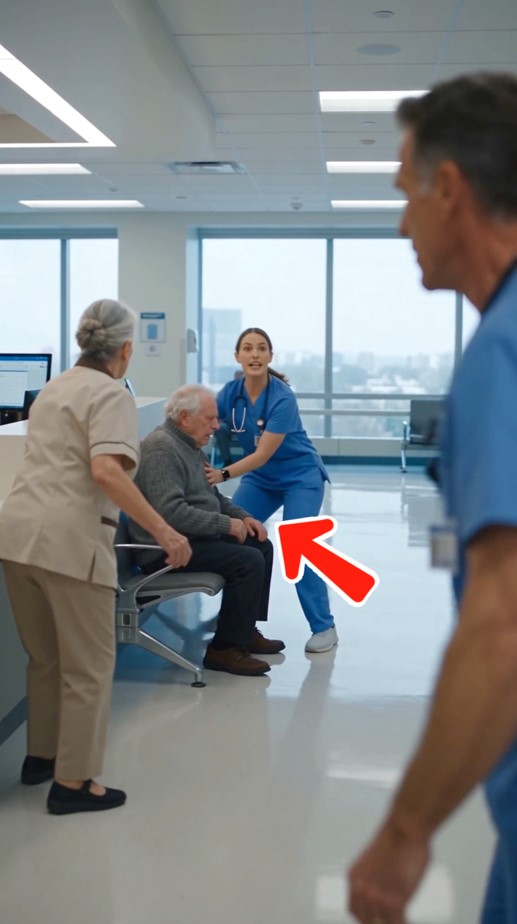
Near the nurses’ station, an elderly patient named George Miller sat alone in a wheelchair, struggling to catch his breath.
At seventy-six, George had been admitted overnight after experiencing severe weakness and dizziness.
His pale face glistened with sweat, and his trembling fingers clutched the armrests.
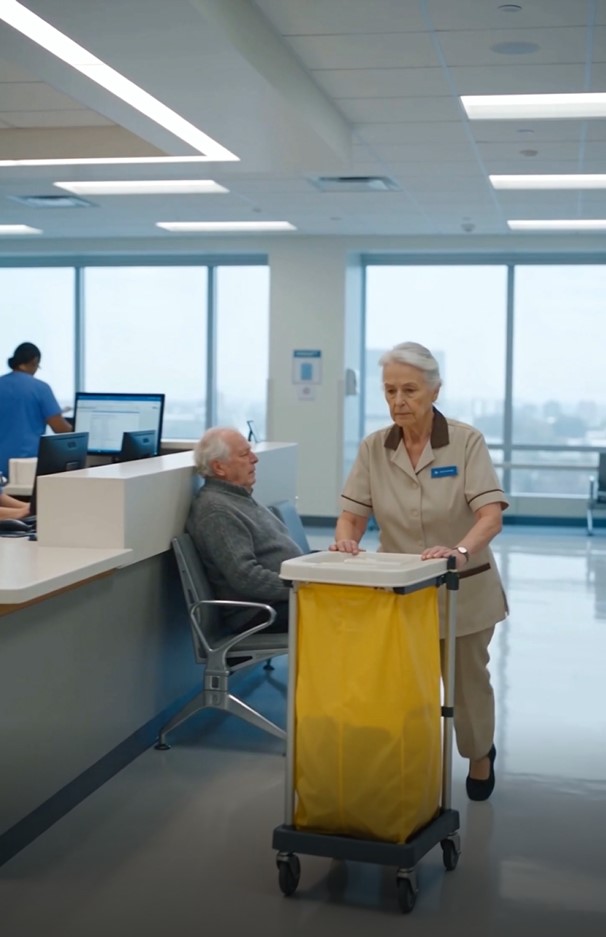
A hospital cleaner named Vanessa Reed pushed her cleaning cart past him, focused on finishing her assigned corridor before the next inspection.
“Excuse me,” George whispered. “Could you please get someone? I don’t feel right.”
Vanessa glanced at him briefly before turning toward a patch of water near the wall.
“I’m cleaning right now,” she replied impatiently. “You need to speak to a nurse.”
George tried to explain that he had already pressed the call button, but nobody had come.
Vanessa continued mopping, leaving him alone as his breathing became increasingly strained.
The Patient Nobody Seemed to Notice
George had spent most of his life refusing to ask others for help.
He had worked as a bus mechanic for forty years, raised two children, and rarely complained about discomfort.
However, that morning felt different.
His chest felt tight, his vision blurred around the edges, and every breath seemed harder than the last.
He reached toward the small call button attached to his wheelchair, pressing it again with shaking fingers.
Across the corridor, Vanessa emptied a wastebasket and checked her cleaning schedule.
“Please,” George called, his voice barely audible. “I think something is happening to me.”
Vanessa sighed and looked over her shoulder.
“Sir, I’ve already told you to wait for the nurse,” she answered. “I cannot stop working every time somebody asks me something.”
A woman sitting nearby looked up from her phone, visibly uncomfortable with Vanessa’s response.
Before she could speak, a hospital porter pushed a trolley around the corner, temporarily blocking her view.
George’s head dropped forward.
His right hand slipped from the wheelchair armrest, and the plastic water cup beside him fell onto the floor.
Vanessa heard the cup crack against the tiles.
She looked down, irritated by the new mess.
“Honestly,” she muttered, reaching for her mop.
At that exact moment, Dr. Daniel Brooks stepped out of a nearby examination room and noticed the elderly patient’s unusual position.
The Doctor Recognizes the Warning Signs
Dr. Brooks had been reviewing test results when the sound of the falling cup caught his attention.
He initially assumed George had dropped something accidentally.
Then he noticed the patient’s slumped shoulders, pale lips, and shallow breathing.
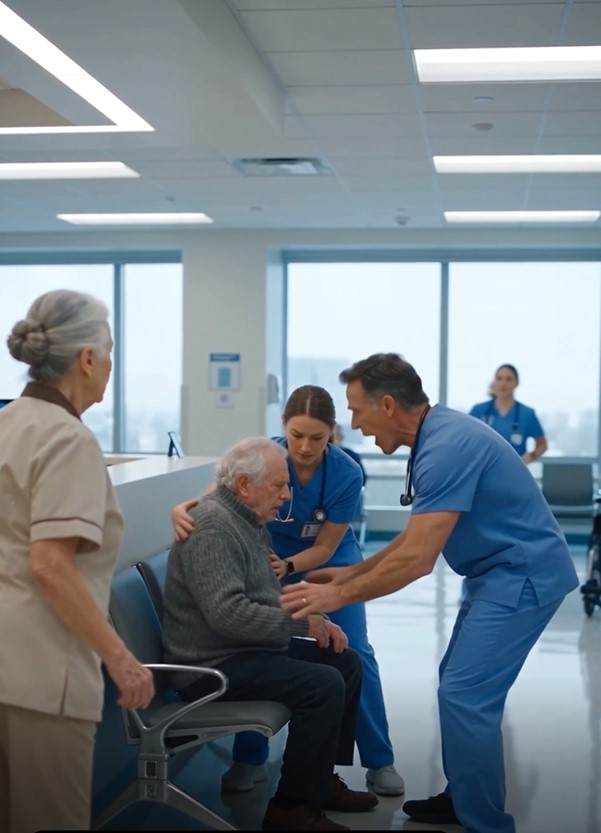
“Sir, can you hear me?” Daniel asked, immediately approaching the wheelchair.
George lifted his eyes with considerable effort.
“Doctor,” he whispered. “I tried to get someone.”
Daniel checked George’s responsiveness and breathing while calling loudly for the emergency response team.
“Get a nurse here immediately! We need medical assistance!”
A nearby nurse hurried over, followed by another clinician carrying emergency equipment.
Daniel instructed them to move George carefully into the treatment area while monitoring his condition.
As the team worked, Daniel noticed Vanessa standing only a few feet away, holding her mop.
“You were here with him?” Daniel asked sharply.
Vanessa stiffened.
“He asked me for help, but I’m not a nurse,” she replied defensively.
“Did you notice that he was struggling to breathe?”
“I thought he was just uncomfortable.”
Daniel stared at her, struggling to contain his frustration.
“He was visibly unwell, and he was asking for help. You didn’t need medical training to alert someone.”
Vanessa looked toward the floor.
“I had work to finish,” she said quietly.
Daniel’s expression hardened.
“Cleaning can wait when someone’s safety is at risk. You cannot simply walk away from a person who may be having a medical emergency.”
Several staff members turned toward them as the corridor fell unusually quiet.
A Difficult Confrontation in the Corridor
The emergency team wheeled George through the treatment doors, leaving Daniel outside for a brief moment.
He turned back toward Vanessa, who had begun gathering the equipment scattered around her cart.
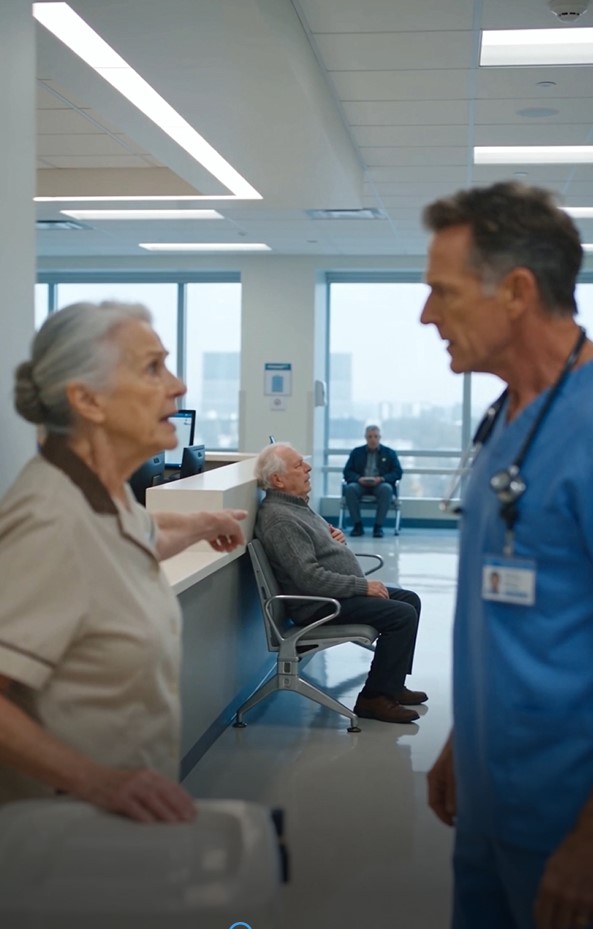
“Look at me, please,” he said firmly.
Vanessa hesitated before raising her eyes.
“You may not be responsible for diagnosing a patient’s condition, but you are responsible for reporting an obvious concern.”
“I didn’t know it was that serious,” she answered.
“That’s exactly why you call someone qualified to assess him.”
His voice carried across the corridor, attracting the attention of a senior nurse and the hospital’s duty supervisor.
Daniel continued, visibly angry.
“If he had collapsed completely while you were standing beside him, would you still have said you were too busy?”
Vanessa’s face reddened.
“I was behind schedule. My supervisor has been warning me about unfinished areas.”
“Then you should have contacted your supervisor,” Daniel replied. “A schedule never gives anyone permission to ignore a person asking for urgent help.”
The duty supervisor, Helen Carter, stepped closer.
“What’s happened here?” she asked.
Daniel explained what he had witnessed and what Vanessa had told him.
Helen listened carefully, her expression becoming increasingly serious.
Vanessa tried to defend herself by explaining that she had been working alone and had several corridors to finish before the morning inspection.
Helen acknowledged the workload but shook her head.
“Those pressures are real,” she said. “But the correct response was to alert a nurse immediately.”
For the first time, Vanessa seemed to understand that this was not simply an argument about workplace manners.
A patient’s condition had deteriorated while he was asking for help.
The News From the Treatment Room
Nearly twenty minutes passed before Daniel returned from the treatment area.
Helen and Vanessa were still standing near the nurses’ station, waiting for an update.
“How is he?” Helen asked immediately.
Daniel removed his gloves and took a slow breath.
“George is receiving treatment. His condition was serious enough that we needed to act quickly.”
He explained that the team was investigating a possible cardiac problem and monitoring George closely.
Although his condition had stabilized temporarily, further tests were necessary before anyone could determine what had caused the episode.
Vanessa covered her mouth with one hand.
“Is he going to be all right?” she asked.
“We’re doing everything we can,” Daniel replied. “But those first minutes matter. When someone tells you they cannot breathe properly, you don’t assume they’re exaggerating.”
Vanessa’s eyes filled with tears.
She remembered how easily she had dismissed George’s requests, convinced that he was interrupting her work.
“I honestly thought a nurse would come eventually,” she whispered.
Daniel looked at her directly.
“Patients sometimes cannot wait for eventually. A simple call to the nurses’ station could have brought help sooner.”
Helen asked Vanessa to step into the supervisor’s office while another cleaner temporarily covered her assigned area.
The conversation that followed was uncomfortable but necessary.
Helen documented the incident, explained the hospital’s patient-safety procedures, and arranged a formal review of Vanessa’s conduct.
She also made clear that staff members should never be punished for reporting emergencies or asking for assistance when workloads become unmanageable.
Vanessa listened without interrupting.
For the first time that morning, she stopped thinking about her unfinished checklist.
She could think only about the elderly man sitting alone in that wheelchair.
An Apology the Patient Deserved to Hear
Later that afternoon, Daniel learned that George was stable enough to speak briefly with visitors.
His tests and treatment were continuing, and the medical team had not yet reached a final conclusion about his condition.
When Helen asked whether he wanted to speak with the hospital staff involved in the incident, George agreed.
Vanessa entered his room accompanied by Helen, keeping her hands clasped tightly in front of her.
George looked tired but more alert than he had been in the corridor.
“Mr. Miller,” Vanessa began, her voice trembling, “I came to apologize.”
George watched her quietly.
“I heard you asking for help, and I didn’t take you seriously. I was thinking about my work instead of your safety.”
She swallowed hard before continuing.
“I should have called a nurse immediately. I’m sorry I left you sitting there.”
George remained silent for several seconds.
Then he spoke softly.
“When you’re old and frightened in a hospital, even asking for help can be difficult.”
Vanessa lowered her head.
“I understand that now,” she replied.
George did not pretend that her behavior had not hurt him.
“I don’t expect everyone to know medicine,” he said. “I just hope the next person who asks for help gets someone who listens.”
Those words affected Vanessa more deeply than Daniel’s confrontation had.
She promised to follow the hospital’s reporting procedures and never dismiss a patient’s concern again.
George accepted her apology without offering an easy reassurance.
He simply nodded, then asked whether the hospital cafeteria served decent coffee.
The unexpected question eased the tension in the room.
Daniel smiled slightly, and Vanessa managed a small, tearful laugh.
For the first time since the incident, the conversation felt less like a disciplinary meeting and more like an opportunity to change.
Hospital Cleaner Overlooks a Patient in Need, but a Doctor Notices and Questions Her Actions https://t.co/Q24uN1TwI8
— Animal Rescue Stories (@AnimalStory5) October 17, 2026
A Lesson That Changed the Hospital
Over the following week, Helen reviewed the incident with the hospital’s patient-safety team.
The review considered Vanessa’s response, the workload assigned to cleaning staff, and whether patients had clear ways to summon assistance.
Management reinforced a simple rule throughout the hospital: any staff member who notices a potentially serious medical problem must alert clinical personnel immediately.
Additional training helped cleaners, porters, receptionists, and other nonclinical workers recognize situations requiring urgent attention.
Supervisors also adjusted cleaning schedules to reduce pressure during the busiest morning hours.
Vanessa received formal corrective action and was required to complete further patient-safety training.
She understood why the hospital had taken the incident seriously.
Rather than treating the consequences as unfair, she used them as a reason to change how she worked.
Whenever a patient approached her afterward, she listened carefully before responding.
If someone appeared unwell or described a serious symptom, she contacted the appropriate clinical staff without delay.
Several weeks later, George returned to the hospital for a follow-up appointment.
He was recovering, although his doctors continued monitoring his health and adjusting his treatment.
As he waited near the nurses’ station, Vanessa passed with her cleaning cart.
She stopped immediately and asked whether he needed assistance.
George smiled faintly.
“I’m all right today,” he said. “But thank you for asking.”
Vanessa nodded, then continued toward her assigned corridor.
Daniel watched the brief exchange from the nearby doorway.
He knew one polite question could never erase what had happened that morning.
Still, he hoped the experience had changed something lasting in Vanessa’s understanding of her responsibility.
A hospital depended on doctors and nurses, but patient safety also depended on every person who worked inside its walls.
Sometimes, the most important act of care begins when someone decides to stop, listen, and take another person’s suffering seriously.