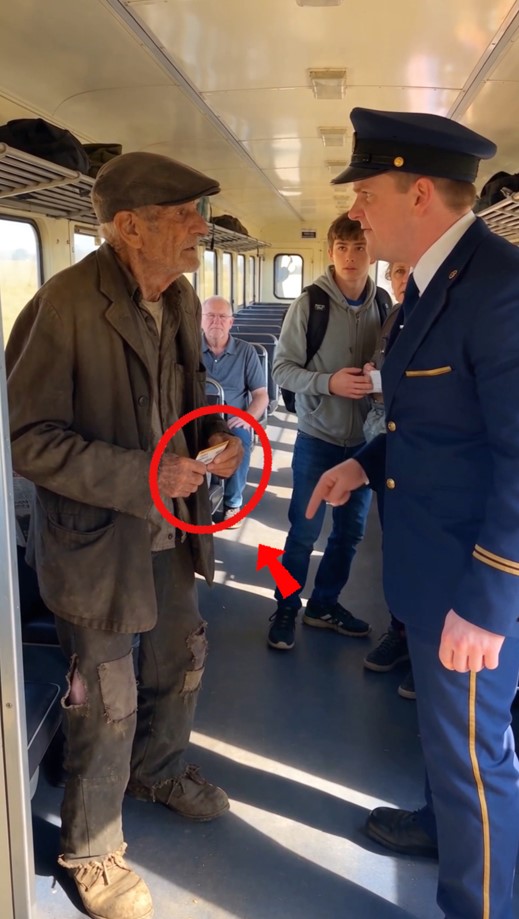
The morning train rolled through the countryside, carrying commuters, families, and travelers toward the city.
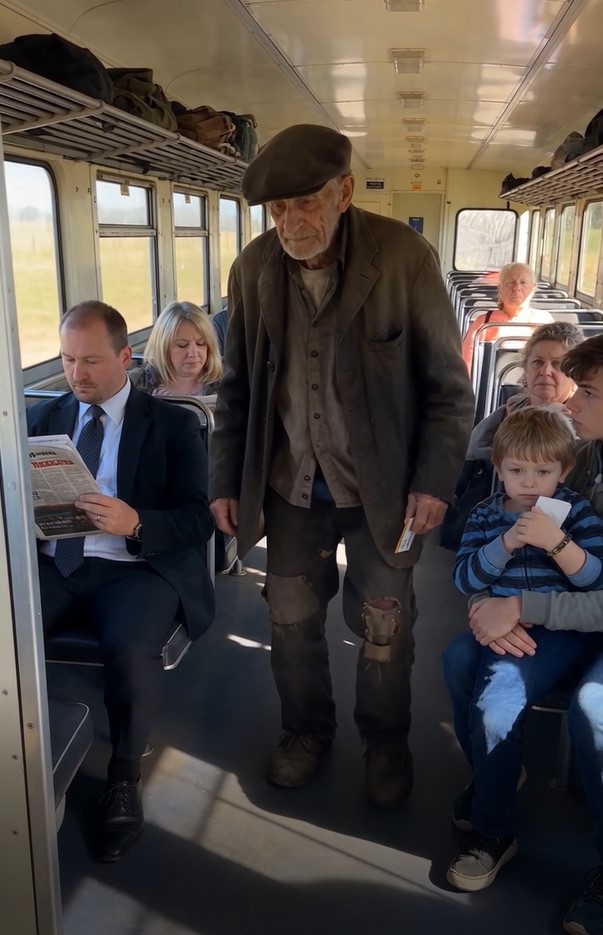
Among the passengers sat an elderly man wearing a faded brown coat with torn sleeves, worn trousers, and scuffed shoes.
His name was Arthur Bennett, and he kept a small canvas bag resting carefully between his feet.
He sat quietly near the window, watching the fields pass while holding a folded piece of paper in his trembling hands.
Most passengers barely noticed him.
But when the conductor reached his row, he stopped abruptly and stared at Arthur’s clothes.
“Ticket,” the conductor demanded.
Arthur looked up and began searching his coat pockets.
“I’m sorry,” he said gently. “I have it somewhere. My hands aren’t what they used to be.”
The conductor sighed loudly as passengers turned to look.
“Then you should have been ready before boarding.”
Arthur lowered his eyes and continued searching, his fingers shaking as he checked his pockets one by one.
When he still couldn’t find the paper, the conductor’s expression hardened.
“People like you always have an excuse,” he said. “If you can’t prove you’ve paid, you’ll have to get off at the next station.”
The carriage became painfully quiet.
Then a railway official sitting several rows away slowly stood up.
And the moment he heard what the conductor said next, he decided he could no longer remain silent.
The Conductor’s Public Accusation
The conductor, Mark Reynolds, stood over Arthur with his ticket scanner in one hand and a small inspection notebook in the other.
Arthur continued searching his pockets, growing more distressed with every passing second.
“I know I bought it,” he explained. “I purchased it at the station this morning.”
Mark crossed his arms.
“Then show it to me.”
“I will. Please give me another moment.”
A young passenger sitting across the aisle glanced at Arthur’s trembling hands.
An older woman near the door frowned at Mark’s tone.
But nobody immediately intervened.
Mark leaned closer, speaking loudly enough for several rows to hear.
“You’re holding up my inspection. If you can’t produce a valid ticket, I have to treat you as an unpaid passenger.”
Arthur swallowed hard.
“I understand the rules, sir. I’m not trying to avoid paying.”
“Then why are you dressed like that and carrying nothing that proves you paid?”
The remark drew uncomfortable looks from nearby passengers.
Arthur’s face reddened.
His coat was old because he could not afford to replace it, and the tears in its sleeves had been carefully stitched more than once.
He had not expected his appearance to become part of the conversation.
“I don’t have much money,” he said quietly. “But I paid for this journey.”
Mark shook his head.
“Everyone says that.”
Arthur looked down at the folded paper in his hand, trying to remember where he had placed the ticket.
He checked the canvas bag beside his feet and carefully opened its worn zipper.
Inside were a small thermos, a packet of sandwiches, a knitted scarf, and several envelopes.
His hands shook so badly that one envelope slipped onto the floor.
Arthur bent down to retrieve it.
Mark watched impatiently.
“Enough. You can explain yourself to the station staff.”
Arthur slowly straightened.
For the first time, his expression showed more sadness than embarrassment.
“I only need to reach the city,” he said.
From the opposite end of the carriage, a calm voice interrupted.
“That is enough, Mr. Reynolds.”
Everyone turned.
Another Railway Official Steps Forward
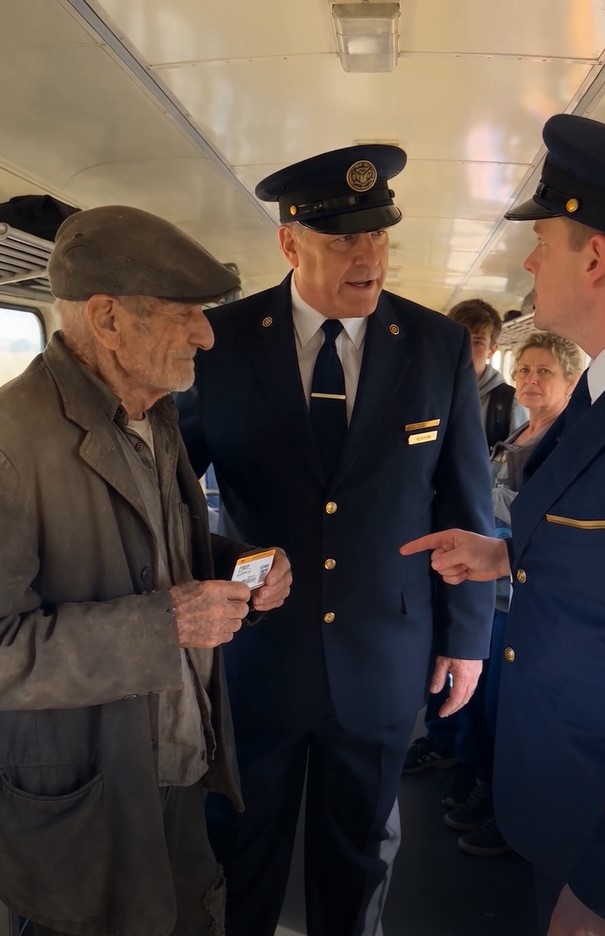
The man who had spoken stood up and adjusted the dark blue railway jacket he wore over his uniform.
His name was David Mitchell, a senior railway inspector traveling to the central station for a scheduled operations meeting.
Unlike the conductor, David had been sitting quietly and observing the carriage.
He had heard the entire exchange.
“Sir,” Mark said, visibly irritated, “I’m conducting a ticket inspection.”
“I understand that,” David replied. “You’re entitled to verify a passenger’s ticket. You’re not entitled to humiliate him.”
Mark glanced at David’s uniform and recognized the insignia indicating his senior position.
His posture changed slightly.
“I haven’t humiliated anyone. I’m enforcing the rules.”
“Then enforce them professionally.”
David approached the row but kept a respectful distance from Arthur.
“Good morning, sir,” he said. “My name is David Mitchell. Could I ask you a question?”
Arthur nodded uncertainly.
“Of course.”
“Do you remember where you purchased your ticket?”
“At the ticket counter in Millbrook Station,” Arthur answered. “Just before the train arrived.”
David listened carefully.
“Did you receive a printed ticket or an electronic confirmation?”
“A printed ticket. The young man at the counter handed it to me.”
David turned toward Mark.
“Have you checked whether this journey was purchased through the station’s ticketing system?”
Mark frowned.
“I haven’t found a ticket to scan.”
“That wasn’t my question.”
A few passengers exchanged glances.
Mark looked toward the inspection device in his hand.
David continued in a measured tone.
“Let’s establish the facts before making assumptions about this gentleman.”
Arthur looked relieved that someone was finally listening.
He opened his canvas bag again and began checking the envelopes.
David crouched to help retrieve the items that had fallen to the floor.
Among them was a small receipt from Millbrook Station.
David examined it without taking anything else from Arthur’s bag.
“This may help us verify the purchase,” he said.
Mark’s expression became more serious.
For the first time, the situation was no longer simply a conductor questioning a passenger.
A senior official was now asking whether the inspection had been handled correctly.
A Small Receipt Reveals an Important Detail
David carefully read the receipt.
It contained the station name, the purchase time, and a transaction reference.
Although it was not itself proof that Arthur had a valid ticket for the entire journey, it gave the railway staff a clear starting point for checking the purchase.
“Mr. Reynolds, could you contact the ticketing office and ask them to verify this transaction?” David requested.
Mark hesitated.
“We’re already behind schedule.”
“Then let’s do it efficiently.”
Mark used his radio to contact the appropriate railway control staff.
David remained beside Arthur while they waited for a response.
Arthur looked embarrassed by the attention.
“I’m sorry everyone has to deal with this,” he murmured.
David shook his head.
“You don’t need to apologize for asking to be treated respectfully.”
The woman sitting nearby nodded in agreement.
Arthur explained that he had been traveling to the city to visit his younger sister, Margaret, who had recently moved into a small assisted-living residence.
He had saved money for the journey and bought the ticket before sunrise.
His coat was old, he explained, because he had spent the previous winter repairing it rather than buying another.
“I don’t mind people seeing that I don’t have much,” he said. “I just don’t like being treated as though it means I’m dishonest.”
David listened without interrupting.
He had worked on the railway for more than twenty years and had seen passengers arrive from every imaginable circumstance.
He knew that a person’s appearance revealed very little about whether they had paid their fare.
The radio crackled.
Mark listened to the response, then asked the control office to repeat the transaction reference.
The Truth Comes Out
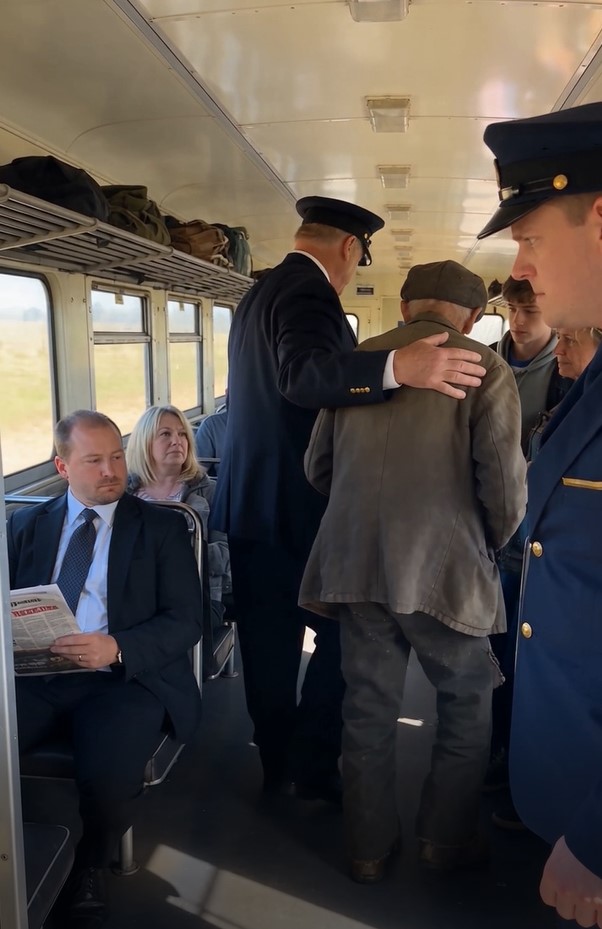
A few minutes later, the control office confirmed that Arthur had purchased a valid ticket for the journey.
The printed ticket had apparently slipped from his coat pocket and become lodged inside the lining, where he had been unable to find it during the inspection.
Arthur remembered the ticket being in his inner pocket when he boarded.
With David’s permission, he carefully checked the pocket again.
After feeling along the damaged lining, he discovered the ticket folded into a narrow gap beneath the fabric.
“There it is,” he exclaimed softly.
He pulled it free and handed it to David.
David checked the ticket against the information provided by the control office.
Everything matched.
Arthur had paid for his journey.
Mark stared at the ticket before returning his attention to his inspection device.
The accusation that Arthur had traveled without paying was no longer supported by the evidence.
David handed the ticket back to its owner.
“You’re all set, Mr. Bennett.”
Arthur held the paper carefully between his fingers.
“Thank you,” he said. “I was beginning to think nobody would believe me.”
David’s expression softened.
“You deserved a proper check from the beginning.”
Mark cleared his throat.
“I was doing my job,” he said defensively.
David turned toward him.
Train Conductor Questions an Elderly Man in Worn Clothes About His Ticket, Until Another Railway Official Gets Involved https://t.co/IExfTgPLW1
— Animal Rescue Stories (@AnimalStory5) October 18, 2026
A Different Kind of Arrival
When the train reached the central station, David walked with Arthur toward the platform exit.
He offered to help carry the canvas bag, but Arthur insisted on holding it himself.
“It’s not heavy,” the old man said. “I’ve carried it for years.”
David smiled.
“Then I’ll walk beside you.”
They reached the station entrance, where a woman in a burgundy scarf stood scanning the arriving passengers.
When she spotted Arthur, her face brightened.
“Arthur!”
Margaret hurried forward and wrapped her arms around her brother.
Arthur laughed softly as he embraced her.
“I told you I’d come,” he said.
Margaret noticed David standing nearby and asked whether there had been a problem.
Arthur hesitated, then explained what had happened aboard the train.
He did not exaggerate the details or demand that anyone be punished.
He simply told her how the conductor had spoken to him and how David had stepped in to help.
Margaret looked at David with gratitude.
“Thank you for standing up for my brother.”
David nodded.
“Everyone deserves to be treated with respect.”
Before leaving, he made sure Arthur knew how to contact the railway’s customer-service department if he wished to raise a formal concern.
Arthur thanked him but said he was more interested in spending the day with his sister.
The two walked slowly toward the station café, already discussing where they would have lunch.
David watched them for a moment before returning to his duties.
He knew that the incident would be documented and reviewed according to railway policy.
He also knew that one public apology could not erase the embarrassment Arthur had experienced.
But the conductor had been challenged, the facts had been established, and a passenger who had been treated unfairly had been allowed to continue his journey.
Sometimes, doing the right thing did not require a dramatic speech or an extraordinary act.
It required noticing what was happening, asking the right questions, and refusing to let someone’s appearance become a reason to deny them dignity.
Arthur had boarded the train hoping for an ordinary journey to see his sister.
He arrived with a story he had never expected to tell.
And he left the station knowing that, when one person chose to judge him, another had chosen to see him as a human being.
A torn coat could never measure an honest man’s worth, and one railway official’s courage reminded an entire train that respect belongs to everyone.