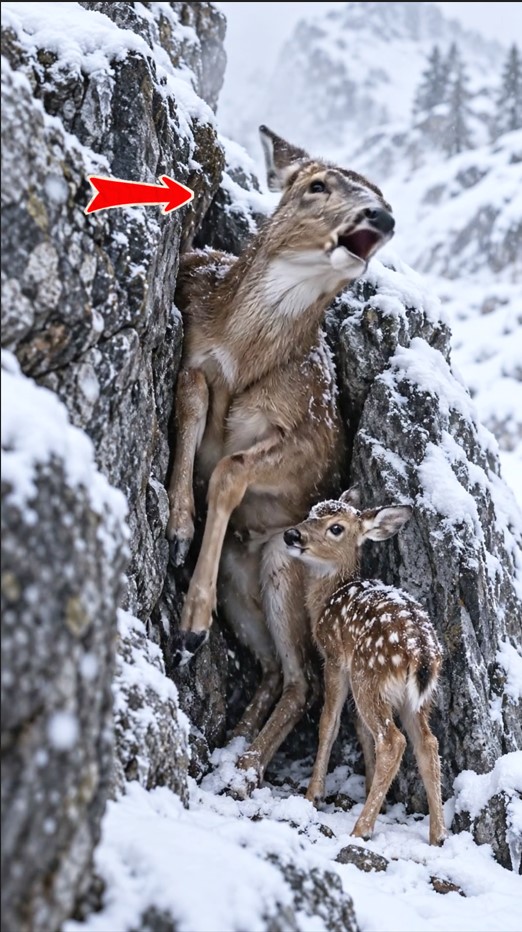
Snow drifted across the mountainside, covering the narrow trail beneath a pale winter sky.
Emma Collins pulled her scarf closer around her face as she walked between towering pine trees. She had spent the morning photographing the winter landscape, hoping to capture the soft light before another storm arrived.
The wind was growing stronger when she noticed movement beside a cluster of snow-covered bushes.
A tiny deer stood there, its spotted coat dusted with snow and its thin legs trembling against the cold.
Emma stopped immediately.
The fawn stared at her with wide, dark eyes but didn’t run away. Instead, it took a few cautious steps toward her, paused, and looked back toward the rocky slope.
“Where’s your mother, little one?” Emma whispered.
The fawn made a faint sound and moved farther along the trail.
Emma hesitated before following at a distance.
Something about the animal’s behavior seemed unusual. It repeatedly stopped to look behind it, as if checking whether she was still there.
Then a distant, frightened bleat echoed through the mountains.
The fawn suddenly hurried toward a narrow passage between two enormous boulders.
Emma followed—and stopped when she saw a gray wolf standing beyond the rocks.
A Frightened Fawn in the Snow
Emma had photographed wildlife for nearly eight years, and she knew that approaching wild animals could put both people and animals at risk.
She kept her movements slow and watched the fawn carefully.
It was small, perhaps only a few weeks old, with delicate legs and a reddish-brown coat marked by fading white spots. Snow clung to its eyelashes as it moved between the trees.
The fawn stopped beside a fallen branch and looked back at her.
Emma remained several yards away.
“I’m not going to hurt you,” she murmured, although she knew the animal couldn’t understand her words.
The fawn moved again, descending toward a rocky hollow.
Emma followed the trail only far enough to see where it led, keeping an open route back to the wider path.
Another distressed bleat came from below.
This time, the sound was deeper and more urgent.
Emma stopped near a large pine tree and peered between its branches.
Several yards ahead, the gray wolf stood on a narrow ledge. Its thick winter coat blended with the dark stone, while its pointed ears remained alert.
The wolf wasn’t running or making noise.
It simply watched the area below.
Emma’s stomach tightened.
She knew wolves were wild predators, and the animal’s presence meant she needed to be extremely careful.
Then the fawn slipped past a snow-covered rock and disappeared from sight.
Emma heard another desperate call from the hollow.
She slowly moved toward a safer vantage point, trying to understand what lay beyond the ledge.
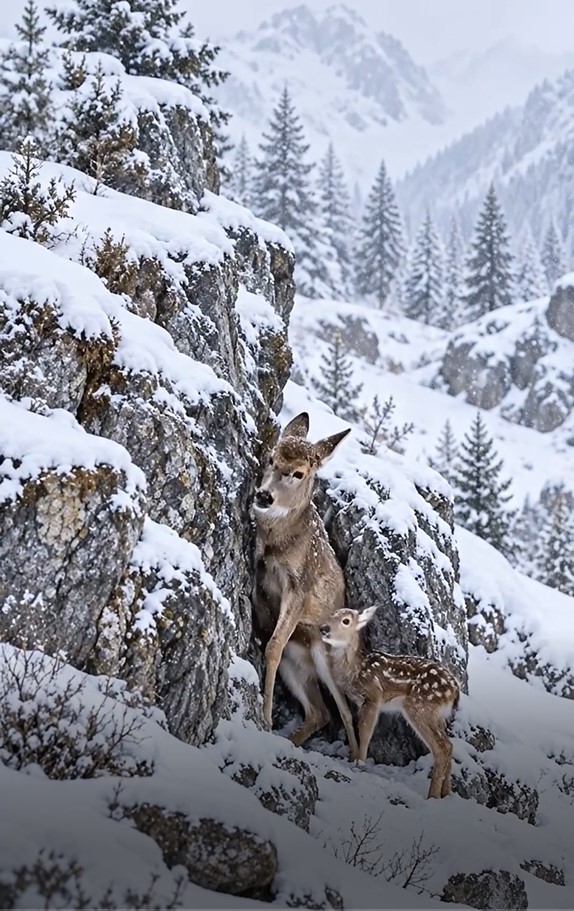
The Mother Deer Trapped Between the Rocks
From behind a broad boulder, Emma finally saw the source of the cries.
An adult doe was wedged between two massive rocks at the bottom of the hollow.
Her hindquarters were pressed against a sloping stone, while one front leg appeared trapped beneath a narrow shelf of rock. Snow had gathered around her body, and she struggled whenever she tried to pull free.
Each attempt sent loose snow tumbling down the slope.
The fawn stood several feet away, shifting nervously between its mother and the rocky passage.
The doe lifted her head and called to her young.
The fawn answered with a thin, trembling bleat.
Emma felt an ache in her chest.
She wanted to help immediately, but the rocks were steep and unstable. A careless approach could frighten the doe into struggling harder, possibly worsening her injury.
The wolf remained on the ledge above them.
Its head lowered slightly as it watched the trapped deer.
Emma couldn’t tell whether the wolf was waiting for an opportunity to hunt or simply observing the movement below. She had no intention of testing the difference.
She backed away from the exposed edge and took out her phone.
The screen showed a weak signal.
She tried calling the local wildlife rescue service, but the first attempt failed.
Behind her, the fawn moved closer to its mother.
The doe struggled again, scraping one hoof against the stone. A small shower of ice fell from the ledge.
Emma looked at the wolf, then at the narrow gap surrounding the doe.
The situation was becoming more dangerous with every passing minute.
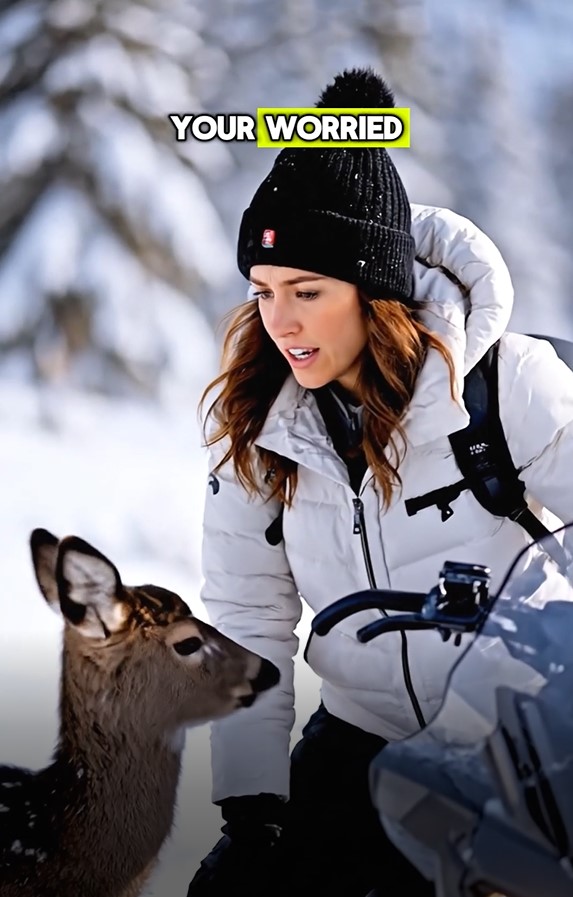
The Wolf Moves Along the Ridge
A gust of wind swept through the hollow, scattering powdery snow across the rocks.
The wolf stepped sideways along the ledge.
Its paws moved carefully over the icy surface, and its body remained low as it navigated the uneven stone.
Emma retreated behind the pine tree, keeping the wolf in view without approaching it.
She knew that running or making sudden movements could increase the danger. She also understood that the wolf was not a villain in the scene; it was a wild animal responding to its surroundings.
The trapped doe raised her head when the wolf shifted closer.
Her ears flattened, and she tried to pull herself farther into the narrow space.
The movement only tightened the position of her trapped leg.
The fawn gave a sharp call and hurried toward its mother, but stopped when the doe kicked weakly against the stone.
Emma’s hands tightened around her phone.
She tried the rescue number again.
This time, the call connected briefly before breaking apart.
She managed to tell the dispatcher that an adult deer was trapped in a rocky hollow, with a wolf nearby and a fawn wandering close to the danger.
The dispatcher asked for her location and instructed her to remain at a safe distance while the wildlife team prepared to respond.
Emma described the trail, the rock formation, and a distinctive dead pine tree near the entrance to the hollow.
The signal faded before she could provide further details.
She stared at the phone, hoping the information had been enough.
Then she noticed fresh movement on the ridge.
The wolf had turned its head toward the forest.
For several seconds, it stood completely still, listening.
Emma followed its gaze and saw nothing but dark trees and drifting snow.
Yet the quiet felt increasingly fragile.
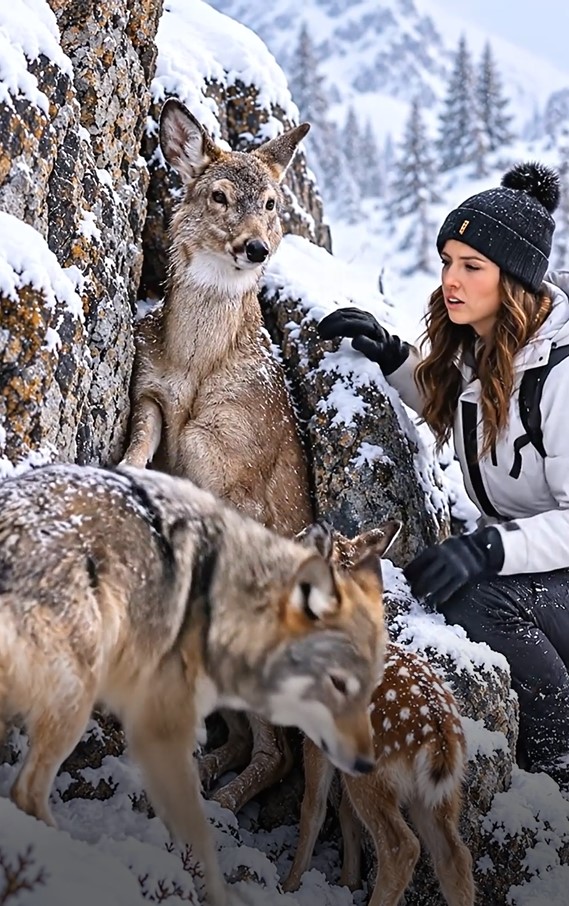
A Narrow Window to Get Help
Emma moved back toward the wider trail, where the phone signal had been stronger.
She did not attempt to approach the wolf or squeeze between the rocks to reach the doe.
Instead, she marked the location on her offline map and took several photographs from a safe distance. She sent the images to the wildlife service when a brief signal returned.
The pictures showed the trapped leg, the unstable slope, and the wolf’s position along the ridge.
A dispatcher called back a few minutes later.
A wildlife response team was heading toward the mountain access road, but heavy snowfall had slowed their progress.
Emma explained that the doe was still moving and that the fawn remained nearby.
“Don’t try to pull the deer out yourself,” the dispatcher warned. “The rocks could shift, and the mother may injure herself further. Keep your distance from the wolf and wait for the team.”
Emma agreed.
She found a sheltered position behind a thick stand of trees, far enough away to avoid disturbing the animals.
From there, she could see the hollow through a gap in the branches.
The fawn had moved close to its mother’s head. The doe occasionally touched noses with it, then turned toward the ridge whenever the wolf moved.
The wolf paced along the ledge, stopping at intervals to sniff the air.
Emma felt helpless, but she knew that rushing forward would not necessarily save the deer. It could instead create another emergency for the rescue team.
Minutes passed slowly.
Snow gathered on her gloves and shoulders.
Then, through the wind, she heard the distant sound of an engine.
A vehicle had reached the mountain access road.
Emma stood and waved a bright orange scarf above her head, hoping the approaching team could locate her position.
The rescue vehicle stopped near the trailhead.
Two wildlife responders climbed out carrying equipment, ropes, and a medical pack.
Emma hurried toward them, careful to remain on the marked path.
“The doe is below the eastern ridge,” she explained. “Her leg is trapped, and the wolf is still nearby.”
The team leader nodded and studied the photographs.
“Show us the safest route,” she said.
Baby Deer Leads a Woman to Its Mother Trapped Between Rocks, A Wolf Stands Nearby https://t.co/KbuB1CguJC
— Animal Rescue Stories (@AnimalStory5) October 18, 2026
A Mother and Her Fawn Reunite
Dr. Morgan examined the doe for several minutes before giving the team a quiet signal.
There were bruises and swelling around the trapped leg, but no obvious fracture was detected during the initial assessment.
The veterinarian advised allowing the animal time to recover from the struggle before encouraging movement.
The team kept the area clear and monitored the doe’s breathing.
The fawn stayed close, occasionally stepping away to sniff the snow before returning to its mother.
Eventually, the doe planted her front hooves beneath her body.
She pushed herself upright, wobbled, and lowered herself again.
Nobody rushed toward her.
Dr. Morgan waited until the doe attempted to stand a second time.
This time, she remained on her feet.
Her injured leg trembled, but she managed several careful steps away from the rocks.
The fawn followed beside her.
The team observed the pair as they moved toward the shelter of the pine trees. Dr. Morgan decided that the doe could remain in the area under observation, provided she continued to bear weight on the injured leg and showed no signs of deterioration.
The responders recorded the location and arranged a follow-up check.
Emma thanked them, still looking toward the trees where the deer had disappeared.
“You did the right thing by calling us and staying back,” Dr. Morgan told her. “Wildlife emergencies can be dangerous, even when your intentions are good.”
Emma nodded.
She had arrived on the mountain expecting a quiet morning of photography. Instead, a tiny fawn had led her toward a frightening scene that required patience, caution, and professional help.
Sometimes, the most important act of compassion is not rushing into danger, but recognizing when a life needs help and having the patience to bring the right people to its side.