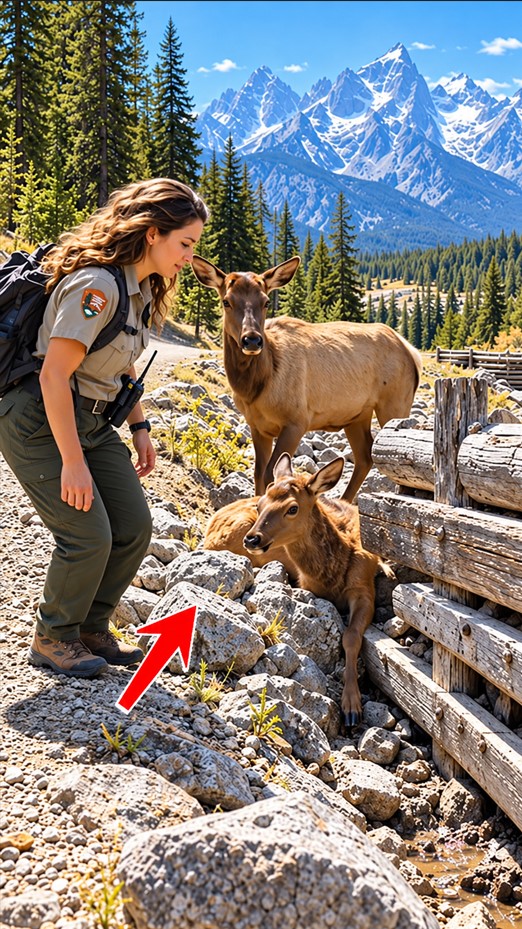
The woman slowed her car when she noticed a deer standing beside the narrow mountain road, refusing to move even as vehicles passed nearby.
Thirty-six-year-old Emily Carter had been driving through a remote mountain valley when the animal suddenly stepped toward the roadside barrier.
The deer appeared unusually distressed, repeatedly turning its head toward a steep drainage ditch below the road.
Emily pulled into a safe turnout several yards away and switched on her hazard lights.
At first, she assumed the deer was simply frightened by traffic.
But then she heard a faint, high-pitched cry coming from below the metal guardrail.
Looking toward the ditch, she spotted a tiny fawn trapped between fallen branches and loose rocks.
The young animal struggled to stand, but one of its legs appeared caught beneath a heavy branch.
A Frightened Fawn Struggled Beneath the Roadside Barrier
Emily remained beside her vehicle and carefully examined the situation from a distance.
The fawn was lying in a shallow drainage channel approximately fifteen feet below the road.
Recent rainfall had washed branches, stones, and loose soil into the ditch.
One thick branch rested across the animal’s hind leg, preventing it from moving freely.
The mother deer stood several yards away, shifting nervously between the roadside and the slope.
Whenever the fawn cried, she turned toward it.
Emily knew that approaching a frightened wild animal could cause additional stress or injury.
She also understood that deer sometimes leave their young alone, but this fawn was clearly trapped and needed assistance.
She called the regional wildlife rescue service and described the location.
The dispatcher asked her to remain at a safe distance and avoid attempting to lift the branch herself.
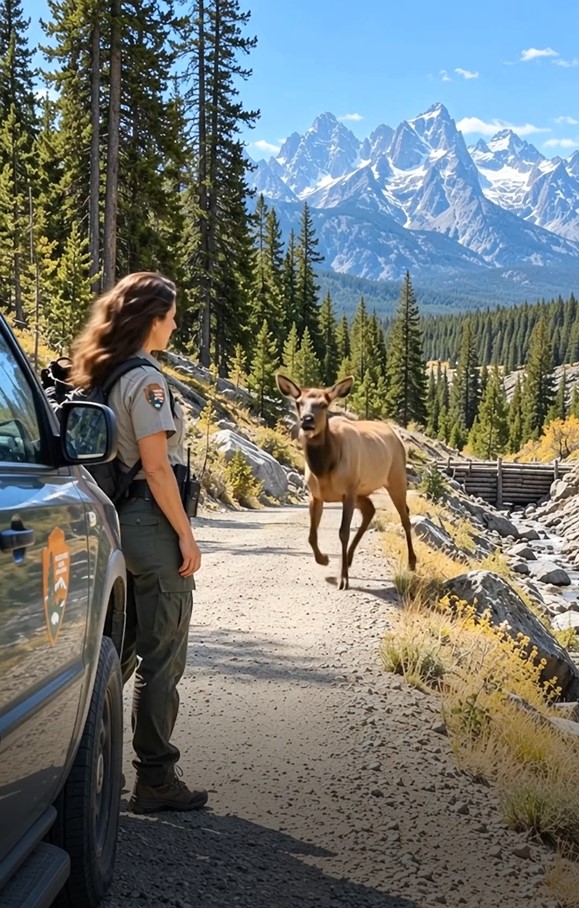
The Wolf’s Appearance Turned the Rescue Into a Race Against Time
The wolf descended slowly through the trees, occasionally stopping to observe the deer.
The mother immediately noticed the movement.
She raised her head, stamped one hoof, and positioned herself between the predator and the ditch.
Emily watched from inside her car, her hands gripping the steering wheel.
The wolf remained some distance away, but its presence made the situation more dangerous.
The fawn cried again.
Its mother moved toward the drainage channel before turning back to face the approaching animal.
Emily resisted the urge to leave her vehicle.
She knew that confronting a wolf or attempting to frighten it away at close range could place her in danger.
Instead, she called the wildlife dispatcher again and reported the predator’s position.
The dispatcher confirmed that a response team had been contacted.
Emily was asked to stay inside her car and avoid attracting the wolf’s attention.
A Local Wildlife Worker Arrived at the Critical Moment
The man introduced himself as Thomas Reed, a wildlife field technician who worked with the regional conservation office.
He had been traveling between monitoring sites when he noticed the unusual scene.
Emily explained that she had already contacted wildlife rescue.
Thomas thanked her for reporting the situation and asked her to remain inside her vehicle.
He contacted his office by radio and confirmed that a rescue crew was on its way.
After assessing the wolf’s location from a safe position, Thomas advised Emily not to approach the ditch.
The predator had stopped near a rocky outcrop, apparently watching the mother deer.
Thomas explained that the safest approach was to avoid cornering or confronting the wolf.
He remained near his truck while monitoring the animals and communicating with the incoming team.
The mother deer continued standing protectively near the drainage channel.
The wolf moved along the edge of the forest but did not descend toward the road.
Thomas reported its movements to the rescue crew.
He also asked the highway maintenance service to provide temporary traffic control because the narrow road offered little room for emergency vehicles.
Emily felt relieved that someone experienced had arrived.
But the fawn remained trapped, and the approaching evening made the situation increasingly urgent.
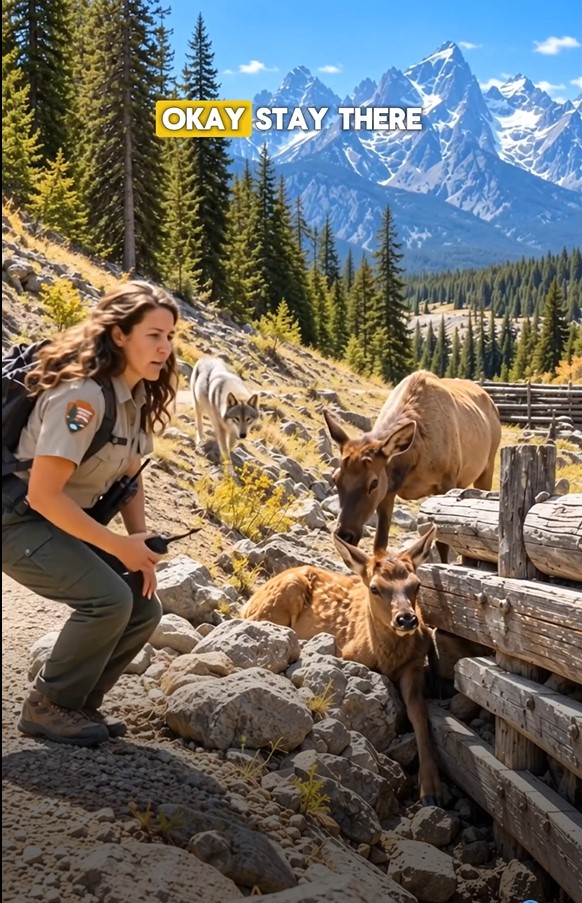
The Rescue Team Worked Carefully as the Wolf Retreated
Two wildlife rescuers arrived with protective equipment and a portable animal transport crate.
A highway maintenance worker positioned warning signs along the road and temporarily slowed approaching traffic.
Thomas briefed the team on the fawn’s location and the wolf’s last observed position.
The predator had moved farther into the forest, although the rescuers continued monitoring the surrounding hillside.
The mother deer retreated a short distance when the team approached the drainage channel.
The rescuers descended carefully using a safer access point farther along the slope.
They avoided sudden movements and kept their voices low.
One rescuer assessed the fawn while another examined the branch trapping its hind leg.
The young animal was frightened and exhausted.
The team carefully stabilized the branch before lifting it enough to release the trapped leg.
Once the pressure was removed, the fawn attempted to move but appeared unsteady.
The rescuers checked for obvious injuries and placed the youngster into a padded transport crate for further examination.
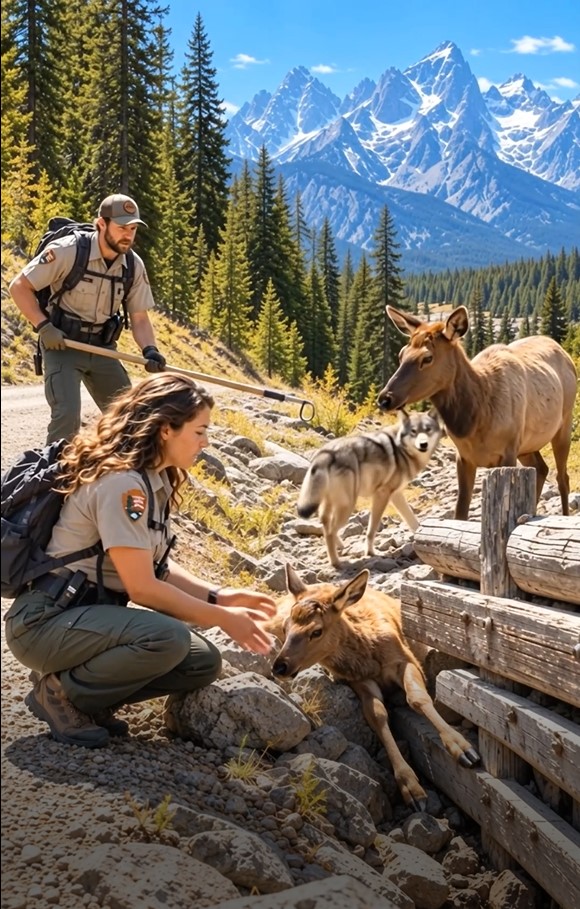
A Careful Reunion Brought Relief to Everyone Watching
The wildlife veterinarian examined the fawn at a nearby field station.
The youngster had bruising and a superficial scrape on its hind leg, but no fracture was found.
After a period of observation, it was able to stand and move without significant difficulty.
Because the fawn’s condition was stable, the team arranged to return it to the area where it had been found.
Thomas and the rescuers traveled back to the mountain road before sunset.
Emily had already left the immediate scene but remained in contact with the rescue service for an update.
The team approached the site quietly and checked the surrounding area for hazards.
The wolf was no longer visible.
The mother deer was still near the edge of the forest.
The rescuers placed the fawn in a sheltered location close to where it had been discovered, then withdrew to a distant observation point.
For several minutes, nothing happened.
Then the mother deer emerged cautiously from the trees.
She approached the fawn, lowered her head, and sniffed it carefully.
The youngster responded by standing and moving toward her.
After a brief pause, the pair walked together into the forest.
How a Mountain Road Rescue Became a Story of Courage and Compassion
Emily Carter was driving along a remote mountain road when she noticed a deer behaving unusually beside the guardrail.
After stopping safely, she discovered that the animal’s fawn was trapped beneath a fallen branch in a drainage ditch.
Emily contacted wildlife rescue and remained at a safe distance.
The situation became more concerning when a gray wolf appeared near the forest and began observing the distressed animals.
The mother deer stayed close to her trapped youngster while Emily followed the dispatcher’s safety instructions.
Thomas Reed, a wildlife field technician traveling through the area, arrived and helped coordinate the response.
Rather than approaching the predator, he monitored its movements and communicated with the rescue team.
Wildlife rescuers eventually reached the fawn, stabilized the fallen branch, and freed its trapped leg.
A veterinarian later confirmed that the youngster had escaped serious injury.
Once it was strong enough to move safely, the team returned it to the mountain habitat.
Emily could not free the frightened fawn alone, but by stopping, recognizing the danger, and seeking the right help, she gave a mother deer the chance to lead her little one safely home.