A Peaceful Morning on the Water Turns Into an Unexpected Wildlife Rescue
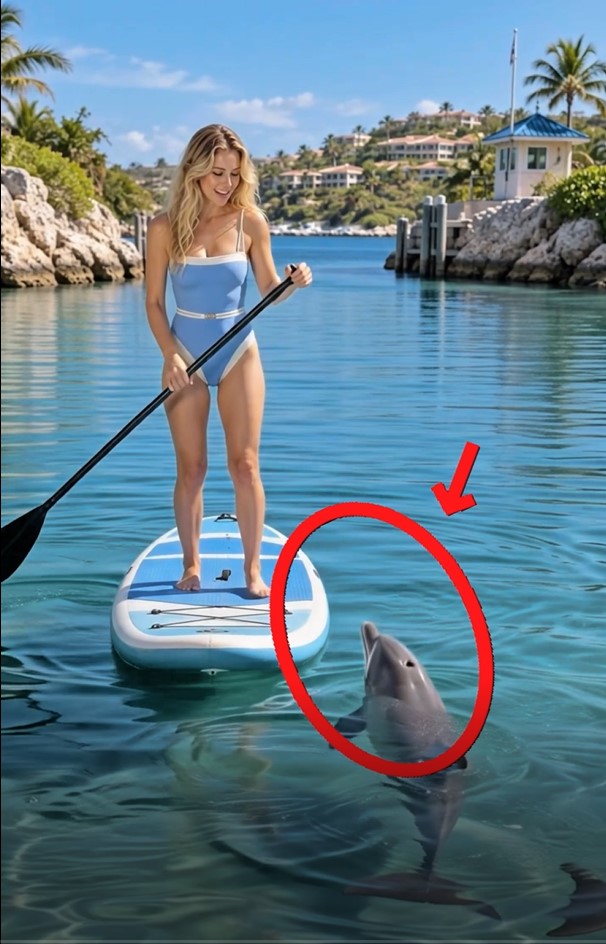
The woman stopped paddling when a dolphin surfaced beside her board for the third time, making an unusual sound before disappearing beneath the water.
Thirty-two-year-old marine photographer Claire Bennett had been exploring a quiet coastal bay when she noticed the dolphin repeatedly swimming in a tight circle near a line of floating buoys.
At first, Claire assumed the animal was simply curious about her paddleboard.
But when it surfaced again, she noticed something dark trailing behind its tail.
The dolphin twisted sideways, revealing a length of fishing line wrapped tightly around its body.
Claire immediately understood that the animal might be trapped.
She remained on her board, keeping a safe distance while trying to determine whether the dolphin could swim freely.
The animal surfaced once more, then struggled toward a partially submerged fishing net.
Claire reached for her waterproof phone and contacted the local marine wildlife rescue team.
Twenty minutes later, a small rescue boat appeared beyond the harbor entrance, carrying two specialists who had no idea how complicated the rescue would become.
A Morning Paddle Reveals Something Unusual
Claire had launched her paddleboard shortly after sunrise.
The weather was calm, and the bay was protected from the stronger currents farther offshore.
She frequently visited the area to photograph seabirds, coastal landscapes, and marine animals from a respectful distance.
That morning, she had planned to spend only an hour on the water.
She carried a waterproof phone, a personal flotation device, and a small emergency signaling whistle.
As she paddled past a cluster of yellow navigation buoys, she heard a sharp splash behind her.
A dolphin surfaced approximately thirty yards away.
Claire stopped moving and watched quietly.
The dolphin disappeared beneath the surface before emerging again near the same location.
Its movements seemed unusually restricted.
Instead of swimming smoothly across the bay, it repeatedly changed direction.
Claire noticed a thin line cutting through the water behind the animal.
She initially thought it might be floating seaweed.
The Dolphin Struggles as the Entanglement Tightens
The dolphin surfaced again and released a forceful breath.
Claire could see that the fishing line had restricted part of its movement.
Each time the animal tried to swim away, the line pulled against the submerged net.
The dolphin managed to travel several yards before being drawn back toward the tangled gear.
Claire felt helpless.
She had photographed dolphins many times, but she had never witnessed one struggling so close to shore.
She contacted the regional marine wildlife response hotline.
The dispatcher asked her to describe the animal, the suspected entanglement, and the nearest recognizable shoreline features.
Claire provided her location and explained that the dolphin was still surfacing regularly.
The dispatcher advised her not to enter the water or attempt to cut the fishing line herself.
A rescue team was being dispatched.
Claire agreed to remain nearby only as long as conditions were safe.
She moved her paddleboard farther from the entanglement and kept the dolphin in sight.
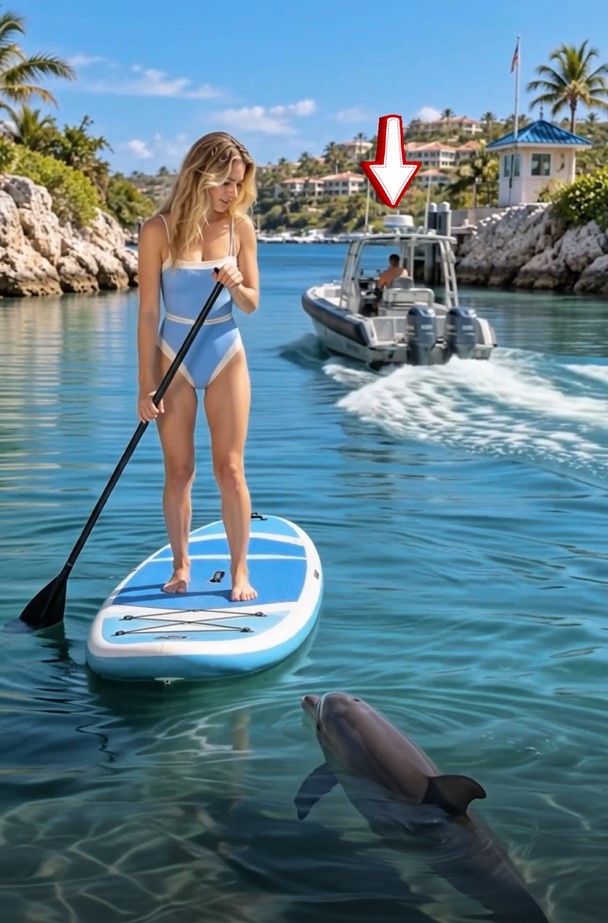
A fishing vessel passed near the bay entrance.
Two Marine Rescuers Arrive and Assess the Situation
A small rescue boat finally entered the bay.
On board were marine wildlife specialist Daniel Mercer and veterinary technician Rebecca Hayes.
Both had experience assisting dolphins and other marine animals caught in abandoned fishing equipment.
Claire raised her paddle to identify her position.
Daniel slowed the boat well before reaching the dolphin.
He asked Claire to describe everything she had observed.
She explained the animal’s restricted movements and pointed toward the submerged net.
Rebecca used binoculars to examine the area.
She noticed several lengths of monofilament line stretched between floating debris and a submerged anchor point.
The dolphin appeared to be entangled near the base of its tail.
Daniel explained that the rescue would require patience.
A frightened dolphin could injure itself if the team approached too quickly.
The rescuers contacted their response coordinator and confirmed that they had authorization to proceed under the applicable marine wildlife rescue procedures.
They also requested a second support vessel in case additional assistance became necessary.
A Complicated Rescue Requires Careful Coordination
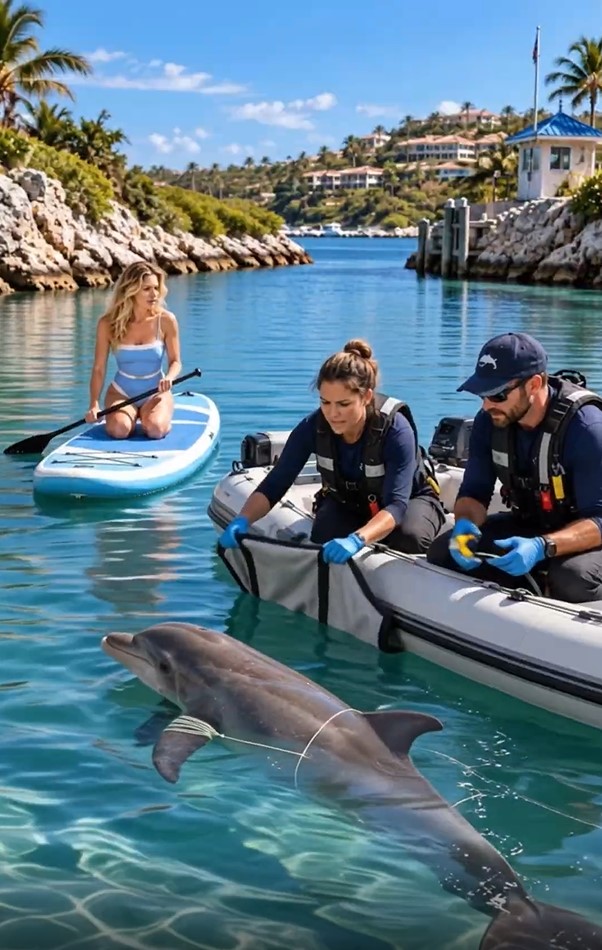
Daniel positioned the boat where the rescuers could inspect the abandoned gear without forcing the dolphin toward the hull.
Rebecca identified a section of netting attached to a submerged rope.
The team realized that cutting the wrong section could leave additional fishing line attached to the animal.
That could allow the dolphin to swim away while still carrying dangerous debris.
Daniel contacted the response coordinator again.
After reviewing the situation, the team prepared a controlled disentanglement attempt using specialized equipment.
Rebecca monitored the dolphin’s breathing and movement while Daniel managed the boat.
The dolphin surfaced several feet away.
For a brief moment, its tail became visible above the water.
Rebecca confirmed that the line was wrapped tightly around the tail stock.
The rescuers waited for a suitable opportunity to work without pulling against the animal.
Then Daniel used a specialized cutting tool attached to a long pole to release one section of the submerged net.
The floating debris shifted.
The dolphin suddenly moved forward.
Claire watched from a distance, hoping it had been freed.
But the animal stopped again.
A second length of line remained attached.
Rebecca immediately alerted Daniel.
They repositioned the boat and reassessed the remaining entanglement.
The second line was shorter and harder to reach.
Daniel knew that rushing could make the situation worse.
He waited while Rebecca observed the dolphin’s movements.
The Dolphin Swims Free, but the Rescuers Notice Another Problem
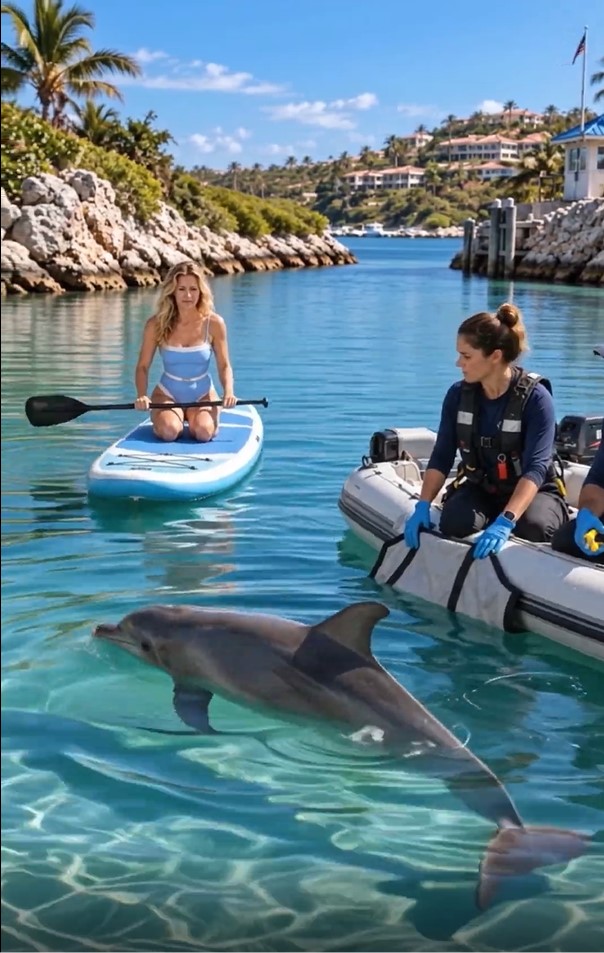
Claire watched the dolphin swim several yards away from the rescue boat.
For the first time that morning, its movements appeared smoother.
But Rebecca noticed that a small section of fishing line was still visible near the tail.
Although the animal was no longer anchored to the submerged net, it might still be carrying material capable of causing further injury.
Daniel contacted the coordinator and reported the remaining concern.
The team followed the dolphin from a respectful distance, documenting its condition without pursuing or crowding it.
Rebecca observed several normal surfacing intervals.
The dolphin appeared alert and capable of swimming independently.
Because attempting another intervention could create additional risks, the specialists decided to continue monitoring and consult the response veterinarian.
They recorded photographs of the tail area for later review.
Meanwhile, the support vessel arrived and helped recover the abandoned fishing gear that could be safely removed.
The rescuers collected sections of netting, loose rope, and fishing line from the water.
How a Woman on a Paddleboard Helped Save an Entangled Dolphin
Claire Bennett was paddleboarding in a coastal bay when she noticed a dolphin swimming unusually close to abandoned fishing gear.
After observing its restricted movements, she realized that fishing line had become wrapped around the animal’s tail.
Rather than attempting a dangerous rescue herself, Claire contacted a marine wildlife response team.
Two specialists, Daniel Mercer and Rebecca Hayes, arrived by boat and assessed the entanglement.
They discovered that the dolphin was connected to submerged netting by multiple lengths of fishing line.
Using specialized equipment and a carefully coordinated approach, the rescuers released the animal from the anchored gear.
The dolphin regained its freedom of movement and swam away.
Although a small amount of line initially remained visible, later observations suggested that the animal was swimming normally.
Claire could not free the dolphin with her own hands, but by recognizing its struggle and calling the right people, she helped give a trapped animal another chance to swim freely through the ocean.