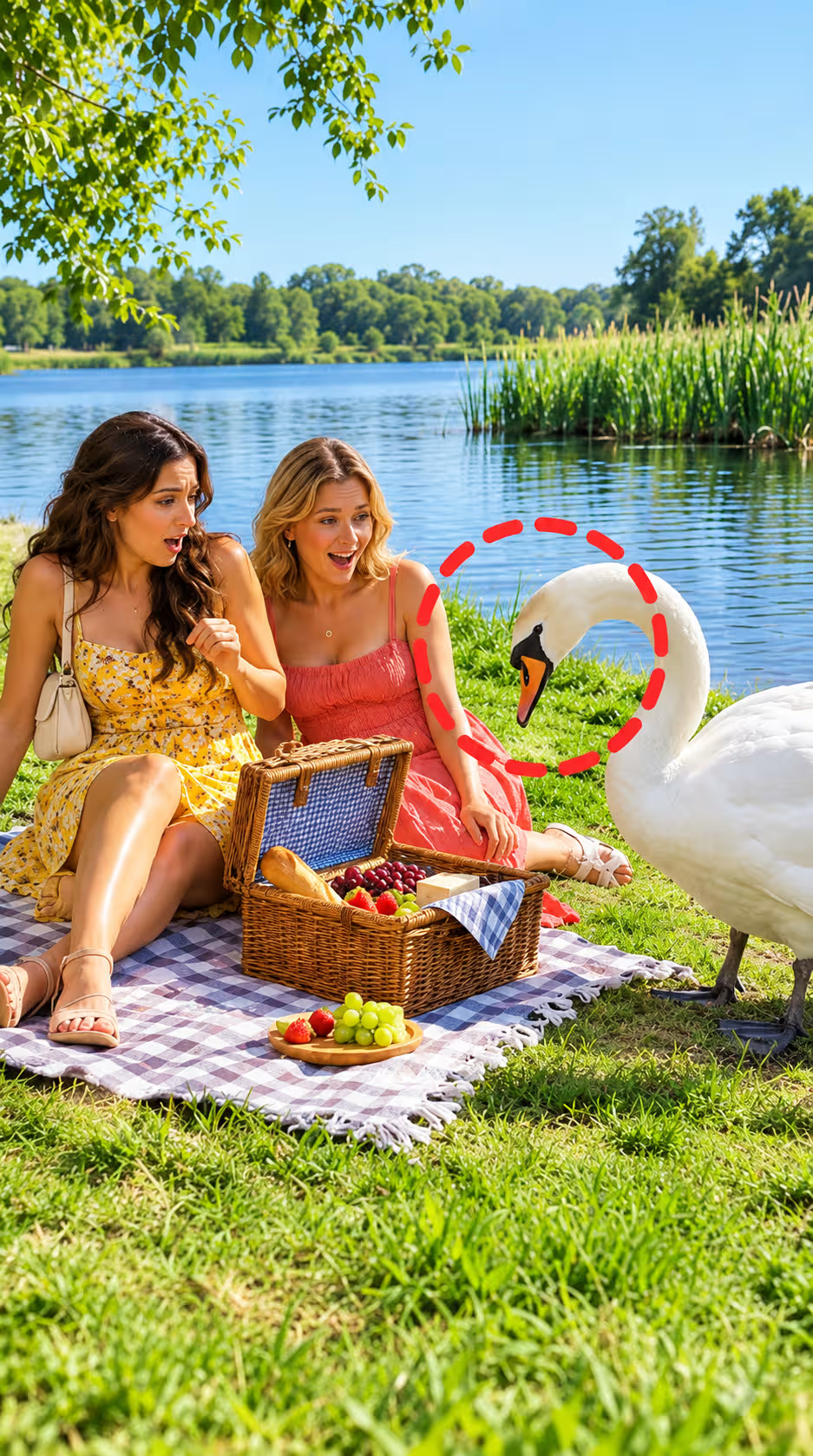
An Unusual Discovery Along the Lakeside Path
The young swan was sitting unusually close to the walking path when Emma Wilson first noticed it.
Its gray feathers were damp, and one wing rested awkwardly against the grass.
Emma stopped walking while her friend, Rachel Morgan, looked toward the nearby water.
Several adult swans were swimming farther along the shoreline.
The young bird made no attempt to follow them.
Instead, it lowered its head and remained almost motionless.
Rachel noticed a thin green line stretched across the grass beside its body.
At first, she thought someone had abandoned fishing equipment near the lake.
Then the swan shifted, revealing that the line was tangled around one leg.
Emma immediately understood why the bird had remained behind.
A Young Bird Unable to Reach the Water
Emma and Rachel regularly visited Willow Lake during their morning walks.
They enjoyed watching the waterbirds that gathered near the northern shoreline.
The young swan was familiar because they had seen it swimming with its family.
That morning, however, it appeared separated from the other birds.
Emma crouched several yards away to examine the situation without approaching.
The green fishing line extended from the swan’s leg toward a cluster of reeds.
A small plastic fishing float was caught beneath a broken branch.
Whenever the bird moved, the line tightened around its lower leg.
Rachel noticed that the swan could still move its wings normally.
However, its attempts to stand ended with the affected leg pulling backward.
Emma considered whether the line could be removed without handling the bird.
She quickly realized that approaching an unfamiliar swan could cause additional distress.
The bird might struggle and tighten the line further.
Rachel suggested contacting the local wildlife rescue service.
Emma agreed and photographed the tangled line from a safe distance.
They needed professional guidance before attempting anything that might worsen the situation.
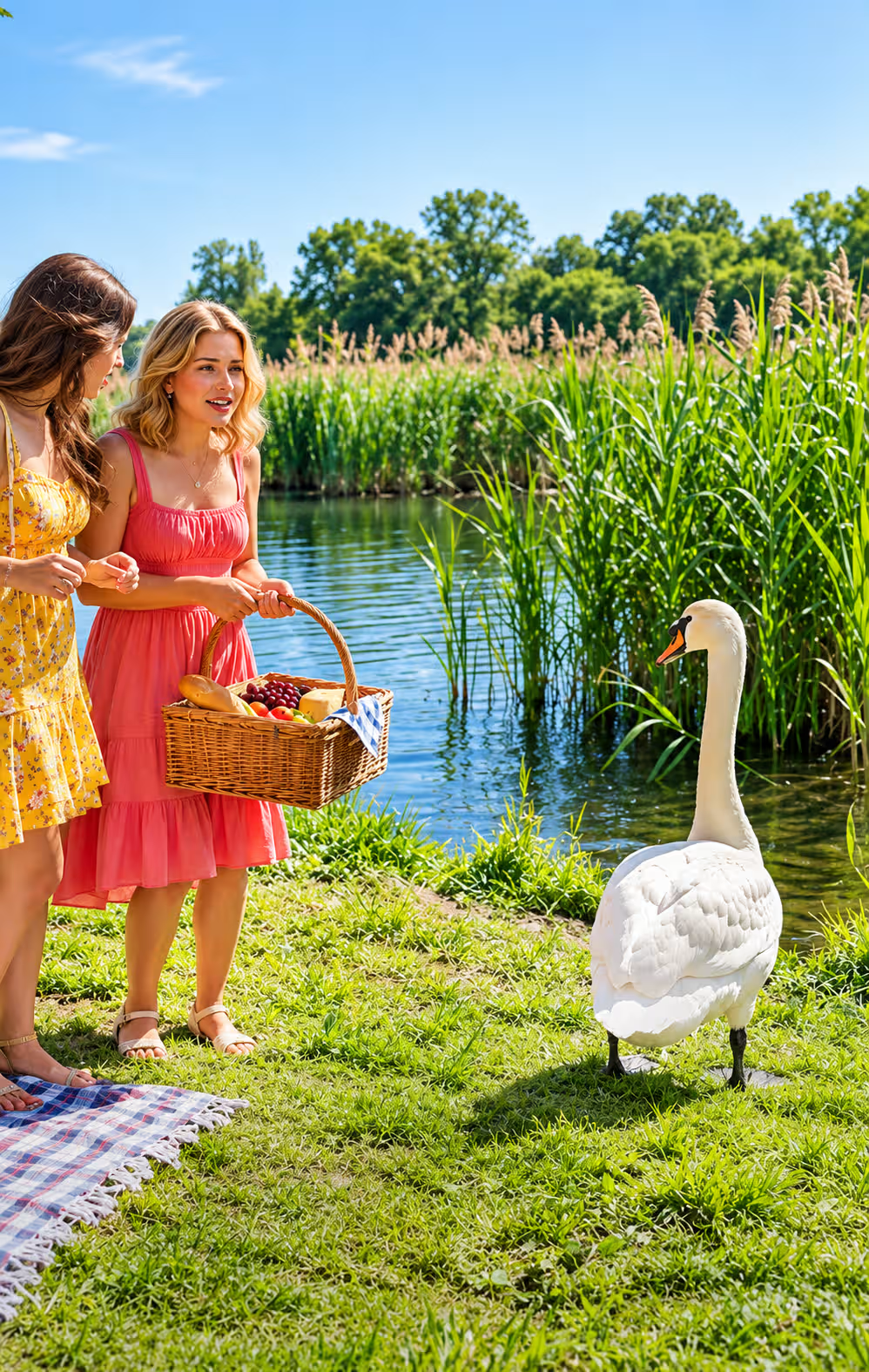
A Phone Call Brings New Information
Rachel called the regional wildlife rescue center and described their discovery.
The operator asked about the bird’s size, behavior, and exact location.
Emma checked a nearby trail marker and provided its identification number.
She also explained that several adult swans remained on the lake.
The operator confirmed that a trained wildlife worker could attend the location.
However, the women were advised not to handle the bird themselves.
Swans could react defensively when frightened, even when they appeared weak.
The operator also warned that pulling fishing line could tighten hidden loops.
Rachel asked whether they should move the plastic float away from the reeds.
The operator advised leaving everything undisturbed until the worker arrived.
Instead, the women were asked to keep pedestrians and dogs at a distance.
Emma stood beside the pathway and politely redirected approaching walkers.
Rachel remained nearby, observing the swan without blocking its view of the lake.
A few minutes later, the young bird attempted to stand again.
The line tightened, and it settled back onto the grass.
Emma noticed that the trapped leg was becoming increasingly difficult to move.
The wildlife worker’s arrival now seemed particularly important.
An Unexpected Complication Near the Shore
A family walking two dogs approached the narrow section of the pathway.
One dog noticed the swan and began pulling toward the shoreline.
Rachel calmly explained that an animal rescue was being arranged.
The family immediately moved to the opposite side of the path.
Unfortunately, the sudden barking had already startled the young swan.
It spread both wings and tried to move toward the water.
The fishing line caught against the branch, preventing it from moving freely.
Emma watched as the bird stopped and lowered its body again.
She noticed another length of line hidden beneath the surrounding reeds.
The tangled material appeared more extensive than they had initially believed.
Rachel called the rescue center again and reported the new information.
The operator confirmed that the wildlife worker was already traveling to the lake.
The women continued keeping the immediate area quiet.
Emma also noticed that one adult swan had moved closer to the shoreline.
It remained in the water, occasionally calling toward the young bird.
Rachel wondered whether the adult was one of its parents.
Neither woman could confirm the relationship, but the behavior seemed encouraging.
They hoped the young swan could return to the water once the line was removed.
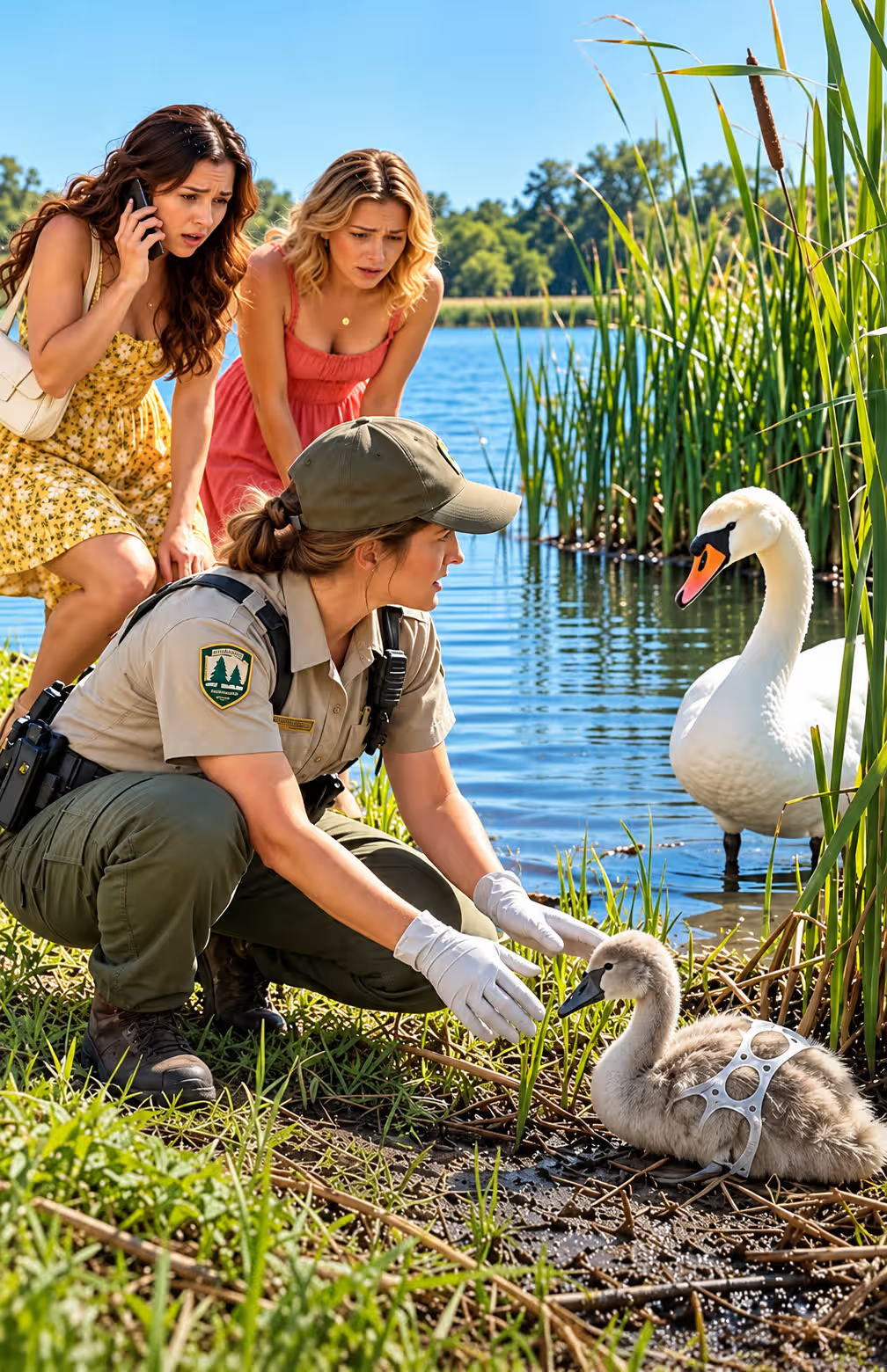
The Wildlife Worker Begins the Rescue
A white wildlife rescue vehicle arrived near the lakeside entrance shortly afterward.
A woman wearing a green field jacket stepped out carrying specialized equipment.
She introduced herself as Sarah Bennett, a trained wildlife rescue worker.
Emma showed Sarah the photographs and explained how the situation had developed.
Sarah examined the bird from a distance before approaching carefully.
She identified several loops of fishing line around the swan’s lower leg.
The remaining line was tangled around the branch and submerged vegetation.
Sarah prepared a lightweight towel, protective gloves, and small cutting tools.
She asked Emma and Rachel to remain behind the pathway boundary.
Moving slowly, Sarah positioned herself beside the young swan.
She gently covered its body with the towel to reduce struggling.
After securing the bird safely, she examined the tangled material.
The line had tightened around the leg but had not completely restricted movement.
Sarah carefully cut the loose sections before removing the remaining loops.
She checked the leg for visible swelling and signs of injury.
The skin showed mild irritation, but there was no obvious open wound.
Sarah placed the swan inside a ventilated wildlife carrier for a more thorough examination.
Emma and Rachel watched as the trapped bird was finally freed from the fishing line.
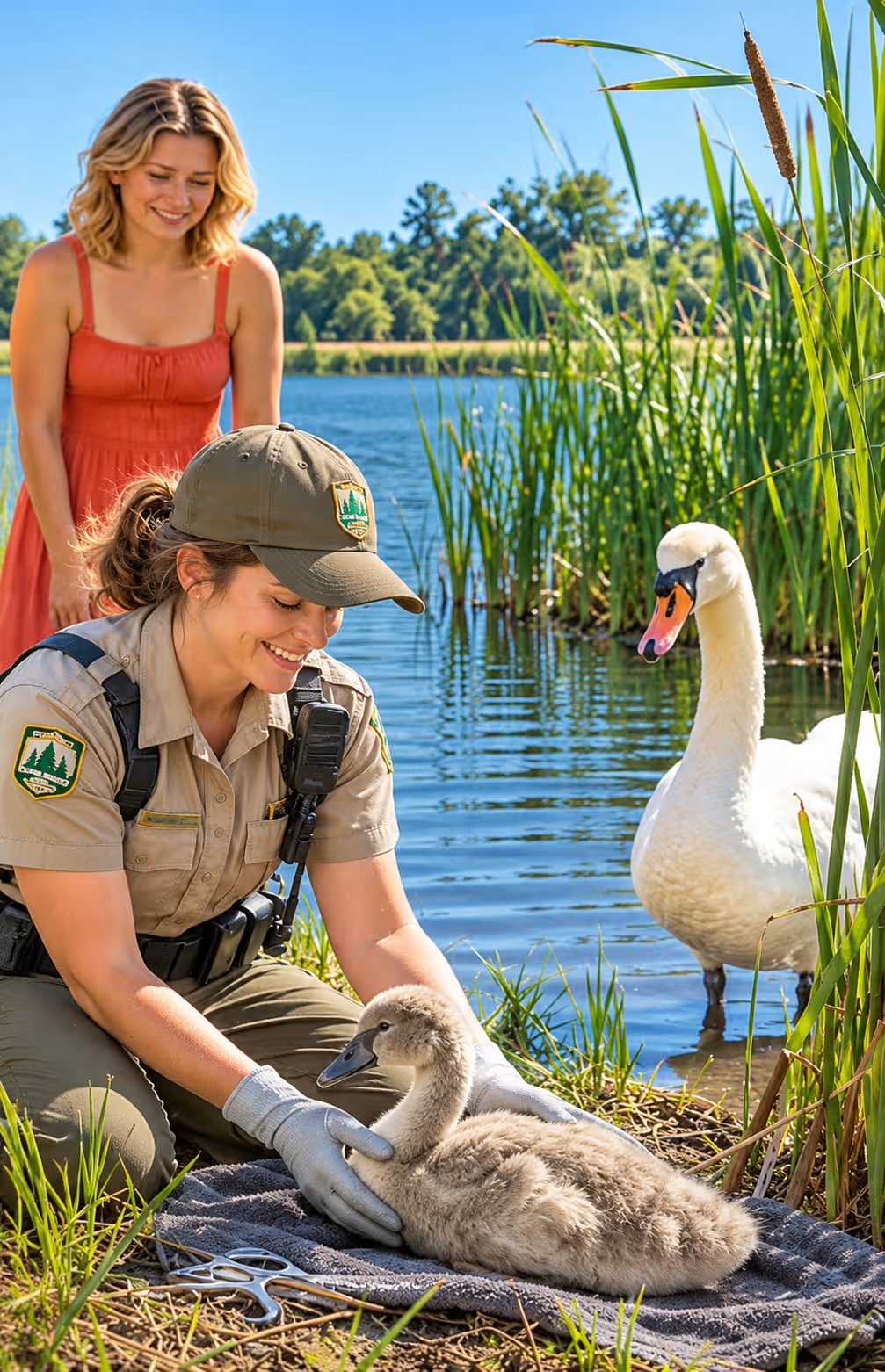
A Careful Examination Before Returning Home
Sarah carried the swan toward her rescue vehicle and opened a portable examination station.
She explained that removing the line was only the first part of the process.
The bird’s leg needed assessment before it could safely return to the lake.
Emma asked whether the swan would require treatment at a rehabilitation center.
Sarah said the decision depended on its ability to move and bear weight.
She examined the leg and checked for remaining pieces of fishing line.
Fortunately, she found no additional material hidden beneath the feathers.
The swan moved both legs during the assessment.
Sarah then observed it standing briefly inside a secure examination enclosure.
Its movements appeared coordinated, although she continued watching for signs of discomfort.
After completing her checks, Sarah decided that release at the discovery site was appropriate.
She carried the bird back toward a quiet section of shoreline.
Emma and Rachel stood farther along the path to avoid disturbing it.
Sarah opened the carrier and allowed the swan to leave independently.
The young bird stepped onto the grass and moved cautiously toward the water.
Moments later, it entered the lake and began swimming away from the shore.
A Welcome Return to the Lake
Emma and Rachel remained beside the pathway as the young swan moved across the water.
Its swimming appeared steady, and both legs moved beneath the surface.
One adult swan approached from the nearby reeds.
The young bird changed direction and began swimming alongside it.
Sarah watched the interaction before collecting her equipment.
She explained that the swan should be monitored for any recurring mobility problems.
The women agreed to report unusual behavior if they visited the lake again.
Sarah also collected the discarded fishing line and plastic float.
She reminded them that abandoned fishing equipment could endanger many waterbirds.
Before leaving, she reported the debris location to the lake’s maintenance team.
The following morning, Emma and Rachel returned to the same section of shoreline.
They observed several swans swimming together near the reeds.
One younger bird appeared to move comfortably among the group.
They could not identify it with certainty, but the sight was reassuring.
In this fictional story, the rescue succeeded through careful observation and professional wildlife assistance.
The women had discovered a problem, protected the area, and allowed a trained worker to respond.
For Emma and Rachel, the most rewarding moment was watching the young swan return to the water where it belonged.