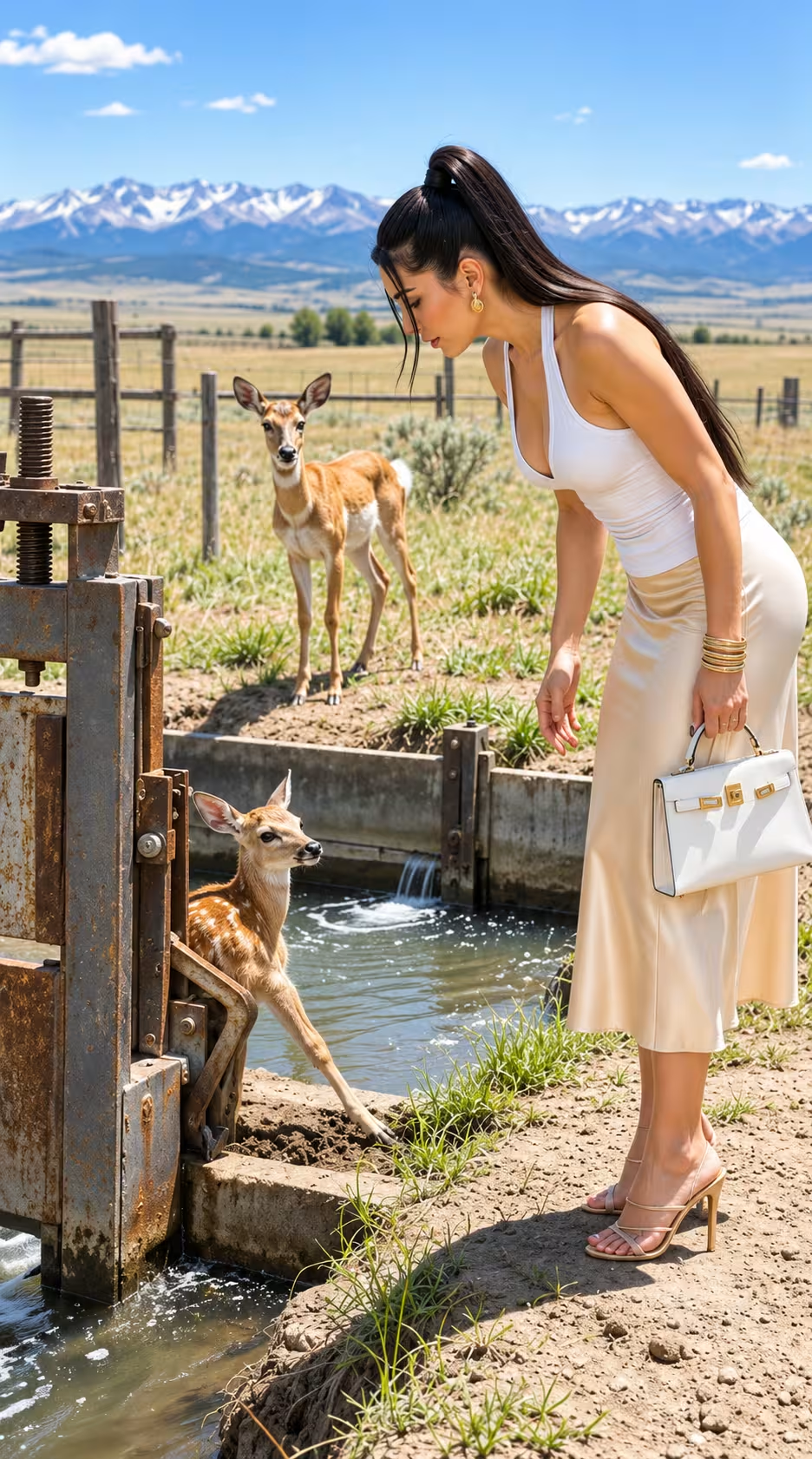
A Desperate Struggle Beneath the Morning Sun
The young deer slipped against the concrete wall for the third time, unable to escape the narrow irrigation canal.
Emily Carter stood on the grassy bank, watching helplessly as the frightened fawn struggled in the shallow, fast-moving water.
“Easy, little one. Please stay still.”
The fawn tried to climb again, but its small hooves found no grip.
Above the surrounding fields, a large eagle circled and released a sharp call.
Emily looked toward a distant farmhouse, hoping someone might hear her shouting.
The eagle descended toward a fence post near the farmyard, calling repeatedly.
A man stepped out of the barn and looked toward the bird.
Moments later, he noticed Emily waving beside the canal.
He climbed into his farm vehicle and headed toward her.
An Ordinary Walk Reveals a Hidden Danger
Emily had been walking along a rural footpath shortly after sunrise.
The route crossed several agricultural fields and followed an irrigation canal used by neighboring farms.
She enjoyed the quiet countryside and often photographed birds and other wildlife.
That morning, the fields were covered with dew, and the canal carried water from an upstream reservoir.
Emily noticed fresh deer tracks near a muddy crossing.
She followed the public footpath beside the canal, careful to remain away from its steep edges.
A faint splashing sound interrupted her walk.
At first, she assumed a bird had landed in the water.
Then she heard a thin, distressed cry.
Emily approached cautiously and looked over the bank.
A spotted fawn stood in the canal, its legs trembling.
The concrete walls rose well above its head.
There was no visible ramp or shallow exit nearby.
Emily searched the surrounding grass for an adult deer.
She saw no movement among the trees.
The fawn was alone in the water, and its strength appeared to be fading.
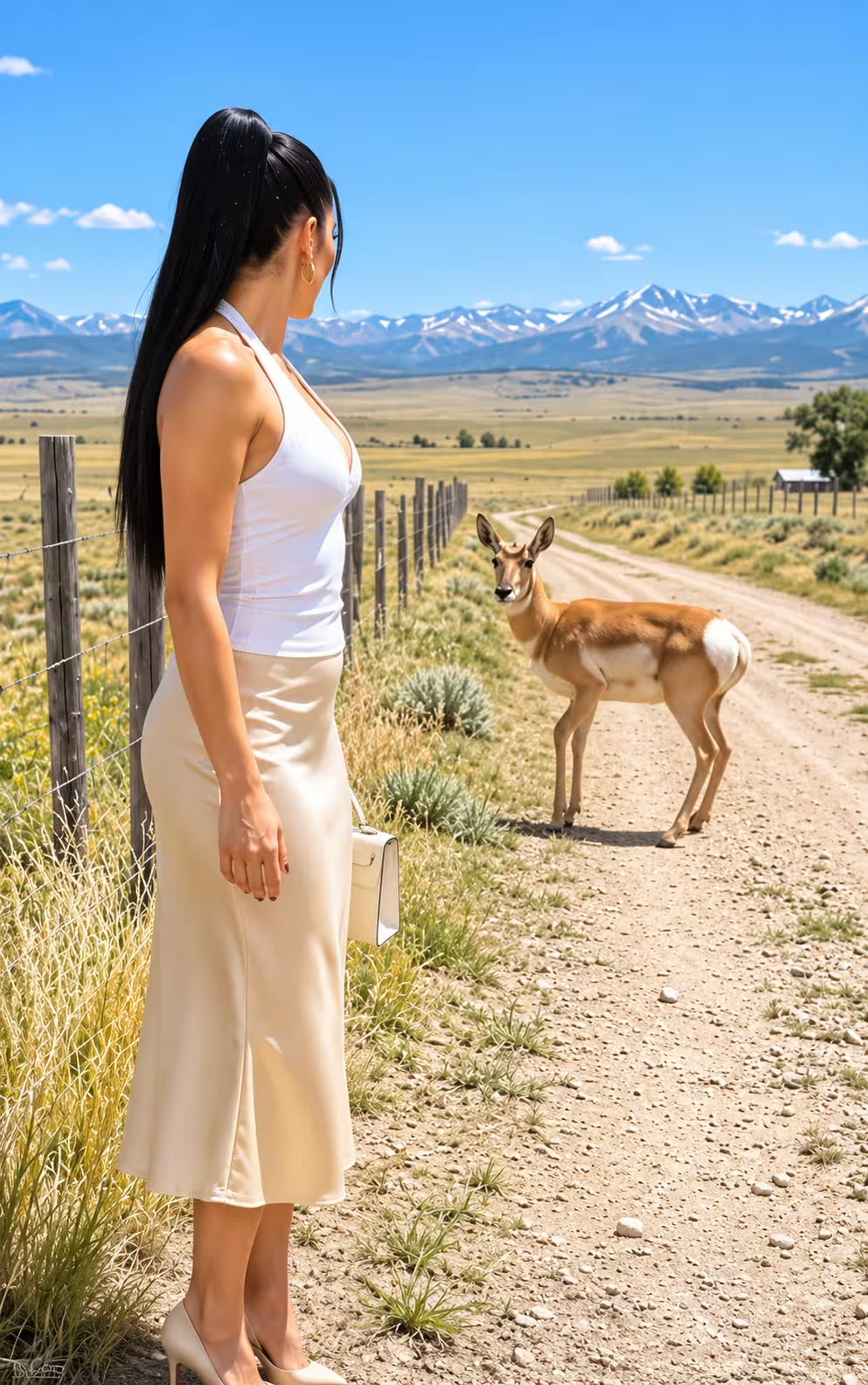
The Fawn Cannot Find a Way Out
Emily crouched several feet from the canal’s edge.
She could see that the fawn was standing rather than swimming, but the current pushed steadily against its legs.
Every attempt to climb ended with its hooves sliding down the smooth concrete.
The animal’s wet coat clung tightly to its small body.
Emily estimated that it was only a few weeks old.
She considered entering the canal but immediately recognized the danger.
The walls were steep, and the water moved faster than it appeared from above.
Without suitable equipment, she might become trapped herself.
She took out her phone, but the signal was weak.
Her first call failed before connecting.
Emily tried again while moving farther along the bank.
Meanwhile, the eagle continued circling above the fields.
Its repeated calls echoed across the quiet farmland.
Emily looked toward the farmhouse and shouted for assistance.
The bird descended near the farmyard, drawing attention with its movement and calls.
Emily could not know what had attracted the eagle.
But its unusual activity coincided with the moment a farmer noticed something happening near the canal.
The Farmer Notices the Eagle’s Unusual Behavior
Daniel Harris had been checking equipment inside his barn when he heard the eagle calling.
Large birds occasionally hunted over the surrounding fields, but this one remained unusually close to the farmyard.
Daniel stepped outside and watched it settle briefly on a fence post.
The eagle called again before taking flight.
As Daniel followed its movement, he noticed a woman waving near the irrigation canal.
He immediately recognized that she might need assistance.
Daniel drove his utility vehicle along the farm track and stopped a safe distance from the canal.
Emily hurried toward him.
“There’s a baby deer trapped in the water.”
Daniel approached the bank carefully and examined the situation.
He saw the fawn struggling against the concrete wall.
The farmer knew that the canal could become dangerous when irrigation pumps were operating.
He contacted the local water-control operator and requested a temporary reduction in flow.
He also called a wildlife rescue volunteer who worked with the regional animal rehabilitation center.
Emily remained near the bank, keeping the frightened fawn in sight.
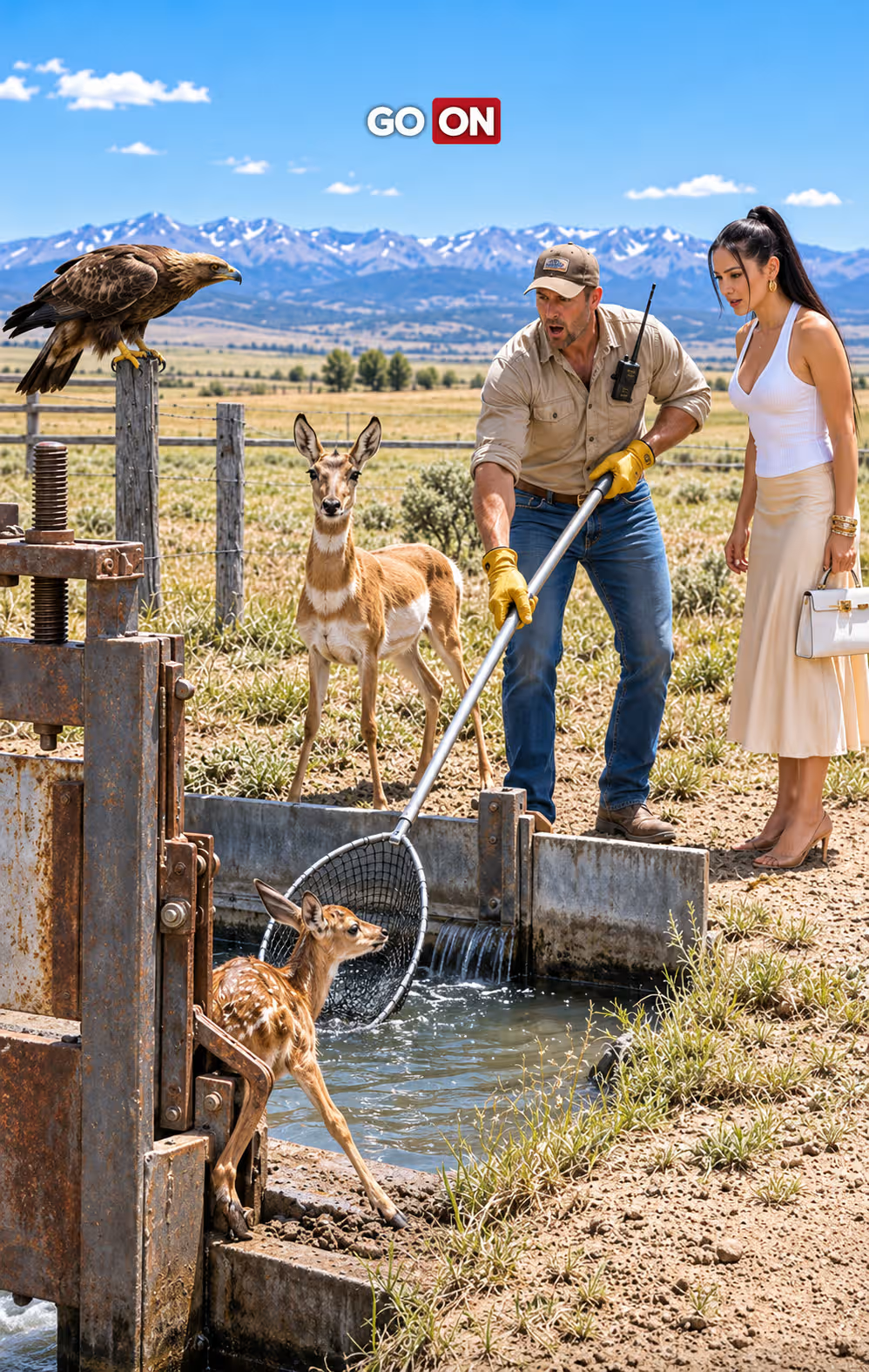
A Careful Rescue From the Concrete Canal
The water level began falling after the irrigation flow was reduced.
Daniel retrieved a sturdy ladder, protective gloves, and broad rescue straps from his vehicle.
The wildlife volunteer, Sarah Mitchell, arrived shortly afterward.
She examined the canal and assessed the fawn’s condition from above.
The animal appeared exhausted but was still standing.
Sarah explained that they needed to avoid unnecessary handling and sudden movements.
Daniel secured the ladder against the canal wall while Sarah prepared a soft rescue sling.
The reduced water flow made the situation safer.
With Daniel stabilizing the ladder, Sarah carefully descended toward the fawn.
She moved slowly to avoid frightening it.
The fawn attempted to retreat but had little room to move.
Sarah gently positioned the sling beneath its chest and abdomen.
She checked that its legs were free and that the straps would not tighten around its neck.
Daniel and another farmworker, who had arrived to assist, carefully lifted the sling from above.
Sarah guided the animal as it rose toward the bank.
Within moments, the fawn was safely on the grass.
It remained still, breathing rapidly.
Emily watched anxiously as Sarah began examining it.
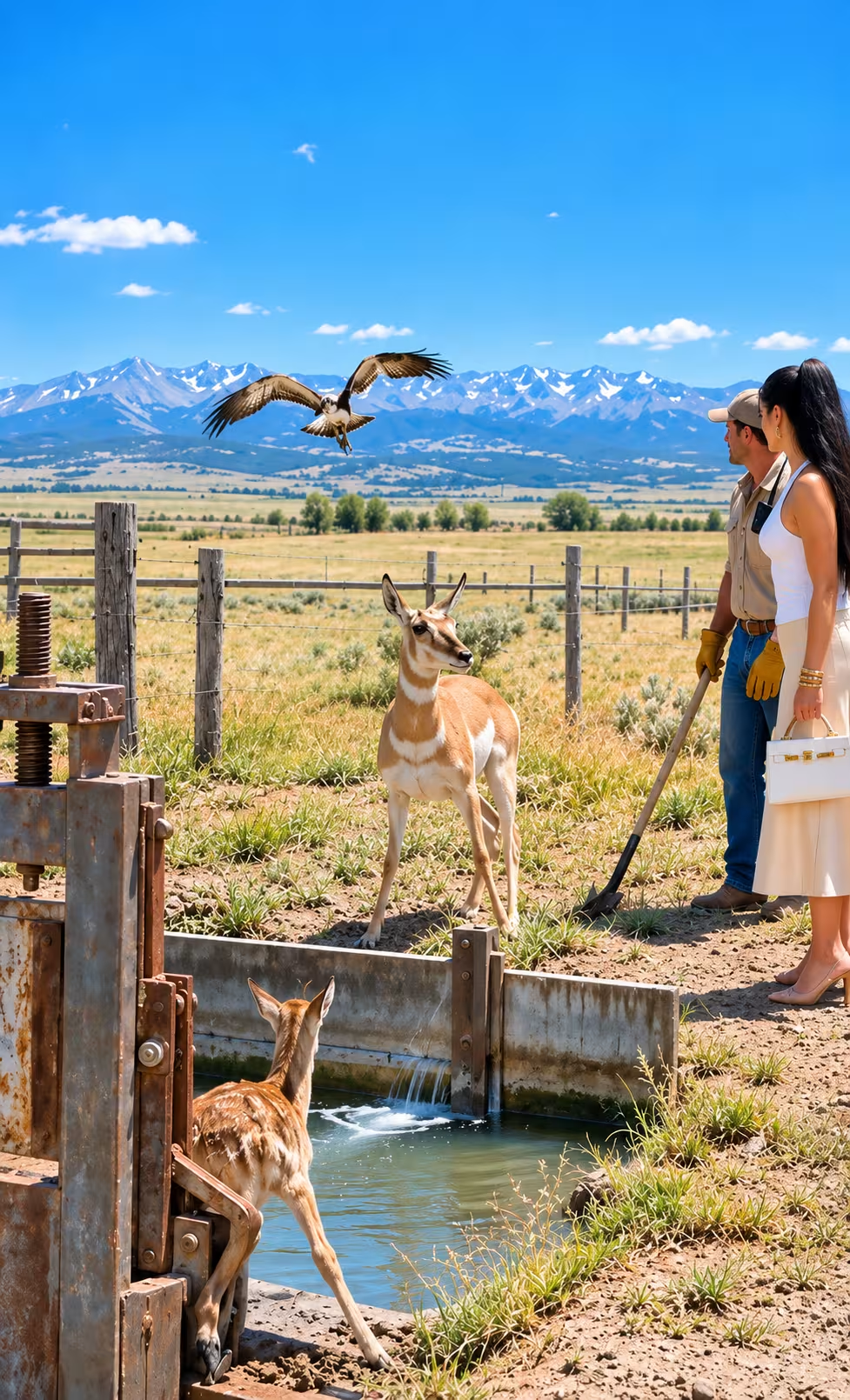
A Young Deer Receives a Second Chance
Sarah checked the fawn for visible injuries.
Its legs appeared intact, although several minor scrapes marked its lower body.
The animal was cold and exhausted from struggling in the water.
Sarah contacted the wildlife rehabilitation center for further guidance.
After discussing the fawn’s condition, she arranged for a qualified wildlife veterinarian to assess it.
Emily helped keep the surrounding area quiet.
Daniel moved his vehicle farther away to reduce unnecessary disturbance.
The veterinarian arrived and examined the young deer.
Fortunately, the fawn showed no evidence of a major injury.
It required time to recover from exhaustion and cold exposure.
The veterinarian recommended brief supervised care before attempting reunification near the original location.
Later that day, the fawn was returned to a sheltered area close to the canal.
The rescue team monitored the site from a distance.
As evening approached, an adult doe emerged from the nearby woodland.
She moved cautiously toward the fawn.
The young deer stood and approached her.
After a brief inspection, the doe guided it toward the trees.
Emily watched the reunion through binoculars, relieved to see the pair disappear together.
A Safer Canal and an Unforgettable Encounter
The following morning, Daniel inspected the section of canal where the fawn had become trapped.
He discovered several places where wildlife could approach the water but had no safe way to climb out.
He reported the problem to the irrigation authority.
The authority arranged for approved wildlife escape ramps at selected locations.
Additional warning signs were also installed near the steepest sections.
Emily returned to the footpath several days later.
The fields looked peaceful again, and the canal flowed quietly between its concrete walls.
She remembered the frightened fawn struggling in the water.
She also remembered the eagle circling above the farmhouse.
No one could determine whether the bird had been responding to the fawn, hunting activity, or something else nearby.
But its calls and movement had drawn Daniel outside at a crucial moment.
This fictional story began when Emily discovered a young deer trapped in an irrigation canal.
The eagle’s activity helped attract the farmer’s attention, allowing him to notice Emily calling for assistance.
Daniel and the wildlife rescue team worked together to free the fawn safely.
After receiving care, the young deer was reunited with an adult doe near the woodland.
For Emily, the most unforgettable moment was watching the rescued fawn follow its mother into the trees, knowing that a chance encounter and the kindness of strangers had helped give it another opportunity to survive.