A Disagreement Among the Market Stalls
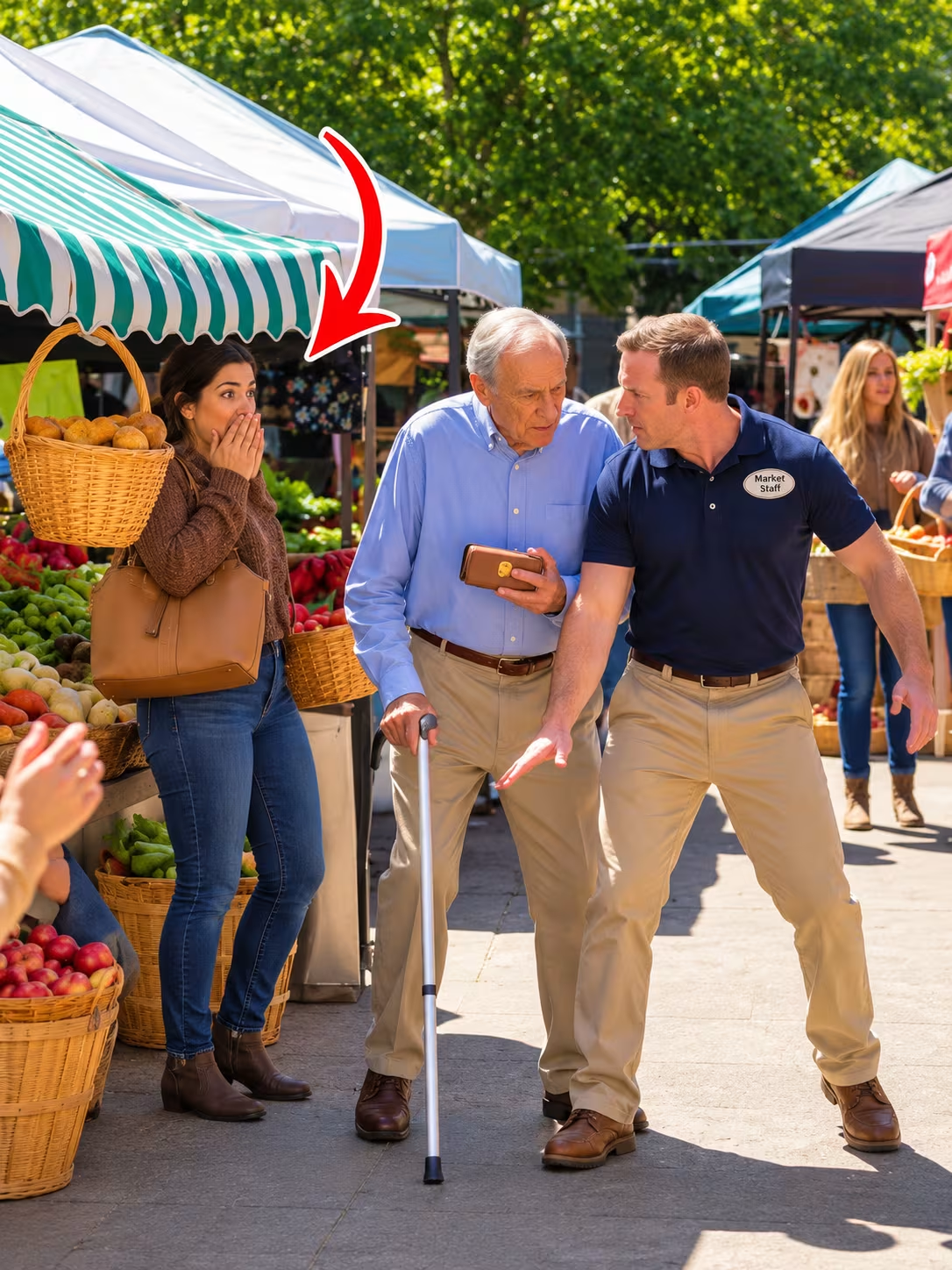
The elderly man stopped beside a wooden produce stand when a younger man stepped into his path.
“Sir, you can’t leave your things here,” the man said sharply.
Eighty-one-year-old Henry Whitmore looked down at the small canvas bag resting beside his walking cane.
“I’m only waiting for someone.”
The man pointed toward the narrow walkway.
“You’re blocking customers. You need to move.”
Henry glanced around.
The morning crowd was growing, but there was still room for people to pass.
“I’ve been standing for quite a while,” he explained. “I just need a moment.”
The man folded his arms.
“Then find somewhere else.”
Henry tightened his grip on his cane.
Before he could answer, another man approached from behind the produce stall.
“Is there a problem here?” he asked.
The younger man turned.
“Yes. This gentleman refuses to move.”
The newcomer looked at Henry, then at the canvas bag.
“Wait a minute,” he said. “I know this man.”
A Familiar Market With Changing Faces
Henry had visited the Riverside Farmers Market almost every Saturday for more than thirty years.
He remembered when the market consisted of only six wooden tables beside an old community hall.
Over time, it had grown into a popular gathering place for local farmers, bakers, and craftspeople.
Henry enjoyed the familiar atmosphere.
He liked talking with vendors and choosing fresh vegetables for his weekly meals.
Since losing his wife several years earlier, these Saturday visits had become an important part of his routine.
He walked more slowly now and relied on a wooden cane for balance.
However, he still valued his independence.
That morning, Henry had arrived earlier than usual.
He was meeting an old friend who had promised to bring him a small box of apples from a nearby orchard.
Henry stopped beside a produce stand where they had agreed to meet.
He placed his canvas shopping bag near his feet and waited.
After several minutes, his legs began to ache.
He leaned lightly against the edge of the stand to rest.
That was when the younger man approached.
A New Vendor Makes an Unfair Assumption
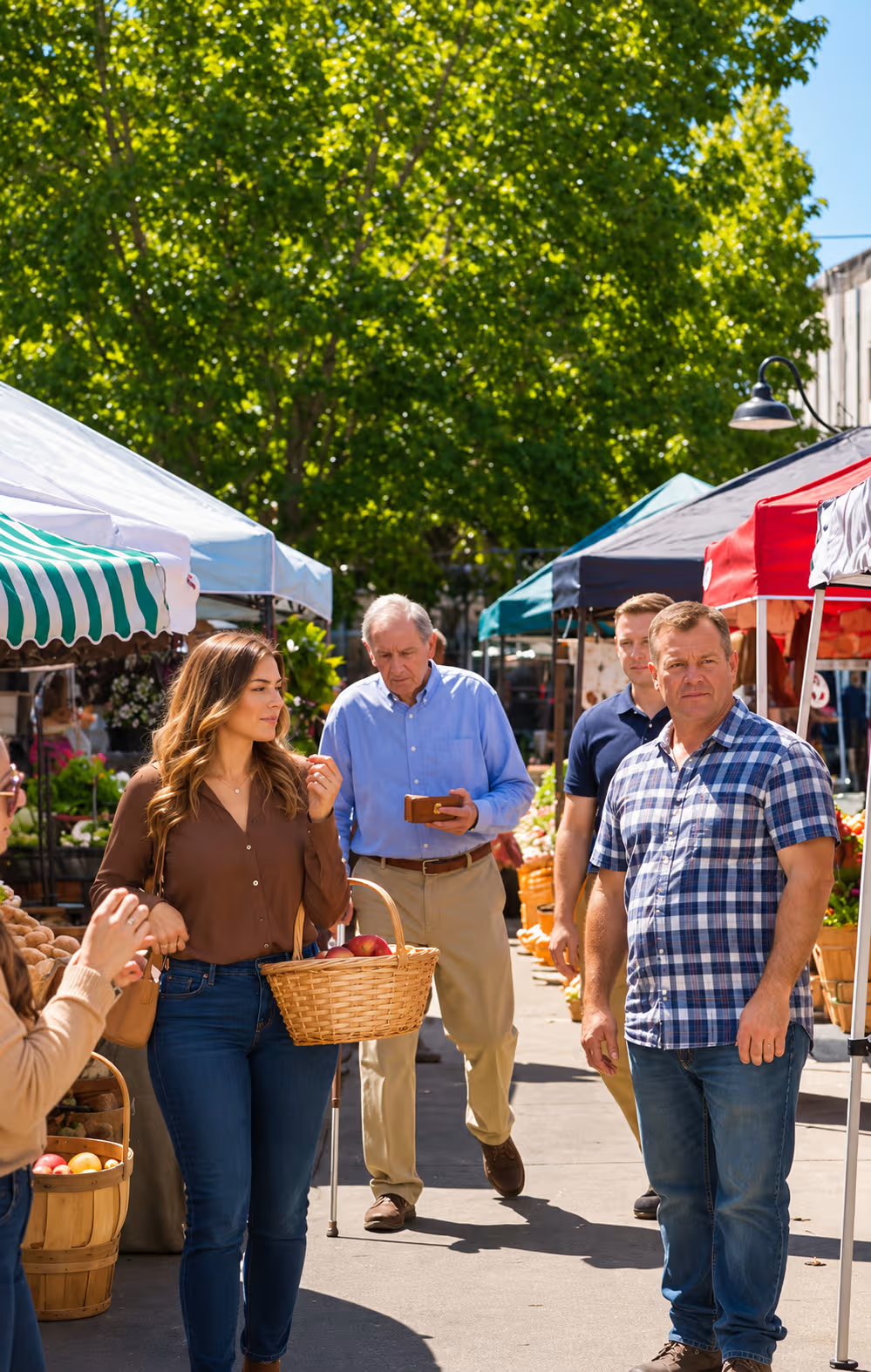
The younger man was Brandon Ellis, a recently hired assistant at one of the market’s busiest stalls.
He had been working there for only two weeks.
The morning had been hectic.
Several deliveries arrived late, and customers were gathering around the produce tables.
Brandon was responsible for keeping the walkway clear.
When he noticed Henry standing beside the stall, he assumed the elderly man was blocking access.
He approached and asked him to move.
Henry explained that he was waiting for someone.
Brandon remained impatient.
He believed that allowing one person to stand near the display would encourage others to gather there.
However, he did not consider that Henry might need a place to rest.
Henry politely asked whether there was a nearby bench.
Brandon pointed toward the far end of the market.
“There’s seating over there.”
Henry looked in that direction.
The benches were several hundred feet away.
He was already tired from walking.
“I don’t think I can make it that far right now,” he admitted.
Brandon sighed.
“Then maybe you shouldn’t be walking around the market.”
Henry’s expression changed.
He had not expected such a dismissive response.
Another Man Arrives and Intervenes
The newcomer was Samuel Price, the owner of the produce stand.
Samuel had known Henry for more than twenty years.
He had been unloading boxes behind the stall when he heard the raised voices.
Samuel immediately recognized Henry.
“Mr. Whitmore, are you all right?”
Henry nodded slowly.
“I’m fine, Samuel. I was just waiting for my friend.”
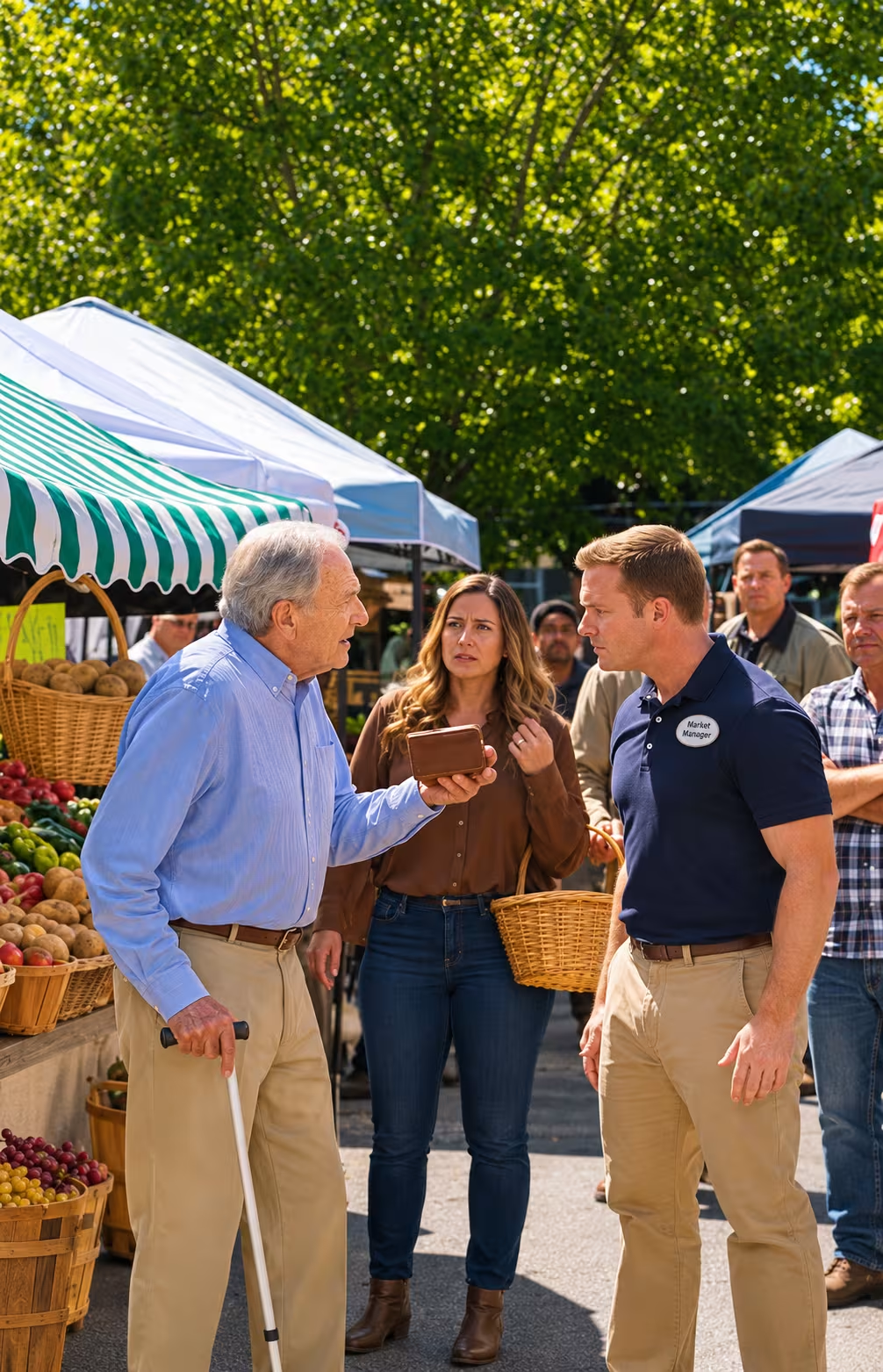
Samuel turned toward Brandon.
“Why are you asking him to leave?”
Brandon explained that he was trying to keep the walkway clear.
Samuel looked at the surrounding area.
There was enough space for customers to pass safely.
He understood that Brandon had been trying to manage the crowd, but his approach had been unnecessarily harsh.
“Keeping the walkway clear is important,” Samuel said. “But we can do that without speaking disrespectfully to someone.”
Brandon looked uncomfortable.
Samuel continued.
“If a customer needs assistance, we should help them find a safe place to rest.”
He then turned back toward Henry.
“Would you like to sit down for a few minutes?”
Henry smiled faintly.
“I’d appreciate that.”
A Simple Gesture Restores the Morning
Samuel brought a sturdy folding chair from behind the stall.
He placed it in a shaded area away from the main walkway.
Before Henry sat down, Samuel checked that the chair was stable.
Henry lowered himself carefully onto the seat.
He rested his cane beside him.
“Thank you, Samuel,” he said.
Samuel offered him a bottle of water.
Henry accepted gratefully.
Brandon stood nearby, watching.
He began to realize that the situation could have been handled differently.
After a moment, he approached Henry.
“I’m sorry for the way I spoke to you.”
Henry looked up.
“I understand that you’re busy,” he replied. “But I wasn’t trying to cause trouble.”
Brandon nodded.
“I know. I should have listened.”
Samuel asked Brandon to help rearrange several produce crates.
They moved the crates farther back, creating additional space near the stall.
The walkway became easier for customers to navigate.
Henry watched the activity with quiet appreciation.
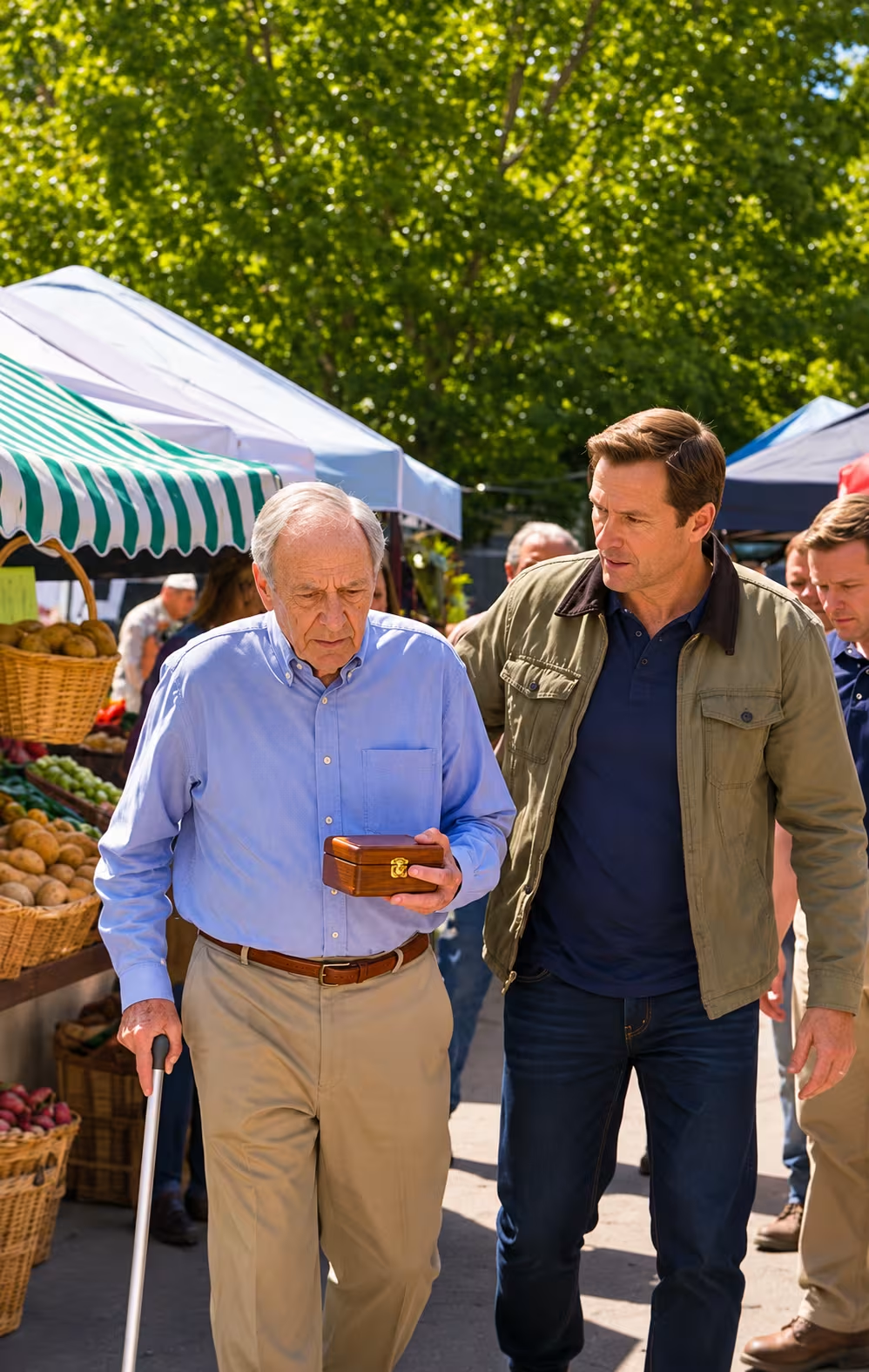
A few minutes later, another elderly man approached carrying a small wooden box.
It was Henry’s friend, Arthur.
An Old Friendship Brings a Pleasant Surprise
Arthur Bennett had known Henry since they were young men working at a local manufacturing plant.
They had remained friends long after retirement.
Arthur approached the chair and smiled.
“There you are. I thought I’d missed you.”
Henry laughed.
“You’re only twenty minutes late.”
Arthur placed the wooden box on the nearby table.
Inside were fresh apples from his daughter’s orchard.
Henry examined them with delight.
“They look wonderful.”
Arthur explained that his daughter had harvested them earlier that week.
She had remembered how much Henry enjoyed homemade apple pie.
Samuel listened to their conversation.
He remembered that Henry’s late wife had once brought apple pies to the market’s community events.
Henry smiled at the memory.
“Margaret used to make enough for half the neighborhood.”
Samuel nodded.
“People still talk about those pies.”
Brandon overheard the conversation.
He had not realized that Henry had such a long history with the market.
Arthur offered to carry the apples while Henry finished resting.
The two friends spent several minutes talking beneath the shade.
A Market Learns From a Small Mistake
Later that morning, Samuel spoke privately with Brandon.
He explained that the market welcomed customers of different ages and abilities.
Keeping pathways clear was important, but staff also needed to recognize when someone required assistance.
Samuel suggested that the market provide additional seating closer to the busiest stalls.
He contacted the market coordinator and described the situation.
The coordinator agreed that more resting areas would benefit older visitors and anyone who had difficulty standing for long periods.
Within the following weeks, several sturdy benches were installed along the market’s main walkway.
Clear signs directed visitors toward the seating areas.
Vendors were also reminded to communicate respectfully when addressing crowding or accessibility concerns.
Henry continued visiting the market on Saturdays.
He still stopped at Samuel’s produce stand.
Brandon began greeting him warmly whenever he arrived.
Sometimes, he offered to carry Henry’s shopping bag to the nearby bench.
Henry appreciated the assistance but always made it clear when he preferred to manage on his own.
Their interactions gradually became friendly.
This fictional story began when a market assistant confronted an elderly man using a walking cane because he believed the man was blocking customers.
The stall owner intervened, clarified the situation, and helped the elderly visitor find a safe place to rest.
The incident encouraged the market to improve accessibility and customer service.
For Henry, the most meaningful part of that Saturday was not the disagreement itself, but the reminder that a familiar community could still offer kindness, friendship, and a welcoming place to rest whenever he needed one.