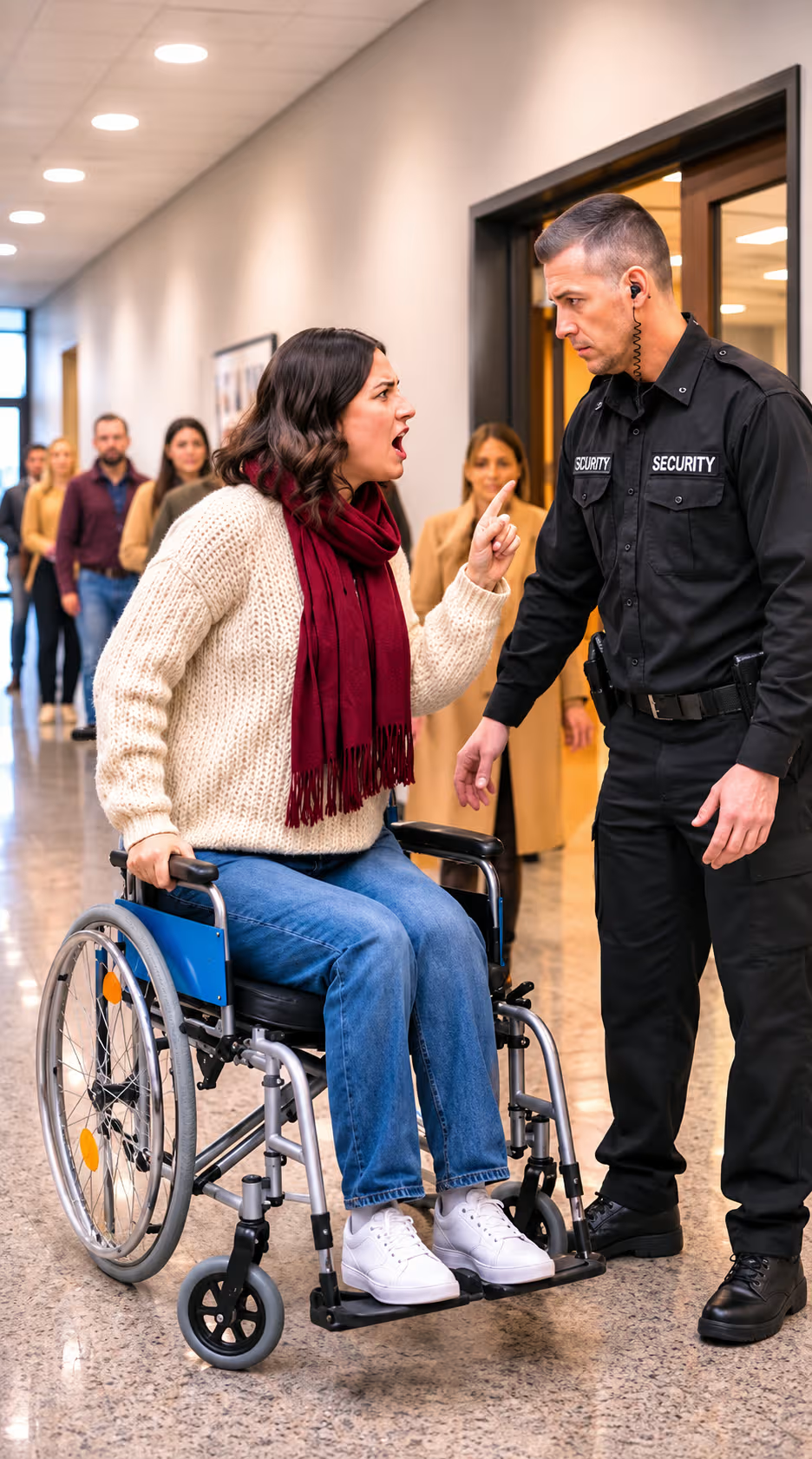
A Difficult Moment Outside the Concert Hall
The security officer examined the woman’s ticket while a growing crowd gathered behind her.
“Your reservation is valid, ma’am, but this entrance has stairs,” he explained.
Thirty-six-year-old Laura Mitchell looked toward the steps leading into the concert hall.
She sat in a wheelchair, holding her phone with the ticket confirmation displayed.
Laura had traveled across the city to attend her daughter’s first professional orchestra performance.
She had reserved an accessible seat weeks earlier and expected a straightforward arrival.
Security officer James Carter checked the ticket again, searching for the correct entrance information.
The printed signs offered no clear directions for wheelchair users.
Laura glanced at her watch as the performance approached.
Then a woman wearing a venue identification badge stepped through the doors.
She noticed the conversation and immediately approached them.
An Evening Laura Had Carefully Planned
Laura’s daughter, Sophie, had spent years preparing for a career in music.
At twenty-two, she had recently joined a regional orchestra as a violinist.
That evening marked her first performance in the city’s historic concert hall.
Laura had promised to attend, regardless of the difficulties involved.
She purchased her ticket as soon as reservations became available.
The booking confirmation identified a wheelchair-accessible seating space near the front of the auditorium.
However, it provided only the building’s main street address.
Laura assumed the accessible entrance would be clearly marked upon arrival.
She arranged transportation and left home early to avoid unexpected delays.
Her driver dropped her near the main doors shortly before seven.
The building’s impressive stone staircase immediately presented a problem.
Laura searched the surrounding area for a ramp but found none.
James noticed her looking around and approached to offer assistance.
He checked her reservation and confirmed that her seat was correctly assigned.
Unfortunately, he had not been informed about recent changes to the building’s accessibility arrangements.
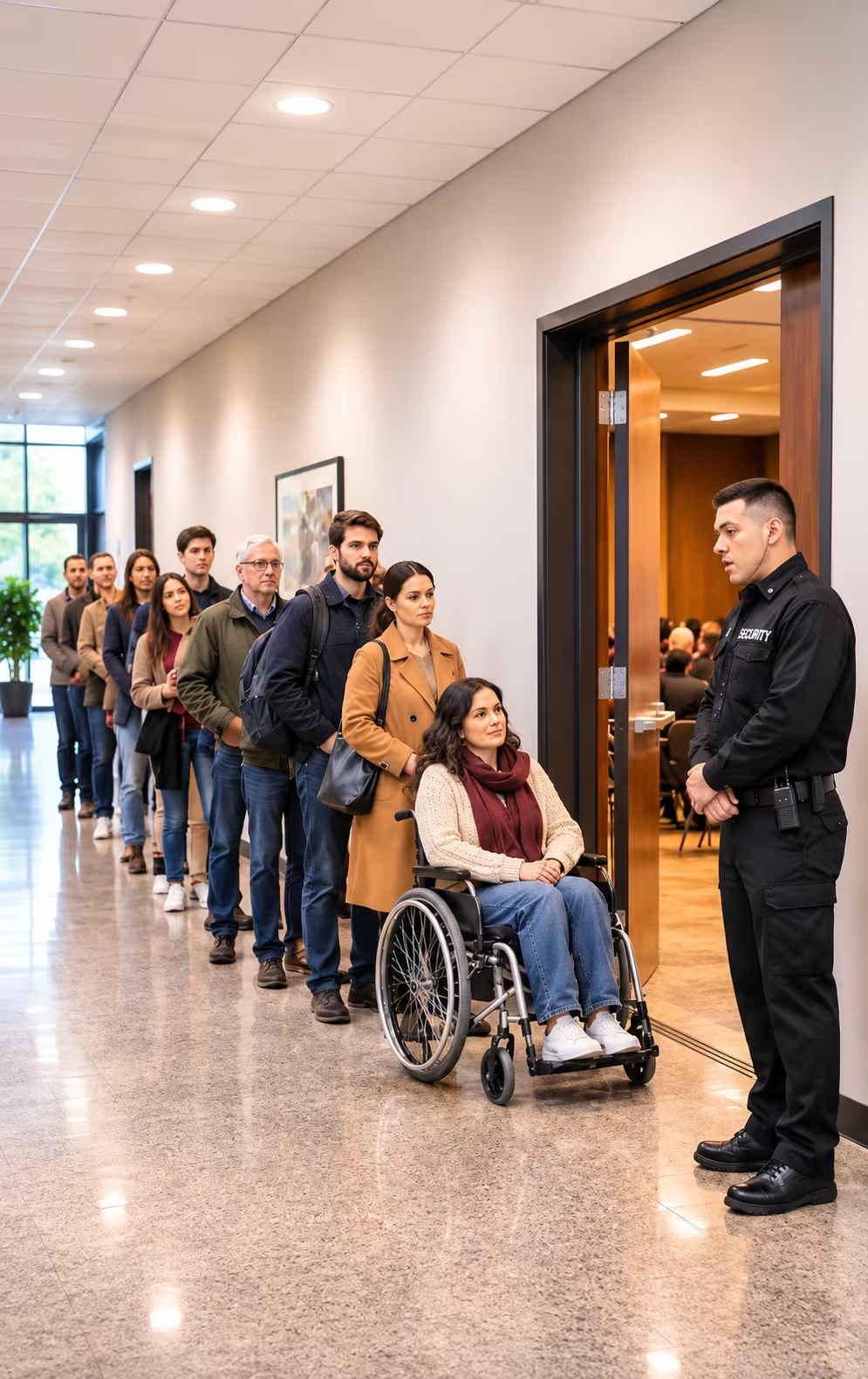
The Employee Recognizes the Problem
The woman approaching from the entrance was Emily Foster, the concert hall’s guest services supervisor.
She introduced herself and asked whether Laura needed help reaching the auditorium.
Laura explained that she had a valid accessible reservation but could not locate the appropriate entrance.
Emily examined the ticket and immediately recognized the seating section.
She explained that wheelchair users normally entered through a side doorway connected to an elevator.
However, the usual entrance had been temporarily closed for maintenance.
A replacement route had been established through the adjoining cultural center.
Laura asked why the change had not appeared in her booking confirmation.
Emily acknowledged that the venue should have provided updated instructions.
James explained that he had been assigned to the main entrance without receiving the revised accessibility information.
Emily thanked him for checking rather than directing Laura toward an uncertain route.
She contacted the building operations team to confirm that the alternative entrance was available.
The response came quickly.
The accessible route was operating, but an employee needed to unlock the connecting corridor.
Emily offered to escort Laura personally.
A Second Obstacle Along the Way
Emily guided Laura along the sidewalk toward the adjoining cultural center.
James remained at the main entrance to continue checking arriving guests.
The alternative entrance was located around the corner beneath a covered walkway.
Laura followed Emily toward a wide set of automatic doors.
However, the entrance did not open when Emily approached the sensor.
She tried the accessibility button, but nothing happened.
Emily contacted the cultural center’s reception desk using her radio.
A maintenance employee explained that the automatic door mechanism had been temporarily disabled.
The nearby manual entrance was wide enough for Laura’s wheelchair, but it required staff assistance.
Emily requested that an employee open and secure the door.
Laura waited beneath the covered walkway while they resolved the issue.
She asked whether the orchestra had already started.
Emily checked the time and explained that guests were still being seated.
Laura remained concerned about missing Sophie’s opening performance.
A cultural center employee soon arrived with the appropriate access key.
He opened the manual doorway and secured it safely.
Emily checked the clear passage before inviting Laura inside.
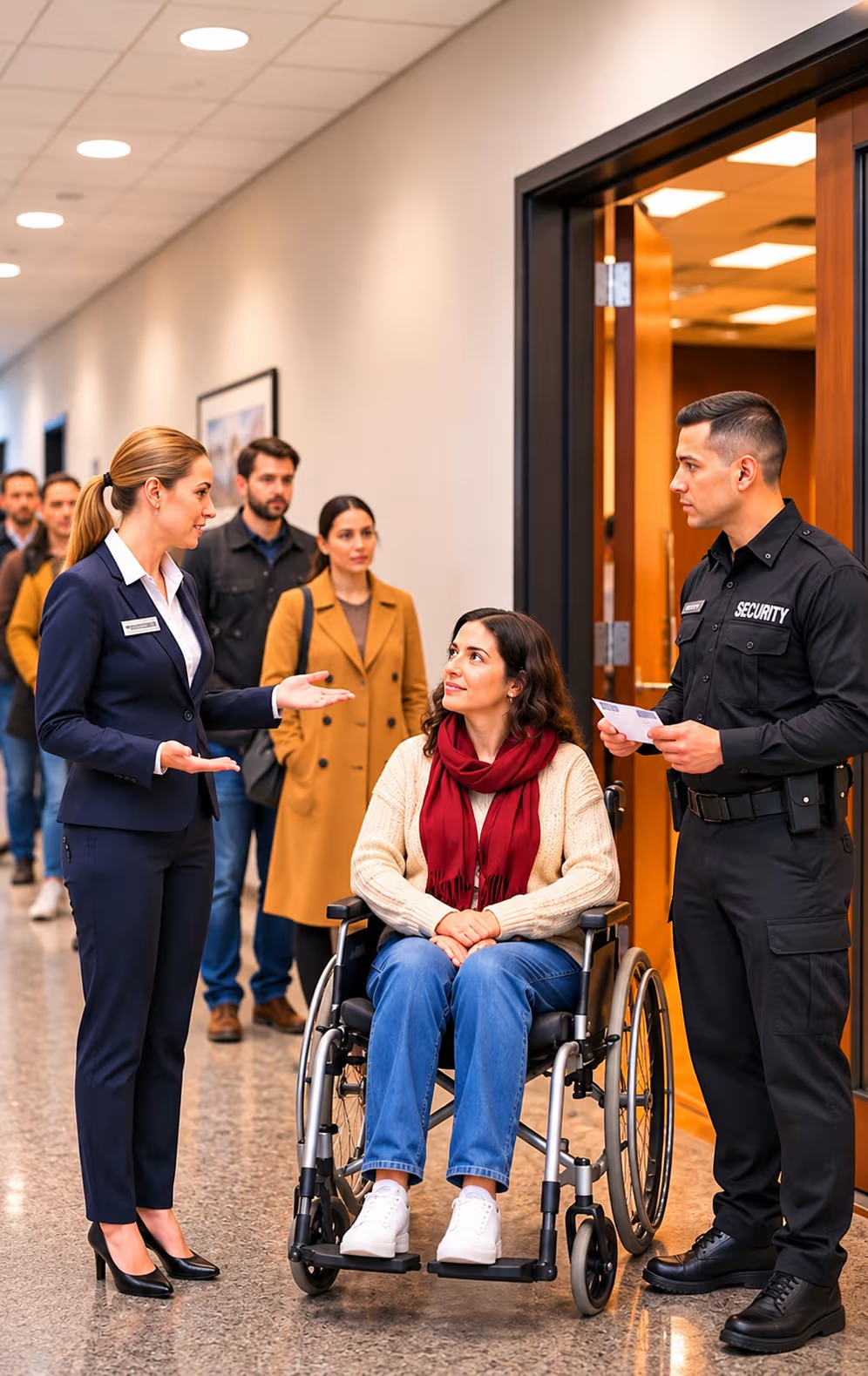
Emily Guides Laura to the Accessible Entrance
Inside the cultural center, Emily led Laura toward a connecting corridor.
The passage was level, brightly lit, and wide enough for her wheelchair.
At the far end stood an elevator serving the concert hall’s auditorium level.
Emily pressed the call button and waited beside Laura.
When the elevator arrived, she allowed Laura to enter first.
They traveled to the designated floor without difficulty.
The doors opened near the auditorium’s accessible seating section.
Another employee, Marcus Reed, was waiting to verify the final seating arrangements.
He checked Laura’s ticket and confirmed her reserved space.
Emily explained the entrance difficulties and asked Marcus to ensure Laura could reach her seat comfortably.
Marcus opened the auditorium door and guided her toward the accessible seating area.
Laura recognized the stage immediately.
Several musicians were already seated, adjusting their instruments before the performance.
Marcus showed her the reserved wheelchair space and confirmed that the surrounding aisle remained clear.
Laura positioned herself facing the orchestra.
Emily asked whether she needed anything else before the concert began.
Laura shook her head and thanked her for staying throughout the journey..

A Performance Worth the Journey
The auditorium lights dimmed several minutes after Laura reached her seat.
She watched the musicians take their places beneath the stage lighting.
Then Sophie entered with the violin section.
Laura immediately recognized her daughter’s familiar posture and careful movements.
Sophie glanced toward the audience before sitting down.
For a brief moment, her eyes found Laura near the front.
She smiled, visibly relieved to see her mother.
Laura returned the smile and raised one hand.
The conductor appeared, and the audience became quiet.
As the orchestra began playing, Laura forgot the confusion outside the building.
She remembered Sophie’s earliest violin lessons in their small living room.
There had been difficult rehearsals, disappointing auditions, and countless hours of practice.
Now Sophie was performing alongside professional musicians.
During the interval, Laura sent her daughter a short message.
She explained that she had arrived safely and was enjoying every moment.
Sophie replied with a simple expression of gratitude.
After the concert, Marcus returned to assist Laura with the accessible exit route.
Emily was waiting near the connecting corridor.
A Better Experience for Future Visitors
The following morning, Emily reported the entrance problems to the venue’s operations manager.
She explained that Laura’s booking confirmation had omitted essential accessibility information.
The temporary entrance arrangements had also not been communicated to all security personnel.
James confirmed that clearer instructions would have helped him direct Laura immediately.
The manager requested an immediate review of the venue’s accessibility procedures.
Staff updated the online booking instructions to identify the correct accessible entrance.
Temporary directional signs were installed near the main doors.
The cultural center also repaired its automatic entrance mechanism.
Employees received updated guidance about accessible routes during maintenance closures.
Several days later, Laura sent a message thanking the staff who had helped her.
She explained that attending Sophie’s performance had been deeply important.
She also encouraged the venue to provide clearer information for future visitors.
Emily responded personally and described the improvements already completed.
This fictional story followed a mother determined to attend her daughter’s first professional concert.
James identified the entrance problem, while Emily coordinated a safe alternative route.
Their assistance allowed Laura to reach her seat before the orchestra began.
The venue’s subsequent changes helped reduce similar difficulties for other visitors.
Laura remembered the evening not for its obstacles, but for the moment Sophie saw her in the audience.
For Laura, reaching the concert hall meant more than attending a performance—it meant keeping a promise to her daughter when that promise mattered most.