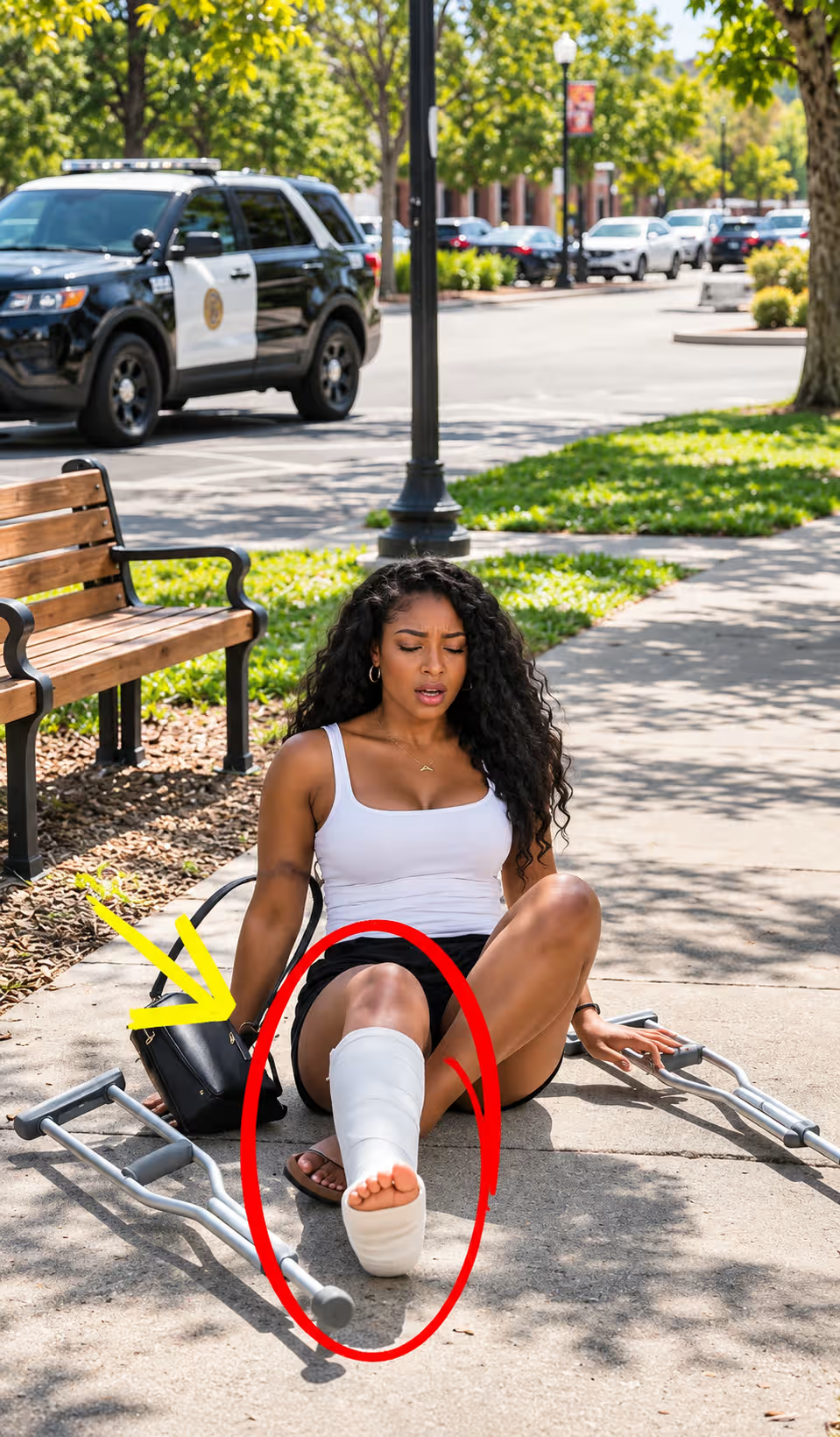
The woman stopped beside the shopping center entrance, gripping her crutches as she struggled to take another step.
Thirty-six-year-old Emily Carter had a cast on her right leg and needed to collect several essential items.
Her doctor had instructed her not to put weight on the injured leg.
But the distance between the parking area and the pharmacy was greater than she expected.
Emily leaned against a concrete pillar, trying to regain her balance.
A police officer walking past noticed her difficulty.
Officer Daniel Foster approached and asked whether she needed assistance.
Emily explained that she had hoped to borrow a mobility scooter from the shopping center.
Unfortunately, she had been unable to locate one.
Daniel looked toward the entrance and offered to help her find an appropriate scooter.
An Injury Disrupts an Ordinary Routine
Emily worked as an elementary school teacher and lived with her husband and daughter.
Two weeks earlier, she had fractured her ankle after slipping on wet steps outside her home.
The injury required immobilization, and her doctor had instructed her to use crutches.
Emily was gradually learning to manage everyday activities without placing weight on her injured leg.
Her husband, Michael, had been helping with shopping and household responsibilities.
However, he was working an extended shift that afternoon.
Emily needed to collect a prescription and several personal items.
She arranged transportation to Brookfield Shopping Center, where the pharmacy was located.
Before leaving, she checked whether the center offered mobility assistance.
Its website mentioned wheelchairs and electric scooters for visitors who needed them.
Emily assumed she could request one near the entrance.
When her ride dropped her off, she carefully stepped onto the sidewalk.
The automatic doors were only a short distance away.
Nevertheless, moving with crutches required more effort than she anticipated.
By the time she reached the entrance, her arms were aching.
A Difficult Search for Mobility Assistance
Emily entered the shopping center and approached the information desk.
She asked whether an electric mobility scooter was available.
The employee explained that the scooters were normally stored near the customer service office.
Unfortunately, the office was located at the opposite end of the entrance corridor.
Emily asked whether someone could bring a scooter to her.
The employee attempted to contact the mobility assistance team.
After several minutes, nobody answered.
Emily decided to wait beside the entrance.
But the nearby benches were occupied, and she struggled to remain standing comfortably.
She moved toward a concrete pillar where she could steady herself.
Her crutches slipped slightly against the smooth floor.
Emily caught her balance before falling.
She felt embarrassed as several shoppers passed without noticing her difficulty.
She considered calling her husband.
However, she knew he could not leave work immediately.
Emily wondered whether she should abandon the trip and return home.
Then she noticed a uniformed police officer walking through the entrance.
The Police Officer Notices Her Struggle
Daniel was visiting the shopping center as part of a routine community patrol.
He had stopped to speak with a security supervisor about pedestrian safety near the parking area.
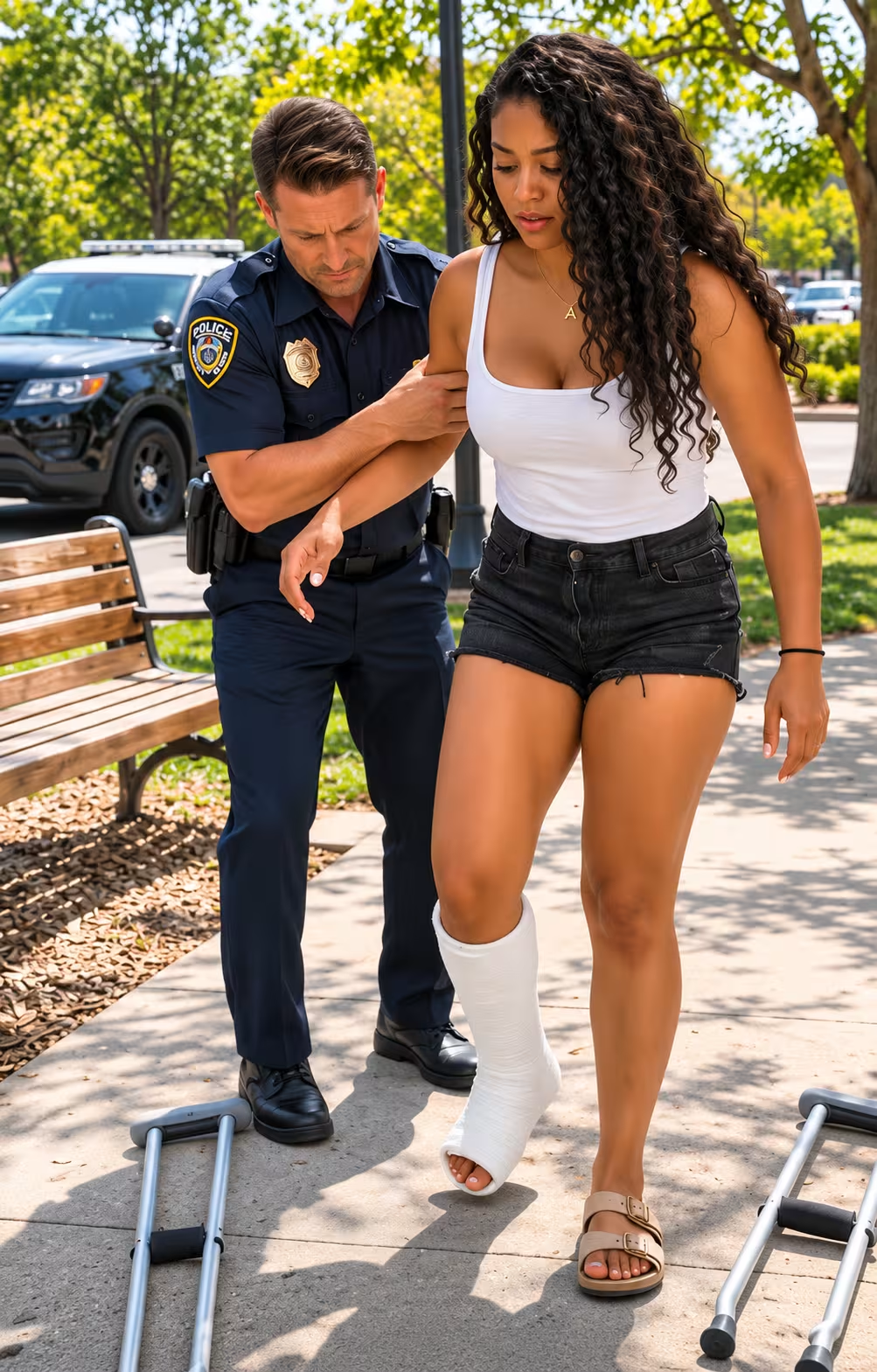
As he approached the main entrance, he noticed Emily leaning heavily against her crutches.
She appeared uncomfortable and was repeatedly shifting her weight.
Daniel walked toward her and introduced himself.
He asked whether she was feeling unwell or needed assistance.
Emily explained that her leg was fractured and that she was trying to obtain a mobility scooter.
She told him about the unanswered request at the information desk.
Daniel asked whether she had somewhere safe to sit.
Emily pointed toward the occupied benches.
He approached the customer service employee and requested a chair.
Within moments, an employee brought a sturdy chair from a nearby office.
Emily sat down carefully and thanked them.
Daniel asked whether she wanted medical assistance.
She explained that she was not experiencing new symptoms.
Her main problem was the distance she needed to travel while using crutches.
Daniel offered to contact the shopping center’s accessibility coordinator.
Emily gladly accepted.
A Practical Solution Takes Shape
Daniel spoke with the customer service supervisor, Rachel Morgan.
He explained that Emily needed a mobility scooter to reach the pharmacy.
Rachel checked the equipment register.
Two scooters were currently in use, while a third was stored in a maintenance room.
She contacted the employee responsible for checking and preparing mobility equipment.
The employee confirmed that the remaining scooter had been charged and inspected that morning.
Rachel arranged for it to be brought to the entrance.
Daniel returned to Emily and explained the situation.
He told her that a scooter should arrive shortly.
Emily looked relieved.
She admitted that she had underestimated how difficult the trip would be.
Daniel reassured her that requesting assistance was sensible.
He also asked whether she had previously used an electric mobility scooter.
Emily explained that she had not.
Daniel suggested waiting for a staff member to demonstrate its controls.
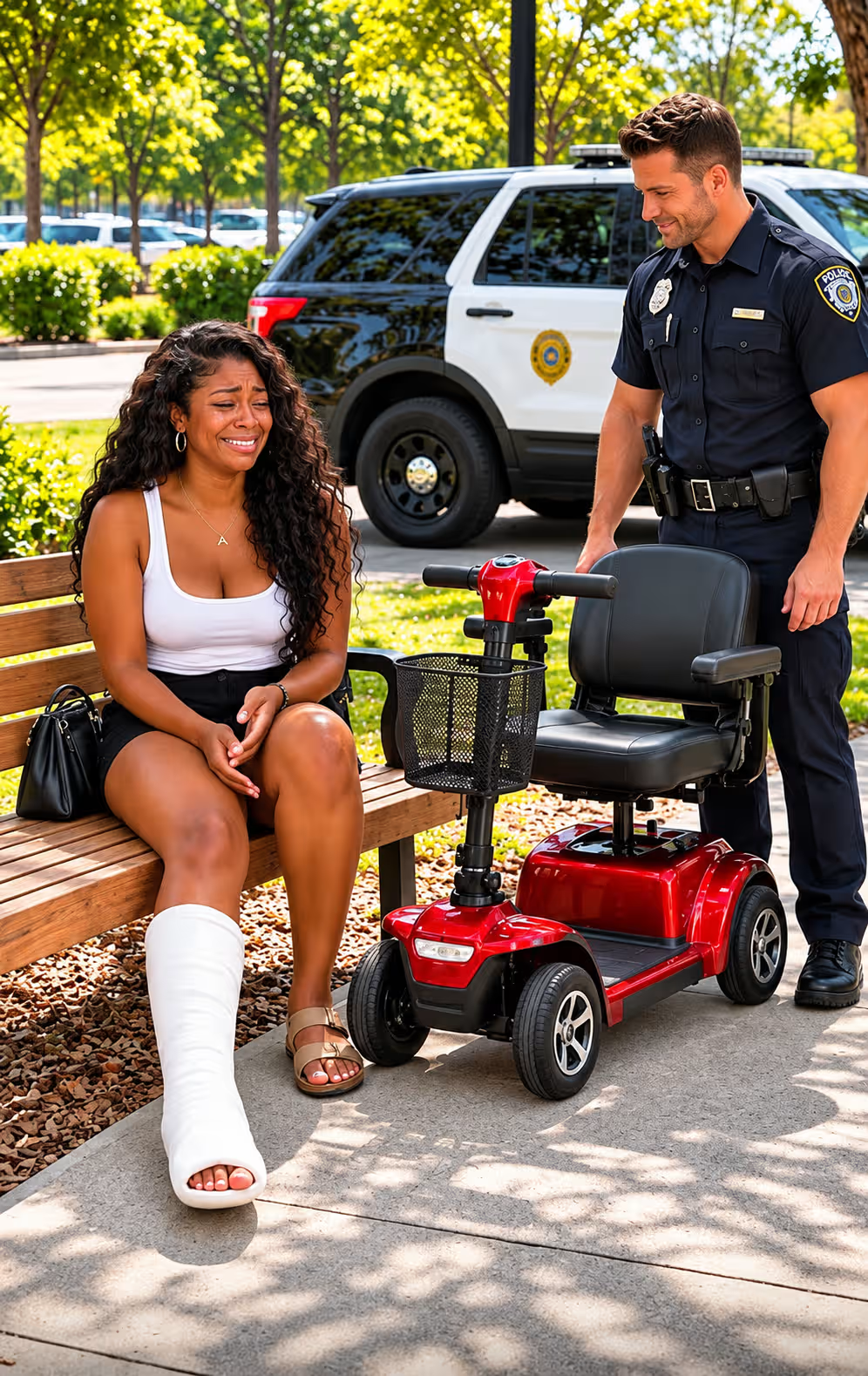
A few minutes later, a shopping center employee arrived with a compact electric scooter.
The employee positioned it beside Emily’s chair and explained how to operate it.
Learning to Use the Mobility Scooter
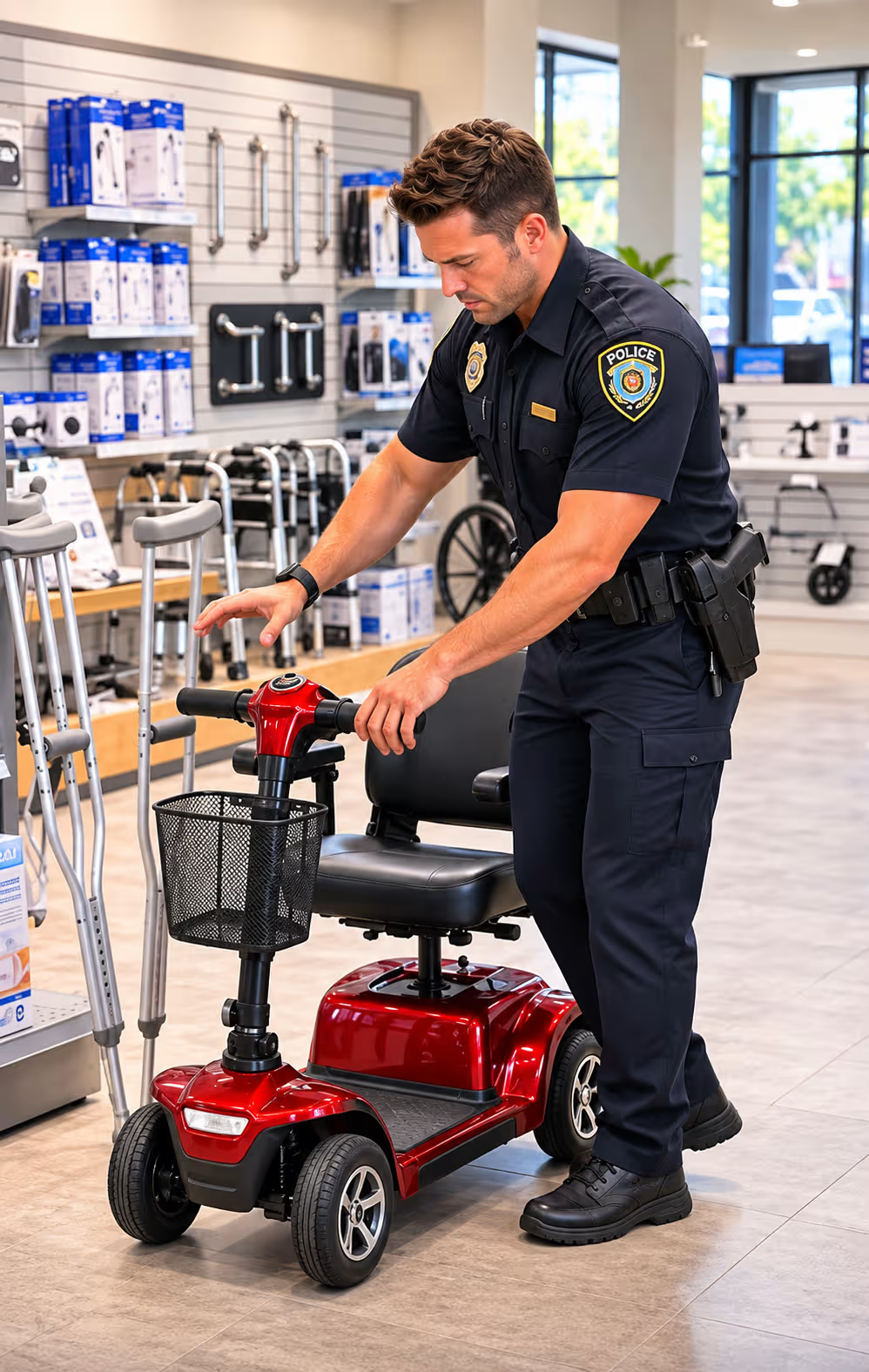
The scooter had a padded seat, adjustable armrests, and simple steering controls.
The employee demonstrated the speed adjustment and braking system.
He explained that releasing the movement control would bring the scooter to a stop.
Emily listened carefully and asked several questions.
She wanted to understand how to turn safely in crowded corridors.
The employee recommended using the lowest speed setting.
He also showed her where to park the scooter when entering the pharmacy.
Daniel remained nearby while Emily prepared to transfer.
She positioned her crutches within reach and followed the employee’s instructions.
With assistance offered and accepted, she moved carefully from the chair onto the scooter.
She kept her injured leg supported without placing weight on it.
A Small Problem Requires Additional Help
Before leaving the entrance area, Emily noticed that her crutches were difficult to secure.
She worried they might fall while the scooter was moving.
Rachel brought an approved carrying attachment designed for mobility aids.
The employee checked that the crutches were properly secured.
Emily then explained that she needed to visit the pharmacy and a small grocery store.
Rachel showed her an accessible route on the shopping center map.
The route avoided narrow passages and included elevators where necessary.
Daniel offered to accompany her as far as the pharmacy entrance.
Emily accepted because she was still unfamiliar with the scooter.
They traveled slowly through the main corridor.
Several shoppers moved aside as Emily approached.
At the pharmacy, Daniel helped her identify a suitable place to stop.
The Shopping Center Reviews Its Assistance Procedures
Later that afternoon, Rachel reviewed the difficulties Emily had experienced.
She discovered that the mobility assistance telephone had been temporarily disconnected during maintenance.
The information desk employee had not been informed.
As a result, Emily’s original request had gone unanswered.
Rachel contacted the shopping center manager and explained the problem.
They arranged for the telephone connection to be restored.
The manager also introduced a backup communication procedure for accessibility requests.
Employees received instructions for arranging mobility equipment without requiring visitors to walk to another office.
Additional seating was placed near the main entrance.
Rachel also reviewed the availability of mobility scooters during busy periods.
She recommended clearer signs explaining how visitors could request assistance.
The management team approved the changes.
Meanwhile, Emily completed her pharmacy visit and collected her groceries.
An Unexpected Thank-You at the Police Station
Several days later, Emily contacted the local police department.
She wanted to thank Daniel for helping her at the shopping center.
The receptionist explained how she could submit a message of appreciation.
Emily wrote a short letter describing the incident.
She explained that Daniel had listened carefully and helped her obtain practical assistance.
He had not treated her situation as an inconvenience.
Instead, he worked with shopping center employees to find an appropriate solution.
The department shared the message with Daniel.
He appreciated the gesture and replied through the department’s community office.
He explained that helping residents access available services was an important part of community policing.
Emily also contacted Rachel to thank the shopping center staff.
Rachel informed her about the improved assistance procedures.
Emily was pleased that her experience had encouraged practical changes.
Over the following weeks, her ankle gradually healed under medical supervision.
She continued following her doctor’s instructions and attended scheduled appointments.
When she eventually returned to the shopping center, she noticed the new seating and accessibility signs.
For Emily, the most meaningful part of that afternoon was discovering that a simple act of kindness could restore her independence when an ordinary journey had become unexpectedly difficult.