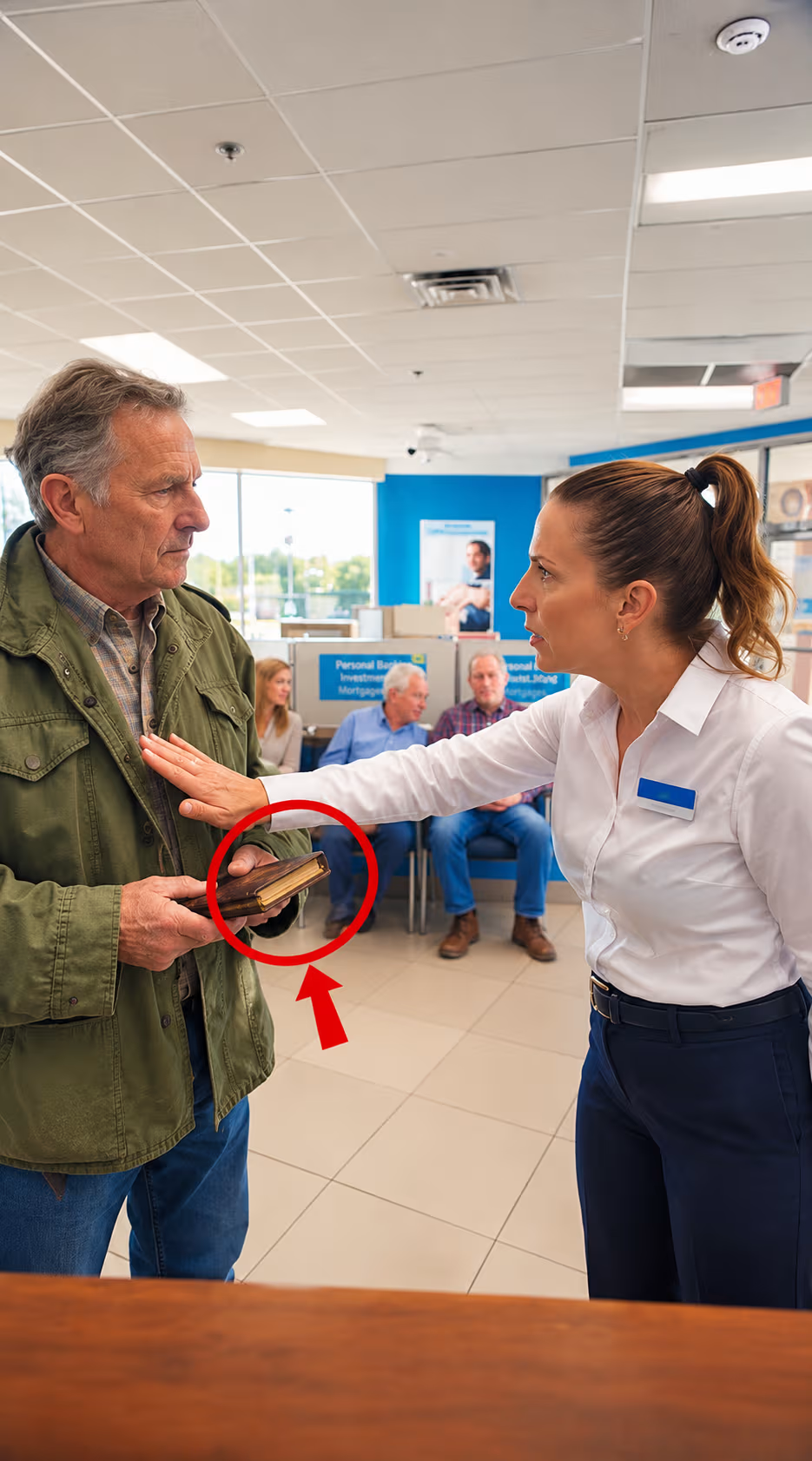
The small silver watch had stopped working, but the elderly man refused to leave it behind.
Seventy-two-year-old Thomas Bennett stood at a department store service counter, holding the watch carefully in his palm.
Across from him, customer service employee Emily Carter examined the worn leather strap and scratched metal case.
Thomas explained that the watch had belonged to his father for more than fifty years.
He had brought it to the store hoping someone could identify why it had stopped.
Emily listened as he described the watch’s history and its recent problems.
Although the store sold modern watches, she was uncertain whether its repair department handled older mechanical models.
Rather than dismiss his request, she contacted a colleague with experience examining vintage timepieces.
Several minutes later, another employee approached the counter.
He noticed the watch in Thomas’s hand and asked permission to take a closer look.
A Watch With More Than Monetary Value
Thomas had received the watch from his father shortly before graduating from college.
His father, William Bennett, worked as a railway maintenance supervisor for nearly thirty years.
He wore the watch every working day and carefully wound it each morning.
When Thomas left home for his first job, William gave him the timepiece as a graduation present.
The gift came with a simple reminder to value time spent with family.
Thomas remembered those words long after his father passed away.
For decades, the watch remained in a wooden box beside his bedroom dresser.
He occasionally wore it during family celebrations and important personal occasions.
Recently, Thomas decided to wear it to his granddaughter’s upcoming wedding.
However, when he attempted to wind the watch, its hands barely moved.
He tried again the following morning, but the mechanism remained still.
Concerned about damaging something irreplaceable, Thomas stopped attempting to operate it.
A neighbor suggested visiting the department store’s watch department.
Thomas brought the timepiece in a protective pouch, hoping someone could offer guidance.
He did not expect a complete restoration, only an explanation of what might be wrong.

A Patient Conversation With the Employee
Emily greeted Thomas when he approached the service counter shortly after opening.
She asked whether he wanted a battery replacement or another type of repair.
Thomas explained that the watch was mechanical and required winding.
Emily examined the case without opening it.
She noticed fine scratches around the edges and a small engraving on the back.
The inscription contained William’s initials and the year he received the watch.
Thomas explained that the engraving had been added by his father’s coworkers.
Emily recognized that the timepiece carried considerable sentimental importance.
She checked the store’s repair information but found limited details about vintage mechanical watches.
The listed services mainly covered batteries, straps, and adjustments to modern models.
Thomas appeared disappointed but thanked her for checking.
Before he could put the watch away, Emily remembered another employee.
James Miller worked in the store’s jewelry department and collected older watches.
He occasionally helped customers identify unusual timepieces and suitable repair specialists.
Emily asked Thomas whether he would like James to examine the watch.
Thomas agreed, provided the inspection would not involve opening or altering it.
Emily contacted James and invited him to the service counter.
Another Employee Recognizes the Timepiece
James arrived carrying a small magnifying loupe and a clean examination cloth.
He introduced himself and asked Thomas about the watch’s history.
Thomas explained that it had belonged to his father and had recently stopped running.
James asked permission to hold the timepiece while examining its exterior.
Thomas carefully placed it on the cloth covering the counter.
James studied the dial, winding crown, and engraved case.
He recognized the general design as a mid-twentieth-century mechanical wristwatch.
However, he explained that identifying its exact model would require further research.
Emily watched as James gently inspected the crown without forcing it.
He noticed that the winding mechanism offered unusual resistance.
James immediately stopped and returned the watch to the cloth.
He explained that forcing the crown could damage internal components.
Thomas admitted that he had attempted to wind it several times at home.
James reassured him that the exterior inspection revealed no obvious catastrophic damage.
Nevertheless, the internal mechanism could not be assessed without specialized equipment.
He recommended consulting a qualified watchmaker experienced with vintage mechanical movements.
Thomas appreciated the careful explanation but had one important question.
Could the watch be repaired without losing its original appearance?

A Decision About Preserving the Past
James explained that vintage watch restoration involved several possible approaches.
Some owners preferred replacing worn parts to restore reliable operation.
Others prioritized preserving original components, even when that limited functionality.
Thomas said he wanted the watch to remain as close as possible to its original condition.
The scratches and worn leather strap reminded him of his father’s daily life.
He did not want those familiar details polished away unnecessarily.
Emily suggested writing down his preferences before arranging a professional assessment.
James agreed and helped Thomas prepare a short description of the watch.
They recorded its visible condition, engraving, and the difficulty winding the crown.
James also recommended photographing the timepiece before sending it for examination.
Thomas used his phone to capture the front, back, and sides.
Emily helped him check that the engraving was clearly visible.
James then provided contact information for an independent watch repair specialist.
He explained that the specialist would need to inspect the movement before discussing costs or repairs.
Thomas asked whether he should replace the strap before the wedding.
James suggested waiting until the watchmaker had examined the entire timepiece.
That way, any changes could be considered together rather than made separately.

A Small Detail Brings Back a Memory
As Thomas prepared to leave, James noticed something unusual about the watch’s back.
The engraved initials were accompanied by a tiny symbol resembling a railway wheel.
Thomas leaned closer and smiled when James pointed it out.
He had seen the symbol many times but never considered its meaning.
His father had worked with a small team responsible for maintaining railway equipment.
Thomas remembered a photograph showing several coworkers beside an old locomotive.
Each man wore a similar symbol on his uniform badge.
He wondered whether the engraving had been inspired by that workplace emblem.
James explained that the connection was possible but could not be confirmed from the watch alone.
Thomas appreciated that he did not present the idea as a certainty.
Emily asked whether Thomas still owned the old photograph.
He said it was stored in a family album at home.
The conversation reminded him that his granddaughter had recently asked about family history.
Thomas decided to bring the photograph to the wedding celebration.
Even if the watch remained unrepaired, its story could still be shared.
James carefully returned the timepiece to its protective pouch.
An Important Gift Finds New Meaning
The following week, Thomas visited the recommended watchmaker for a professional assessment.
The specialist examined the movement and identified components requiring cleaning and servicing.
He explained the available repair options and their estimated costs.
Thomas chose a conservative service that preserved the watch’s original exterior.
The work required additional time, so the watch was not ready immediately.
Thomas accepted the delay because preserving the timepiece mattered more than rushing the repair.
On his granddaughter’s wedding day, he carried the watch inside its protective pouch.
He also brought the old railway photograph and a handwritten account of his father’s life.
During the reception, his granddaughter asked about the watch.
Thomas showed her the engraving and explained why William had given it to him.
She listened carefully as he described her great-grandfather’s work and family traditions.
The conversation became one of Thomas’s favorite memories from the celebration.
Several weeks later, the watchmaker completed the agreed service.
Thomas returned to the department store and thanked Emily and James for their guidance.
Both employees were pleased that he had found someone qualified to examine the timepiece.
In this fictional story, a routine service counter conversation helped preserve a meaningful family possession.
The employees’ patience gave Thomas the information he needed without promising an uncertain repair.
Thomas eventually heard the watch ticking again, but the memory he treasured most was sharing his father’s story with another generation.