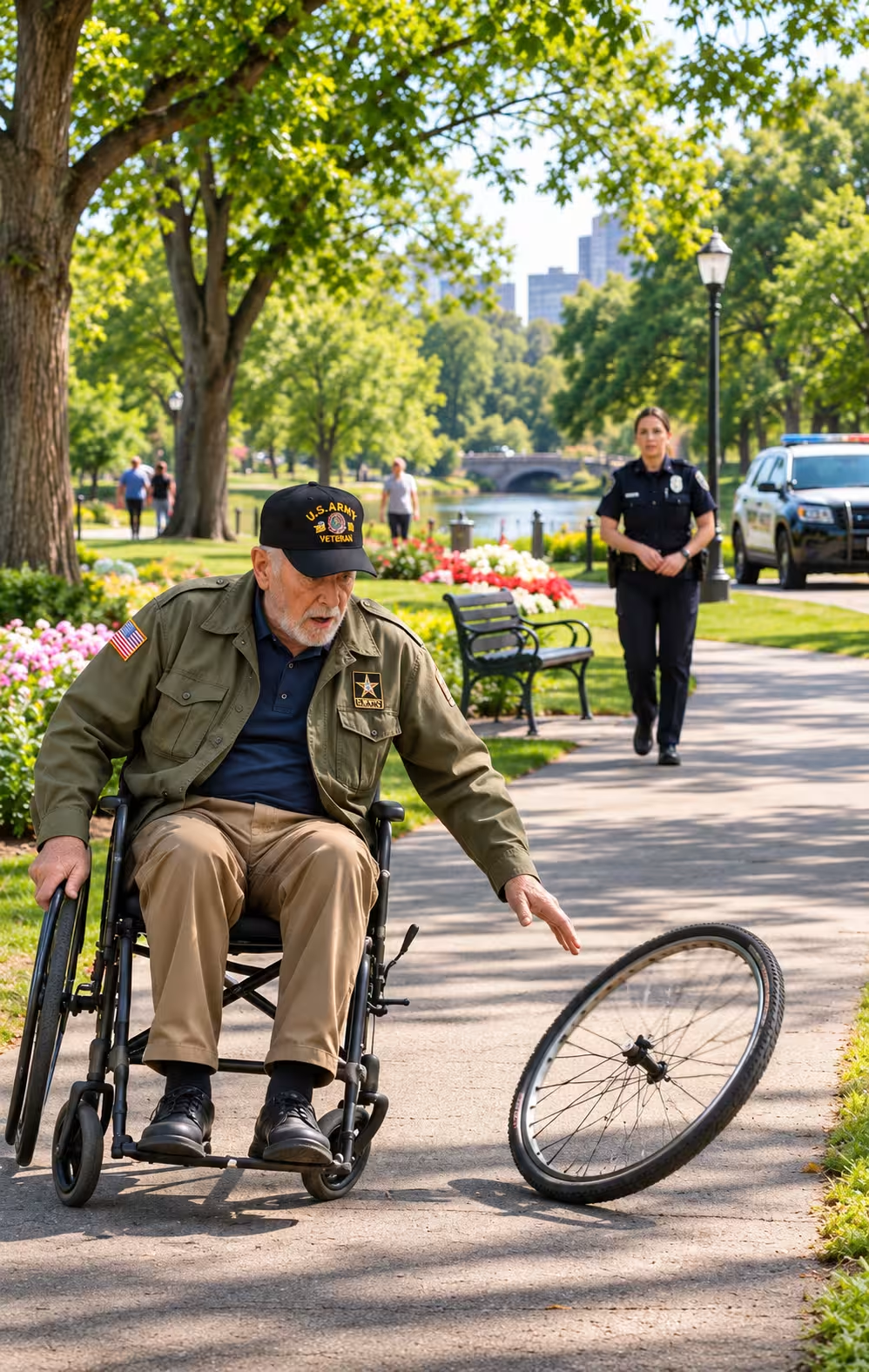
The wheelchair suddenly tilted sideways as one of its wheels detached and rolled across the paved pathway.
Seventy-eight-year-old Arthur Coleman gripped the armrests, trying to maintain his balance.
He had been enjoying his usual afternoon visit to the park when the unexpected mechanical problem left him unable to continue.
A police officer patrolling the nearby walking paths noticed Arthur’s damaged wheelchair and immediately approached.
The officer checked whether Arthur was injured before examining the detached wheel.
Unfortunately, the damage appeared too extensive for a simple roadside repair.
As they spoke, the officer learned more about Arthur’s circumstances and the importance of his daily park visits.
Their conversation would eventually lead to a meaningful change in the elderly man’s everyday life.
An Afternoon Routine Filled With Familiar Faces
Arthur had lived in the same neighborhood for more than forty years.
Before retiring, he worked as a carpenter, building furniture for local families and businesses.
His declining mobility had gradually made walking increasingly difficult.
For the past several years, he had relied on a manual wheelchair.
Although his daily activities required additional effort, Arthur remained determined to maintain his independence.
One of his favorite routines involved visiting the neighborhood park.
He enjoyed watching birds near the pond and speaking with familiar visitors.
The park also provided an opportunity to spend time outdoors away from his apartment.
That afternoon, Arthur left home shortly after lunch.
He followed the familiar sidewalk toward the park entrance.
His wheelchair had served him for many years, although several components showed signs of wear.
Arthur had recently noticed an unusual movement in one of its wheels.
He planned to arrange an inspection when his finances allowed.
Unfortunately, the mechanical problem developed sooner than he expected.
A Wheel Detaches Along the Park Path
Arthur moved slowly along the paved pathway beneath a row of maple trees.
Several families were enjoying the afternoon sunshine nearby.
As he approached a slight bend, he heard a metallic clicking sound.
He stopped briefly and looked toward the wheelchair’s left side.
Nothing appeared obviously wrong from his seated position.
Arthur continued moving forward, hoping to reach his favorite bench near the pond.
Suddenly, the left wheel shifted away from its normal position.
The wheelchair tilted sharply before the wheel separated completely.
Arthur grabbed both armrests and managed to remain seated.
The detached wheel rolled several feet before stopping against the grass.
A nearby pedestrian noticed the incident and asked whether he needed help.
Arthur explained that he could not move the wheelchair safely.
The pedestrian remained nearby while Arthur attempted to understand what had happened.
Fortunately, he had avoided falling onto the pavement.
However, the damaged wheelchair left him unable to continue independently.
At that moment, a uniformed police officer appeared along the pathway.
A Police Officer Stops to Help
Officer Nathan Hayes had been conducting a routine patrol through the neighborhood park.
He frequently visited the area to speak with residents and monitor public safety.
When he noticed Arthur sitting in the tilted wheelchair, he immediately changed direction.
Nathan approached calmly and introduced himself.
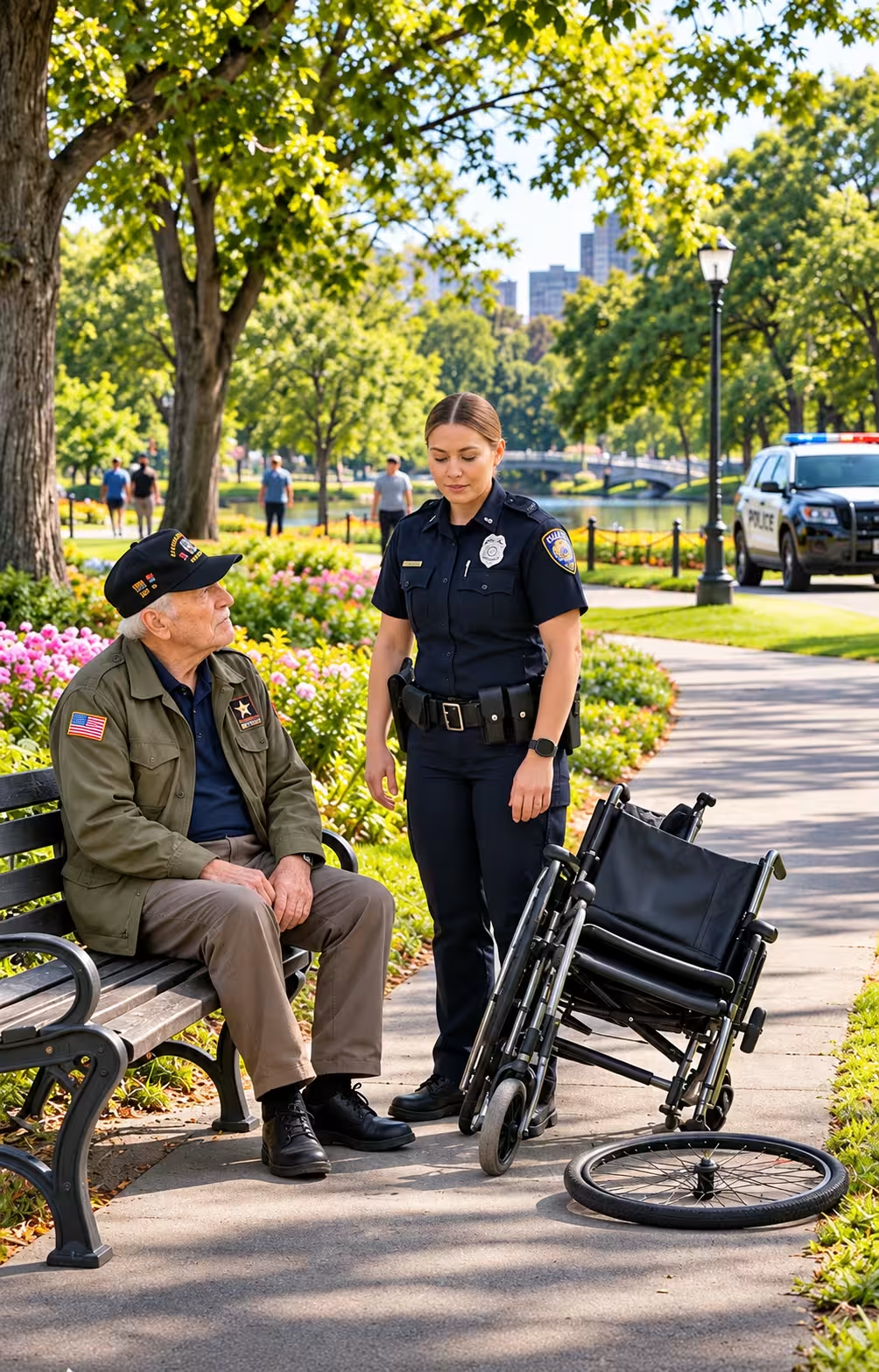
He asked Arthur whether he had experienced any pain or injury.
Arthur explained that the wheel had detached without warning.
Nathan examined the situation while ensuring the wheelchair remained stable.
He noticed that part of the wheel’s attachment mechanism appeared damaged.
Rather than attempting an unreliable repair, Nathan contacted the appropriate assistance services.
He then retrieved the detached wheel and placed it beside the pathway.
Arthur apologized for causing an inconvenience.
Nathan assured him that his safety was the immediate priority.
While waiting for assistance, the officer asked whether Arthur lived nearby.
Arthur described his apartment and explained how frequently he visited the park.
He also mentioned that replacing his aging wheelchair would be financially difficult.
Nathan listened carefully, recognizing how important reliable mobility equipment was to Arthur’s independence.
Finding a Safe Solution for the Afternoon
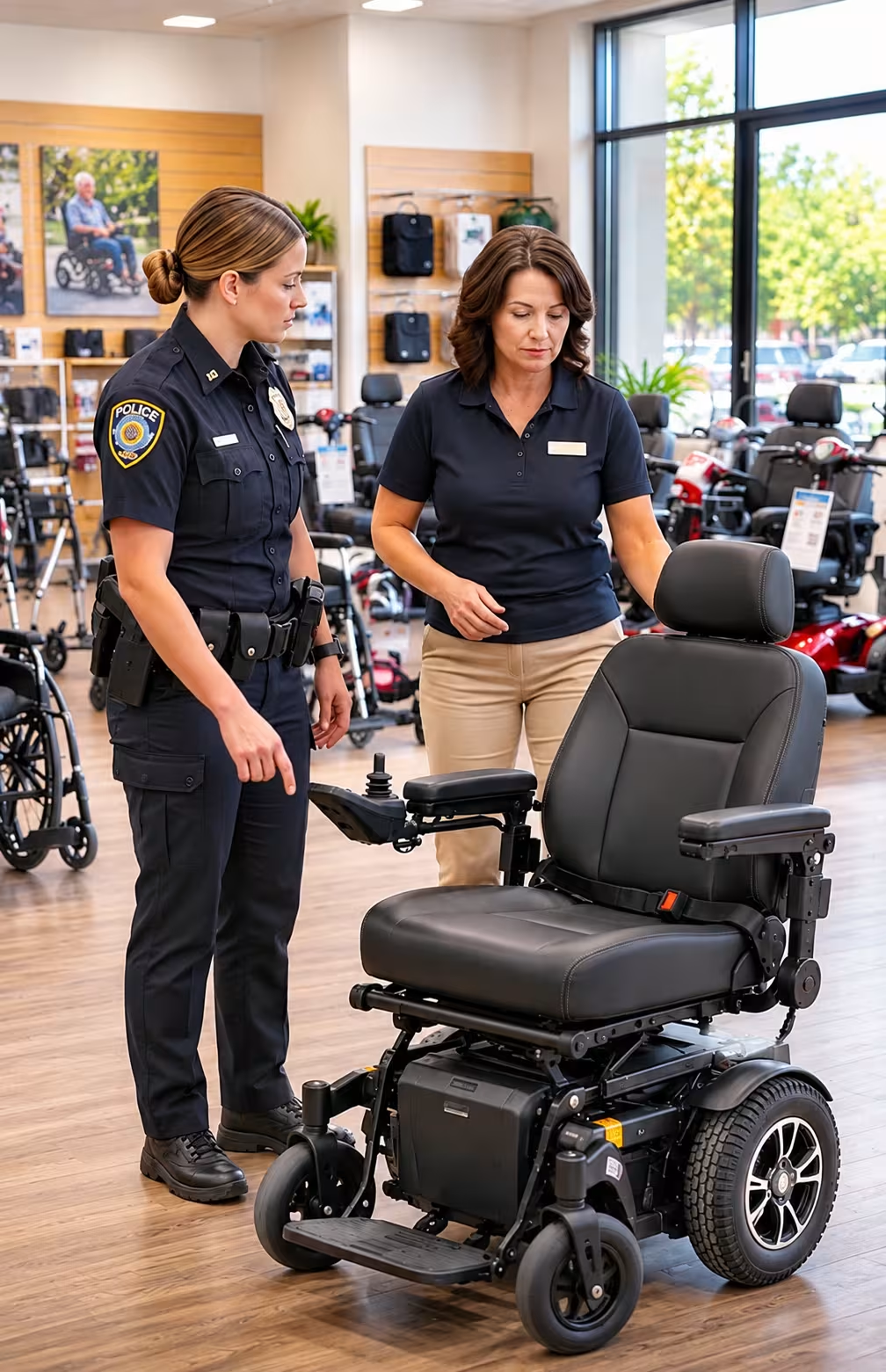
Nathan contacted a community mobility assistance service through the police department’s local outreach program.
A representative confirmed that a temporary wheelchair could be provided.
While they waited, Nathan remained beside Arthur and continued their conversation.
Arthur spoke about his former carpentry business and his enjoyment of working with wood.
He explained that his park visits had become an important part of retirement.
Without a functioning wheelchair, even simple trips outside would become difficult.
Nathan asked whether Arthur had previously considered a powered wheelchair.
Arthur admitted that he had explored the possibility.
However, the cost and application process had discouraged him from continuing.
A community assistance worker arrived with a suitable temporary wheelchair.
After checking Arthur’s condition, the worker helped arrange a safe transfer.
Nathan collected the damaged wheelchair and its detached wheel.
The assistance worker arranged transportation back to Arthur’s apartment.
Before leaving, Nathan asked permission to contact a local mobility support organization on Arthur’s behalf.
Arthur agreed, although he expected the process to take considerable time.
Nathan promised to share any useful information he received.
The elderly man thanked him before returning home.
The Officer Returns With a Powered Wheelchair
Over the following weeks, Nathan contacted several community organizations specializing in accessible mobility equipment.
One nonprofit organization operated a program providing refurbished powered wheelchairs to eligible residents.
Nathan explained Arthur’s situation with his permission.
The organization arranged an assessment with a qualified mobility specialist.
Arthur discussed his daily needs, physical abilities, and home accessibility requirements.
Following the assessment, the specialist identified a suitable powered wheelchair.
The equipment underwent professional inspection, battery testing, and necessary adjustments.
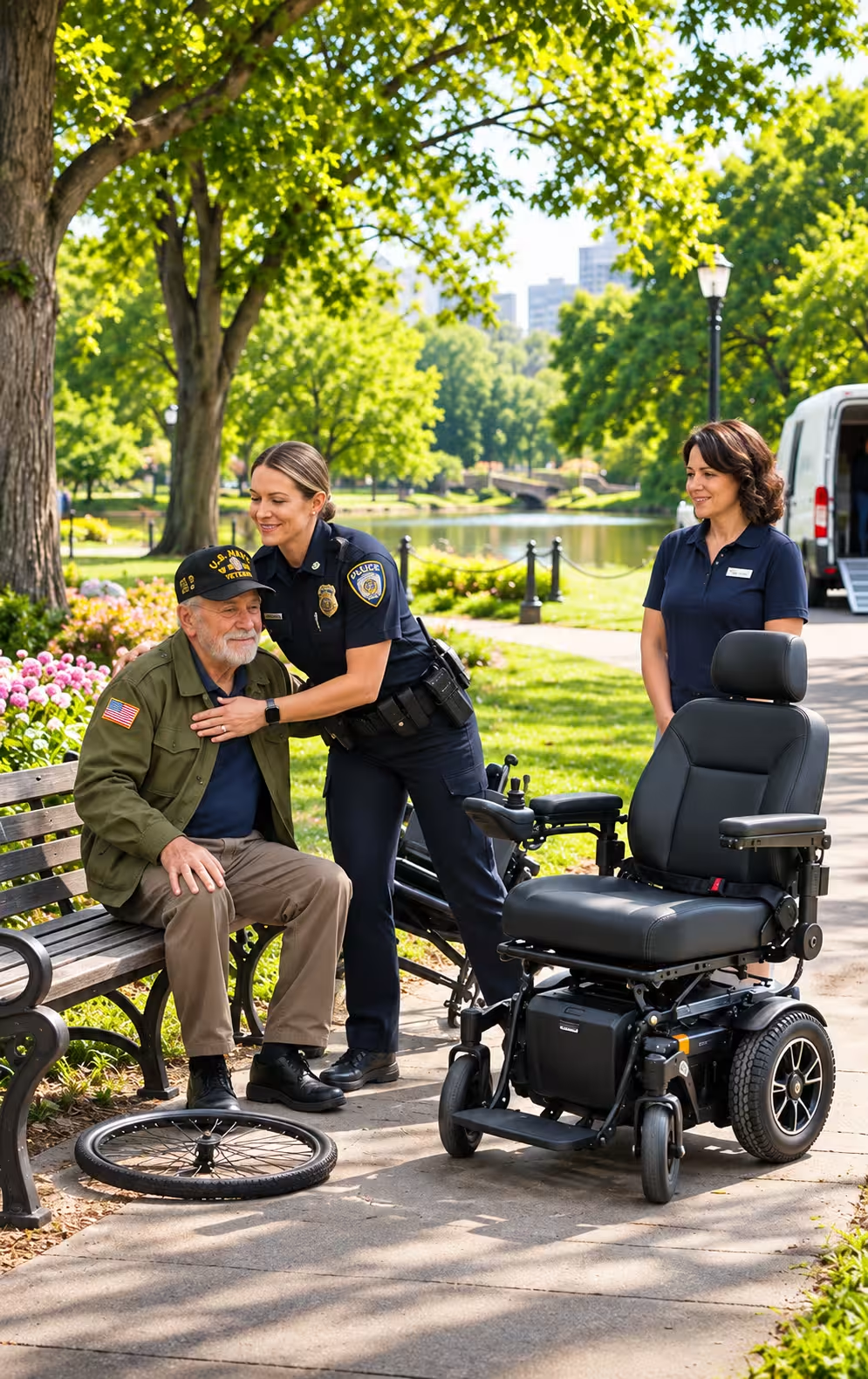
Several weeks after their first encounter, Nathan arranged to meet Arthur at the park.
Arthur arrived using his temporary wheelchair, accompanied by a community assistance worker.
Nathan approached with a representative from the mobility organization.
Beside them stood a professionally refurbished powered wheelchair.
Arthur looked surprised when Nathan explained that the organization had approved his application.
The specialist demonstrated the controls and explained the wheelchair’s safety features.
Arthur received assistance transferring into the new equipment.
After practicing under supervision, he moved slowly along the paved pathway.
A broad smile appeared on his face as he approached his favorite bench.
A Familiar Park Becomes Accessible Again
Arthur gradually became comfortable operating his powered wheelchair.
The mobility specialist provided additional guidance and arranged follow-up support.
Arthur learned how to charge the batteries and monitor the equipment’s condition.
The organization also explained its maintenance and repair services.
With appropriate training, Arthur resumed his regular visits to the neighborhood park.
He enjoyed reaching familiar locations without relying entirely on his upper-body strength.
Nathan occasionally encountered him while conducting routine patrols.
Their conversations often included updates about Arthur’s daily activities.
Arthur expressed particular appreciation for everyone who had contributed to finding suitable equipment.
He also began sharing information about the mobility assistance program with other residents.
In this fictional story, an elderly man’s wheelchair broke when one of its wheels detached along a park pathway.
A police officer stopped to help, arranged temporary assistance, and connected him with a community mobility organization.
Through professional assessment and coordinated support, Arthur received a powered wheelchair suited to his needs.
The experience demonstrated how practical assistance could help someone preserve their independence.
Arthur continued enjoying the park, greeting familiar visitors and spending peaceful afternoons beside the pond.
His daily routine once again included the simple pleasures he had always valued.
As Arthur traveled beneath the familiar maple trees, he remembered the afternoon when his wheelchair broke and felt grateful that one officer’s willingness to stop and listen had helped him regain the freedom to enjoy his everyday life.