The city was awash in golden sunlight as Clara Whitmore, a renowned philanthropist and businesswoman, led her six-year-old son Andrew out of a marble lobby and onto the bustling sidewalk. Andrew, immaculate in his navy blue suit, clung to her hand.
They had just left a charity gala at the Ritz, where crystal chandeliers sparkled and the city’s elite exchanged pleasantries over champagne. It was a world of privilege and certainty, a world Clara had worked hard to build for her son—a world that was about to be shaken by a single, unexpected encounter.
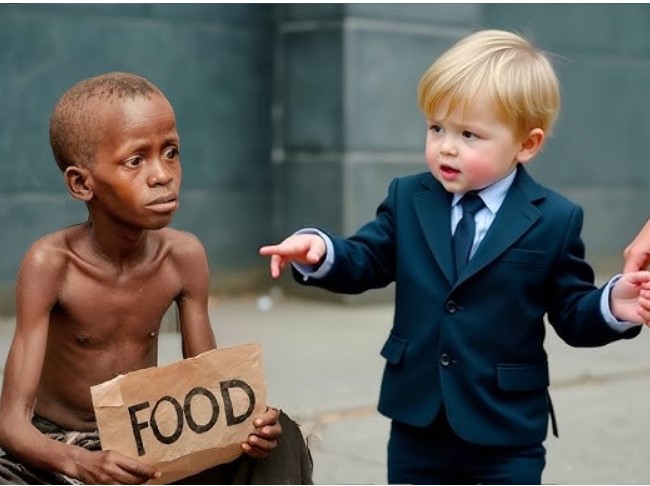
As they turned the corner onto 6th Avenue, Andrew suddenly stopped dead in his tracks. His small hand tightened around Clara’s. “Andrew?” she asked, half-distracted, expecting a plea for ice cream or a complaint about tired feet. But Andrew didn’t answer. His wide eyes were fixed on a figure crouched near a trash bin—a boy, perhaps eight years old, barefoot and shirtless, clutching a battered cardboard sign that read simply, “Food!”
For a long moment, the two boys stared at each other. Then, in a voice that trembled with certainty, Andrew whispered, “Mom, he’s my brother.”
Clara blinked, startled. “I beg your pardon?”
Andrew’s eyes never left the boy on the street. “That’s Malik. He used to give me food when we were little. In the place with the green beds. When I had bad dreams, he held my hand.”
Clara’s heart skipped. “Andrew, sweetheart, you’ve never had a brother.”
“Yes I did,” he insisted, his voice quivering. “Before you and Daddy brought me here. When I didn’t have suits. When I was cold.”
Clara’s carefully constructed world began to tilt. She looked again at the boy on the pavement. The child’s eyes met hers—not with anger or pleading, but with a kind of cautious recognition. Clara tried to guide Andrew away, embarrassed by the attention of passing drivers and curious onlookers. “Come, darling, let’s keep walking.”
But Andrew pulled free. “No!” he cried, louder now. “He’s my big brother! He always shared, even when he was hungry too.”
People began to slow down, drawn by the commotion. Clara felt her cheeks flush. But Andrew stepped forward, his patent shoes clicking on the pavement, and knelt beside the boy. “Malik,” he whispered.
The boy looked up, uncertainty flickering across his face. Then, as if a dam broke, his jaw trembled. “Andy?” he croaked.
Andrew rushed into his arms, hugging him fiercely. Malik’s hand, bony and hesitant, came to rest on Andrew’s back. Clara stood frozen, her hand suspended in the air, as the truth unfolded before her eyes: this was not a stranger. This was family.
Five years earlier, when Andrew was just over a year old, Clara and her husband had adopted him from a foreign country through a private agency. The process had been quick, the records sparse. They were told he had been abandoned and lived briefly in a foster center. There was no mention of another child. No mention of Malik.
As a small crowd gathered, Clara stepped forward, her voice shaky. “You know each other?” she asked.
Malik nodded, shielding his eyes from the sun. “I used to feed him my porridge when the workers forgot. I told him stories at night. He didn’t talk much, but he’d fall asleep next to me.”
Clara’s voice was barely a whisper. “Why are you here?”
Malik looked down, his hands twisting the cardboard sign. “They never took me. Said I had breathing problems. Said nobody would want me.”
He didn’t cry. He didn’t beg. He simply held Andrew, who clung to him as if he’d never let go.
That night, Clara sat alone at her mahogany desk, tears streaking her makeup. Andrew had cried himself to sleep, whispering Malik’s name. Clara, always composed and rational, now stared at the photo she’d snapped on her phone: Andrew wrapped tight around the street boy, Malik sitting silent, as if he didn’t believe he deserved to be remembered.
At midnight, Clara called her private investigator. “I need everything. Adoption records, orphanage files, hospital notes. If there’s another boy—his name is Malik—I want to know why they were separated.”
The next day, the truth arrived like a punch to the gut. Andrew and Malik had come from the same orphanage, admitted the same week, similar height, weight, even illness records. They had shared a room. One record listed Malik’s name beside Andrew’s, but at some point, a line had been drawn through it in red ink: “Deemed unfit—adoption not recommended.” And just like that, Malik vanished from the paperwork. No one had told Clara there were two boys.
The next morning, Clara and Andrew returned to the street, praying Malik hadn’t disappeared again. He hadn’t. He was sitting exactly where they’d left him, a sandwich from a passerby untouched at his feet. His eyes lit up when he saw Andrew, who immediately ran to him.
Clara knelt beside them. “Malik, I want to take you home,” she said gently. “At least until we figure this out.”
Malik stared, stunned. “Why?”
“Because I should have asked about you a long time ago,” Clara replied, her voice soft. “And because my son—your brother—never stopped remembering you.”
Over the next week, Clara moved mountains. Emergency placement, legal intervention, DNA testing. On the sixth day, just before dawn, her lawyer handed her the results: a 99.9% sibling match—not by blood, but by shared history, care IDs, and the same early nourishment. Two boys separated by a pen stroke and a bureaucratic judgment, now reunited by the love of a child who refused to forget.
Clara called a press conference—not for publicity, but for accountability. “We adopted Andrew thinking we were giving a child a second chance,” she said, voice trembling. “But we didn’t know he already had someone who loved him like a brother. We were never told. That omission stole five years from two children who needed each other.” She placed a hand on Malik’s shoulder as he stood nervously beside Andrew. “He isn’t broken. He isn’t less. He’s brave. And from this day forward, he’s home.”
The story spread across the city. Some in the crowd cried. Malik, for the first time in years, smiled.
In the months that followed, Malik started school—his first real classroom. He struggled with reading but excelled at math. Andrew proudly introduced him to his friends as “my big brother.” Clara enrolled Malik in therapy, nutrition support, and art classes. But more than anything, she gave him what he’d never had before: a bed, a nameplate on his door, a spot in the family photo, and a future.
On Malik’s ninth birthday, Clara gave him a special gift: a laminated copy of the cardboard sign that once read “Food.” Beneath it, in gold ink, she had written: “You asked for food. You gave love. And now you both have everything.”
Some families are formed by chance; others, by the children who refuse to forget each other. Andrew didn’t just find a lost boy on the street—he found the missing piece of his own heart. And together, they found their way home.
If this story moved you, share it—and remember: sometimes, the smallest voices speak the loudest truths.