The mall was crowded that Saturday afternoon, packed with shoppers hunting for weekend deals. Teenagers laughed loudly near the food court, parents rushed after excited children, and store speakers blasted holiday music even though it was still early November. But among the crowd walked a man who didn’t look like he belonged.
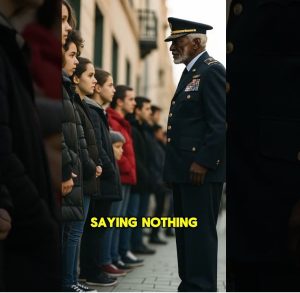
He wore an old military uniform faded jacket, scuffed boots, and a cap that looked like it had survived a hundred storms. His posture was straight, but his steps were slow, as if every movement carried the weight of decades. Some people glanced at him with curiosity. Others stared a little too long. But most ignored him entirely.
Cruel Laughter in a Place of Comfort
One of the teens a tall boy with a loud voice laughed and said, “Look at this guy. Did he steal that from a museum?”
Another chimed in, “Maybe he thinks he’s still in the army from the Stone Age!”
Their friends laughed loudly enough for the man to hear. He paused but didn’t turn around. Instead, he continued walking, head slightly bowed but shoulders still dignified.
The oldest teen wasn’t done mocking him.
“Hey Grandpa!” he called out. “Halloween was last week!”
People nearby turned to look. Some shook their heads. Others pretended not to notice. And a few even smiled awkwardly at the joke.
The Woman Who Saw What Others Didn’t
A woman in her forties, carrying a shopping bag and a coffee, approached him. She didn’t look at the teens. She walked straight to the man and gently touched his arm.
“Sir,” she said quietly, “thank you for your service.”
The teenagers stopped laughing. Their smiles froze.
The man nodded, offering a small, humble smile. “Thank you, ma’am.”
But she didn’t walk away. Instead, she turned to the group of teens and said, “Do you even know who this is?”
The teens exchanged confused glances. One shrugged. “Just some old guy playing soldier.”
The Truth They Never Expected
The woman stepped aside as another man approached—this one wearing a formal suit. He stopped in front of the Colonel and immediately saluted him with complete respect.
“Sir,” he said, voice steady, “it’s an honor to see you again.”
Colonel Harlan saluted back, though slower. “Good to see you too, Major.”
The teens stared, stunned. A Major? In the middle of a mall? Saluting the man they had just mocked?
A small crowd began forming. People whispered, “Is that really him?” “Colonel Harlan?” “I heard he received the Silver Star!” “Didn’t he save a convoy during that mission overseas?”
Word spread quickly. People who had walked past him moments earlier now removed their hats, straightened their posture, or held their hands over their hearts.
The teens looked like they wanted to vanish.
The Major turned toward them. “You boys know who you’re talking to?”
They didn’t answer.
The Major took a deep breath. “This man has done more for this country than any of us ever will. He doesn’t wear that uniform for attention. He wears it because the men he served with can no longer wear theirs.”
Silence. Thick and heavy.
Colonel Harlan raised a hand gently. “It’s alright,” he said. “They’re young. They don’t know.”
But the teenagers did know now. And each of them felt the crushing weight of guilt.