I had gone camping for the exact reason most people do—to disconnect from everything familiar and predictable. The campsite was deep in the forest, far from roads and phone signals, a place where the nights were truly dark and the sounds of nature replaced the constant noise of everyday life.
The first evening had passed quietly. I cooked a simple meal over the fire, watched the flames dance until my eyes grew heavy, and eventually retreated into my tent, expecting nothing more than a peaceful night and an early morning hike. Everything felt calm, almost perfectly ordinary.
Sometime after midnight, I was half-asleep when I heard movement outside the tent. At first, I assumed it was the wind brushing against leaves or a small animal passing by. That kind of noise is common when you camp, and normally it fades as quickly as it comes. But this sound didn’t fade. It grew louder, closer, accompanied by frantic rustling and short, panicked breaths. Before I could fully wake or react, the tent wall suddenly pressed inward, collapsing slightly as something pushed against it with unexpected force.
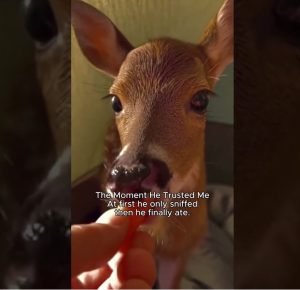
Then, without warning, the zipper burst open and a small body tumbled inside. I sat up so fast I nearly hit my head on the tent pole. My heart was pounding, my mind racing through every worst-case scenario imaginable. In the dim light of my headlamp, I finally saw what had entered my tent—and froze. Standing there, trembling and wide-eyed, was a baby deer.
It was tiny, its legs thin and shaky, its chest rising and falling rapidly as it struggled to understand where it was. Its dark eyes reflected the light, full of fear rather than aggression. For a moment, neither of us moved. We stared at each other in complete silence, both equally stunned by the situation. This was not part of any camping plan I had ever imagined.
My first instinct was panic. A baby deer meant there was almost certainly a mother nearby, and the last thing I wanted was an adult deer charging into my tent in defense. At the same time, the fawn was clearly terrified, pressed against the corner of the tent, slipping slightly on the fabric floor as it tried to stand steady. It let out a soft, distressed sound that went straight through me.
I slowly lowered my hands, reminding myself to stay calm. Sudden movements could make things worse, and I knew enough about wildlife to understand that fear could turn even the gentlest animal unpredictable. The fawn took a shaky step, then another, bumping lightly into my sleeping bag. I could see now that it was exhausted, possibly separated from its mother during the night, and had bolted blindly in search of safety—unfortunately choosing my tent.
Carefully, I unzipped the tent door wider, hoping it would run back out on its own. But it didn’t. Instead, it stayed exactly where it was, breathing hard, legs trembling as if it had run for miles. Outside, the forest was quiet again, almost unnervingly so. No movement, no sound of hooves, no sign of the mother.
Eventually, the fawn collapsed onto the floor of the tent, curling slightly, its breathing slowing but still uneven. That was the moment my panic gave way to concern. This wasn’t just a strange encounter—it was a vulnerable animal in distress. I wrapped myself in a jacket and sat as still as possible, giving it space while staying close enough to prevent it from hurting itself.
As the night stretched on, I listened intently for any sign of movement outside. Every snapping twig made my heart jump. I whispered softly—not words, just quiet sounds—more for myself than for the deer, trying to keep the atmosphere calm. The fawn eventually lifted its head, looking at me with an expression that felt impossibly trusting for a wild animal.