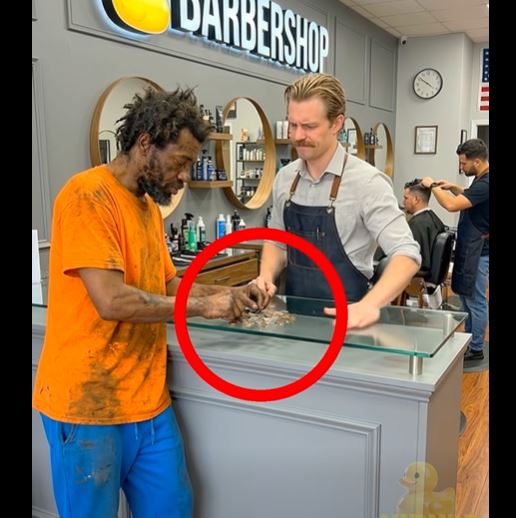
The barbershop sat on one of the busiest streets in the city, its glass windows shining under the afternoon sun. Inside, the scent of shaving cream and aftershave filled the air, and the steady buzz of clippers blended with low conversations and occasional laughter. It was known as an upscale place, where businessmen and professionals came not only for a haircut but for an experience.
On that particular afternoon, the shop was crowded.
Men in tailored suits scrolled through their phones while waiting, others discussed business deals, and the receptionist carefully scheduled appointments with practiced efficiency. Everything seemed perfectly polished—orderly, elegant, and exclusive.
Then the door opened quietly.
A man stepped inside, and the atmosphere shifted.
His clothes were worn and faded, his shoes dusty, and his hair was long, tangled, and unkempt. His beard had grown wildly, and his face carried the marks of hardship and exhaustion. In his trembling hands, he held a small handful of coins.
He hesitated near the entrance, looking around uncertainly.
“I… I would like a haircut,” he said softly.
Several customers glanced at him with visible discomfort. The receptionist forced a polite but strained smile before calling the floor manager.
The manager, a sharply dressed man named Carl, approached with an expression of irritation. He visibly scanned the visitor from head to toe, his lips tightening.
“We serve clients by appointment,” Carl said coldly.
The man lowered his eyes. “I don’t have an appointment. But I saved money. I can pay.”
He carefully placed the coins on the counter. The soft clinking sound echoed awkwardly in the quiet room.
Carl’s expression hardened.
“This is not enough,” he snapped. “And frankly, you’re disturbing our customers. You need to leave.”
The man’s face flushed with humiliation. He gathered his coins slowly, his hands shaking.
“I only want to look presentable,” he murmured. “I have an interview tomorrow.”
But Carl had already turned away.
“Please leave,” he repeated firmly, guiding the man toward the door.
The customers watched silently. Some avoided eye contact, others whispered among themselves. No one intervened.
The man stepped back outside, his shoulders slumped, his dignity shattered.
But someone had witnessed everything.
From one of the barber chairs near the back of the shop, the owner, Marcus, had been observing the scene quietly. A respected barber with decades of experience, Marcus had built the shop from nothing. He believed that a haircut was not merely about appearance—it was about self-respect and confidence.
What he had just seen troubled him deeply.
Without hesitation, Marcus removed his apron and walked to the door.
“Sir,” he called gently.
The man turned, surprised.
“Please come back inside,” Marcus said.
Carl approached quickly, whispering urgently, “This is not the image we want for the shop.”
Marcus looked at him calmly. “Our image is dignity,” he replied.
The room fell silent as Marcus guided the man to his own chair.
“What’s your name?” Marcus asked kindly.
“Thomas,” the man answered quietly.
“Well, Thomas,” Marcus said with a warm smile, “today you are my guest.”
Tears filled Thomas’s eyes as he sat down.
Marcus worked carefully and patiently. He washed Thomas’s hair, trimmed his beard, and shaped his haircut with precision and care. Each movement was respectful, deliberate, and full of compassion.
As the transformation progressed, the shop’s atmosphere began to change.
The tangled hair disappeared. The rough beard was shaped neatly. The exhausted stranger slowly revealed a confident, dignified man beneath the layers of neglect.
When Marcus finished, he turned the chair toward the mirror.
Thomas stared at his reflection in disbelief. His eyes widened, and his hands trembled as he touched his face.
“I… I don’t recognize myself,” he whispered.
“You’re seeing who you’ve always been,” Marcus replied gently.
The room was silent. Even the customers who had earlier judged him now watched with quiet respect.
Marcus then did something no one expected.
“What kind of job interview do you have tomorrow?” he asked.
Thomas hesitated. “A small logistics company. A management position. I used to supervise operations at a warehouse before… before I lost everything.”
Marcus studied him thoughtfully. “What happened?”
Thomas spoke quietly about losing his home after medical bills overwhelmed him following his wife’s illness. He described months of hardship, rejection, and struggle, yet his words revealed intelligence, responsibility, and resilience.
Marcus listened carefully.
Then he turned toward Carl.
“Someone who treats people based on their appearance cannot represent this business,” Marcus said calmly.
Carl’s face paled. “What are you saying?”
“You’re dismissed,” Marcus replied firmly.
Gasps filled the shop.