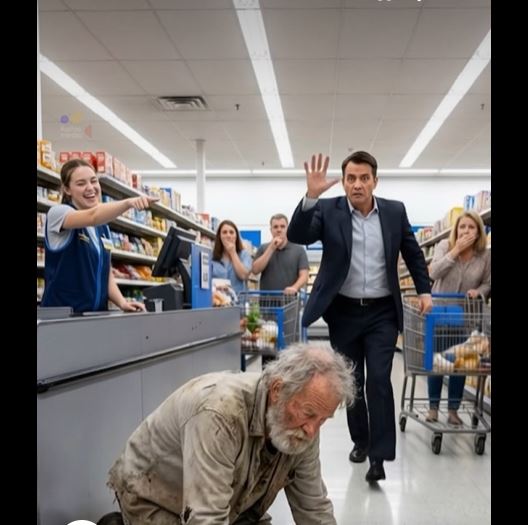
It was early evening, the busiest hour of the day, when carts bumped into one another and tempers wore thin. People checked their phones, sighed loudly, and shifted their weight from foot to foot. No one wanted to be there longer than necessary.
At the end of the line stood an old man.
His coat was faded, his shoes worn thin at the soles. He moved slowly, carefully, as if every step had to be negotiated with his body before it could happen. In his cart were only a few items: a loaf of bread, a small carton of milk, a can of soup, and a packet of tea. Nothing extra. Nothing indulgent.
When it was finally his turn, he placed the items on the counter one by one, apologizing softly as he did.
“I’m sorry,” he said, his voice barely rising above the noise of the store. “My hands shake sometimes.”
The cashier didn’t look at him.
She was young, clearly tired, tapping her nails against the counter as the register beeped. When the total appeared on the screen, she read it aloud with a sigh.
“That’ll be $8.73.”
The old man nodded and reached into his coat pocket. Then another pocket. Then a small cloth pouch tied with a string.
He opened it slowly.
Inside were coins.
Pennies. Nickels. Dimes. A few quarters, smoothed by time.
The line immediately stiffened.
“Oh, come on,” someone muttered behind him.
The cashier’s eyes finally lifted—then rolled.
“You’re paying in coins?” she asked, loud enough for others to hear.
“Yes, miss,” the old man replied. “I counted them twice. It should be right.”
He began placing the coins on the counter, sorting them carefully. His fingers trembled as he worked, and once or twice a coin slipped and rolled away. Each time, he bent down slowly to retrieve it.
The cashier exhaled sharply.
“You know we have other customers waiting,” she said. “This isn’t a bank.”
A few people laughed. Others avoided eye contact, suddenly very interested in the candy racks and tabloids.
The old man’s ears reddened.
“I understand,” he said quietly. “I don’t mean to cause trouble.”
He continued counting, his voice whispering numbers under his breath. The total was close, but not exact.
He stopped.
Looked at the coins again.
Then at the screen.
“I’m sorry,” he said, his shoulders slumping. “I think I’m short… seventeen cents.”
The cashier pushed the coins back toward him.
“Then you can’t buy it,” she said flatly. “I can’t just give things away.”
The old man stared at the bread and milk on the counter. His lips parted, then closed again. He nodded once, slowly, and began gathering the coins with shaking hands.
“I’ll just take the bread, then,” he said. “And put the milk back.”
Something about the way he said it—calm, resigned, practiced—hit harder than any raised voice ever could.
Before the cashier could respond, a voice spoke from the back of the line.
“No,” the voice said. “Don’t put it back.”
Everyone turned.
A man stepped forward, dressed simply, no visible signs of wealth or importance. He was calm, composed, and his eyes were fixed on the old man, not the cashier.
“I’ll cover the rest,” he said, placing a bill on the counter. “And add a little extra.”
The cashier hesitated, then shrugged and rang it up.
“Fine,” she said. “Next time, be prepared.”
The old man looked up, stunned.
“You don’t have to—” he began.
“I want to,” the man replied gently. “Please.”
The old man’s eyes filled with tears. “Thank you,” he whispered. “You don’t know what this means.”
The man smiled, but there was something restrained in it. Something deliberate.
As the old man gathered his bag and shuffled away, the man didn’t return to his place in line. Instead, he turned to the cashier.
The man nodded slowly. “That ‘old guy’ worked for this store’s parent company for forty-two years. He helped design the first distribution system that made this chain profitable.”
“He retired with a pension that was quietly cut in half when the company restructured,” the man continued. “He didn’t complain. He didn’t sue. He adjusted.”
The store had gone quiet now. No one was checking their phones anymore.
The man reached into his wallet and removed a card, placing it on the counter.
“My name is Daniel Whitmore,” he said. “I own this company.”
The cashier’s face drained of color.
“I came in today unannounced because I’ve been receiving reports,” Daniel continued calmly. “Reports about how customers are treated when they’re slow, or poor, or inconvenient.”