The train station was at its busiest point of the day. Commuters hurried across the platform, announcements echoed through the loudspeakers, and the air buzzed with movement and impatience. Suitcases rolled over tiled floors, footsteps overlapped, and conversations blended into a constant hum. In the middle of it all, a woman stood near a bench, distracted by her phone as she waited for her train to be announced.
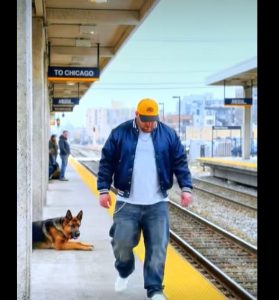
At her feet sat a medium sized mixed breed dog with attentive eyes and a calm posture. His leash was looped loosely around the woman’s wrist, and he watched the world pass with quiet focus. The dog had been trained well, but more than that, he was deeply bonded to his owner. Wherever she went, he stayed close, alert to her movements, tuned to her voice.
When the announcement finally came, the woman moved quickly. She gathered her jacket, adjusted her bag, and stepped toward the platform entrance. In the rush, one smaller bag slipped from her shoulder and landed unnoticed beneath the bench where she had been standing. The woman continued walking, focused on catching her train before the doors closed.
The dog stopped.
He looked back at the bench, then at his owner, then back again. His body tensed. Something was wrong. The familiar shape and scent of the bag caught his attention immediately. He pulled gently against the leash, trying to alert her, but the crowd surged forward, and she did not notice.
Then the leash slipped free.
The dog did not chase after her. Instead, he turned back, trotting quickly to the bench. He sniffed the bag, confirmed what he already knew, and carefully took the strap in his mouth. It was heavier than his toys at home, but he adjusted his grip and lifted it with determination.
People nearby noticed him immediately. Conversations stopped. A few commuters pointed, confused at first, then amused. The dog walked confidently across the platform, weaving through legs and luggage with surprising ease, the bag dangling from his mouth.
He stopped near the ticket gates, scanning faces.
His owner was already halfway through the crowd, still unaware that anything was missing. The dog let out a sharp bark, louder than anything he had made all day. She turned instinctively.
For a moment, she did not understand what she was seeing. Then her eyes widened. There was her dog, standing proudly near the entrance, holding her bag.
She rushed back, heart pounding.
When she reached him, the dog sat down immediately and released the bag at her feet. His tail wagged slowly, his expression calm and focused, as if he had simply completed an important task. The woman dropped to her knees, laughing and crying at the same time, wrapping her arms around his neck.
She checked the bag quickly. Everything was still inside. Her wallet. Her documents. Items she would have struggled to replace. She hugged her dog again, whispering thanks as he leaned into her, satisfied.
Around them, people applauded.
Some shook their heads in disbelief. Others smiled, phones raised to capture the moment. A station employee approached, having watched the entire scene unfold, and praised the dog warmly. Someone nearby joked that the dog deserved a ticket of his own.
The woman clipped the leash back on securely, her hands still shaking slightly. She missed her train, but she did not care. She kept one hand on her dog’s head as they walked toward a quieter corner of the station, her gratitude written clearly across her face.
Later, as the story spread online through photos and short videos, people marveled at the dog’s intelligence and loyalty. But for the woman, it was not surprising. She knew him. She trusted him. He had always watched over her in small ways. This was simply the moment everyone else got to see it.
In a place defined by noise, speed, and distraction, a loyal dog noticed what mattered. He chose responsibility over instinct, patience over panic, and devotion over convenience. And because of that choice, a lost bag was returned, a bond was strengthened, and a busy station paused to witness something quietly remarkable.