A loyal dog waits where his owner was last seen, and day after day, the quiet vigil becomes a living testament to devotion that refuses to fade. The spot is nothing special to most people—a worn bus stop at the edge of town, bordered by cracked pavement and a rusted bench. Cars pass by without slowing, footsteps come and go, seasons change. Yet for the dog, this place holds meaning far deeper than memory. It is where his world stopped moving forward.
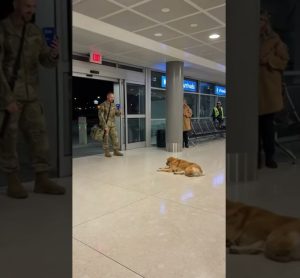
The owner had been a familiar figure in the neighborhood, a man of simple habits and gentle routines. Every morning, he and the dog walked together to that very bus stop. The man would scratch behind the dog’s ears, tell him to stay, and promise to return by evening. And every evening, without fail, he did. Until one day, he didn’t. No one knew exactly what happened—some said illness, others whispered about an accident—but the truth never reached the dog in a way he could understand.
At first, people assumed the dog was lost. They tried to coax him away with food, water, even leashes. He accepted what he needed to survive, but he never left. He always returned to the same place, curling up beside the bench at night and sitting upright during the day, eyes fixed on the road as if watching time itself. His ears perked up whenever a bus arrived, his tail lifting slightly in hopeful recognition, only to fall again when strangers stepped off instead.
Weeks passed, then months. The dog grew thinner, his once-glossy coat dulled by weather and waiting. Rain soaked him. Summer heat pressed down on his tired body. In winter, he shivered through the cold, pressing himself against the bench for shelter. Still, he stayed. The bus stop became his anchor, the last thread connecting him to the person who had been his entire world.
Commuters began to notice. At first, they talked about him in passing, calling him “the waiting dog.” Soon, they started bringing blankets, food, and water. Someone built a small shelter nearby. Another person took him to the vet, discovering he was healthy but deeply stressed, his body worn down by grief rather than disease. Even then, after every act of kindness, he returned to his post.
What broke hearts most was his expression. There was no panic in his eyes, no wild searching. There was only patience—quiet, aching patience. He wasn’t looking everywhere. He was waiting in the one place that mattered. To the dog, leaving would mean giving up hope, and hope was the last thing he had left.
Children asked their parents why the dog never went home. Adults struggled to answer. How do you explain loyalty that doesn’t calculate odds, that doesn’t adapt to reality, that doesn’t move on? The dog didn’t understand absence as final. He understood promises. And in his world, promises were absolute.
Eventually, the truth surfaced. The owner had passed away, alone in a hospital miles from the bus stop. When animal services learned of the dog’s story, they tried to relocate him, to give him a new home. Families offered to adopt him, touched by his devotion. But each time he was taken away, he refused to eat, refused to rest, and cried through the night. Within days, he was back at the bus stop, thinner but resolute.
In time, the town stopped trying to move him. Instead, they adapted around him. The bus stop was cleaned more often. A plaque appeared quietly on the bench, honoring the man who used to sit there and the dog who never left. People spoke to the dog as they passed, telling him good morning, telling him the weather, telling him—gently—that he was not forgotten.