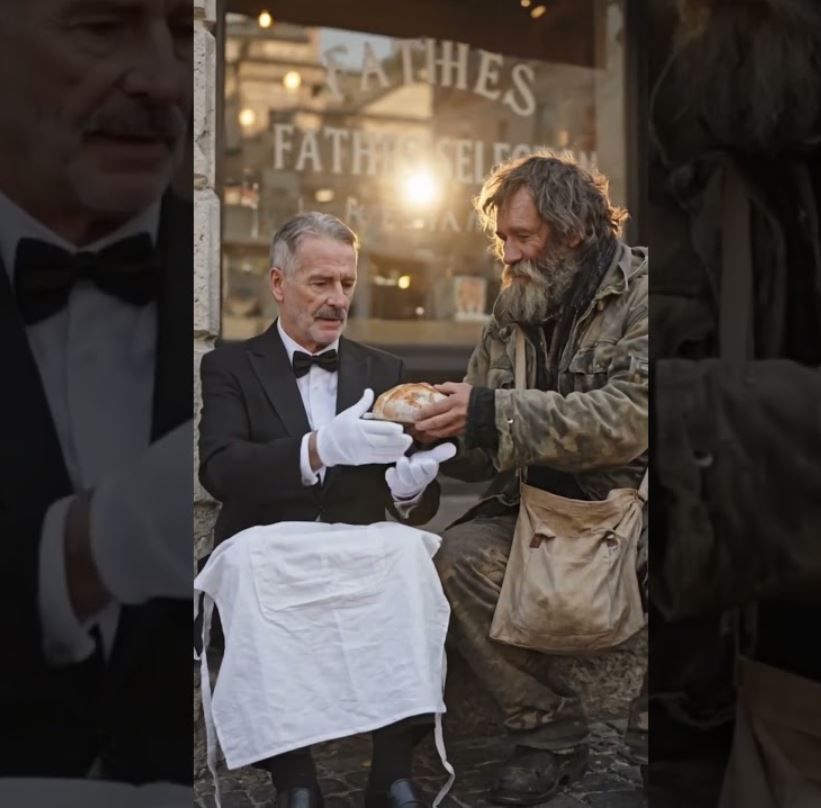
The millionaire arrived in the city without ceremony, exactly the way he preferred it. No entourage, no flashy cars, no announcements. To the world, he was just another well-dressed man stepping out of a black sedan, his tailored coat shielding him from the cold morning air. But to those who knew his name, he was a giant in business—someone who measured life in profits, losses, and leverage. Compassion, in his mind, was a luxury. Respect was earned. And money, he believed, was the ultimate solution to every problem.
That belief had served him well for years.
He walked briskly down the street, checking his phone, irritated by a delayed meeting. Around him, the city moved in its usual rhythm—vendors setting up stalls, workers rushing to jobs that barely paid enough, the quiet hum of survival playing out on every corner. He noticed none of it. Not until his foot struck something solid.
He stumbled slightly and looked down.
A man was kneeling on the sidewalk, carefully arranging apples that had rolled out of a torn plastic crate. The crate itself was cracked, one corner completely broken. Several apples were bruised, some already split open on the pavement. The kneeling man froze when he realized he’d been bumped into.
“I’m sorry, sir,” the man said quickly, bowing his head. His clothes were old but clean, his hands rough and scarred from years of labor. “I didn’t mean to be in the way.”
The millionaire exhaled sharply, annoyance flashing across his face. “Watch where you’re sitting,” he said, his voice clipped. He reached into his pocket, pulled out a bill without looking at it, and dropped it onto the crate. “Buy a new one.”
The poor man stared at the money, eyes widening.
But he didn’t reach for it.
Instead, he stood up, gently pushing the bill back toward the millionaire. “Thank you, sir,” he said calmly, “but I didn’t ask for money.”
That made the millionaire pause.
“I knocked over your things,” the man continued. “It’s my mistake for being in your way. But I don’t need charity.”
The words struck harder than expected.
“You sell apples on the sidewalk,” the millionaire replied, frowning. “Your crate is broken. Take the money.”
The man shook his head. “Money won’t fix what I’m trying to protect.”
The millionaire looked at him for the first time—not past him, not through him, but at him. “And what exactly is that?”
The man knelt back down, carefully picking up the remaining apples, wiping each one on his sleeve. “My dignity,” he said simply.
A few pedestrians had slowed down now, sensing something unusual. The city, for once, was watching.
The millionaire crossed his arms. “Dignity doesn’t put food on the table.”
The man smiled—not bitterly, not defensively, but kindly. “No,” he said. “But it teaches my children how to live.”
“Three,” the man replied. “They help me after school. They learn to count by selling apples. They learn honesty by giving correct change. And they learn self-respect by seeing their father work, not beg.”
The millionaire felt an unfamiliar tightness in his chest. He thought of his own childhood—private schools, drivers, tutors, everything provided. He had never once questioned where dignity came from. He had assumed it followed wealth.
“What if someone steals from you?” he asked. “What if someone walks away without paying?”
The man shrugged. “Then I lose an apple. Not my values.”
The crowd was quiet now.
The millionaire glanced down at the bill still resting on the crate. It suddenly felt heavier than it should have.
“You could have taken the money and said nothing,” he said. “No one would blame you.”
The man nodded. “That’s true. But my children would know. And I would know.”
For the first time in years, the millionaire didn’t have a response ready.
Instead, he did something unexpected. He crouched down beside the man and began picking up apples, placing the bruised ones in a separate pile.
“What are you doing?” the man asked, startled.
“Helping,” the millionaire replied, almost awkwardly.
People passing by stopped completely now. Phones came out. Whispers spread. A man in an expensive coat kneeling on the sidewalk beside an apple seller was not an everyday sight.
When they finished, the crate was as organized as it could be.
The millionaire stood up and held out his hand. “How much for an apple?”
The man hesitated, then smiled. “One dollar.”
The millionaire took out his wallet, handed him a single dollar, and accepted the apple with both hands.