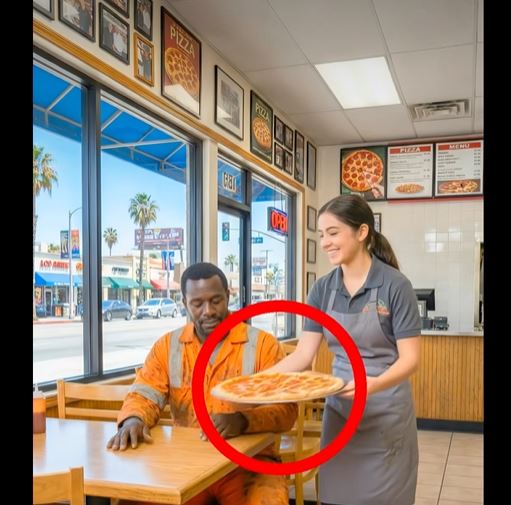
The lunch rush had just begun when the man pushed open the glass door of the restaurant. A small bell chimed overhead, barely noticed above the noise of clinking plates, raised voices, and the constant hum of conversation. The place was popular—brick walls, open kitchen, the smell of fresh dough and tomato sauce filling the air. Every table was nearly full.
The man paused for a moment, brushing dust from his sleeves. His work uniform was clean but worn, the kind of fabric that had seen years of honest labor. His boots were scuffed, his hands rough, his face tired in a quiet, dignified way. He didn’t look lost. He didn’t look unsure. He simply looked like someone hungry.
He approached the counter calmly.
“Good afternoon,” he said politely. “May I have a slice of pepperoni pizza and a glass of water, please?”
The young cashier smiled. “Of course,” she replied, already reaching for a plate. “That’ll be—”
Before she could finish, a sharp voice cut in from behind.
“Wait.”
The manager stepped forward, eyes narrowing as they scanned the man from head to toe. His tailored blazer and expensive watch stood in stark contrast to the dusty uniform in front of him.
“We don’t serve people like this during peak hours,” the manager said flatly.
The cashier froze. “Sir, he’s just ordering—”
“I said wait,” the manager snapped, then turned back to the man. “Look around. You see this place? This isn’t a shelter. Customers expect a certain atmosphere.”
The room grew quieter. Nearby diners slowed their chewing. A woman at the next table frowned. A teenage boy lowered his phone, sensing something uncomfortable unfolding.
The man remained calm. “I’m sorry if I’ve caused any inconvenience,” he said evenly. “I just want a slice of pizza. I’ll eat quickly.”
The manager scoffed. “With boots like that? Covered in dust? You’ll dirty the place. Go wash up somewhere else and come back.”
The man glanced down at his boots, then back up. “I’ve been working all morning. I didn’t realize that disqualified me from eating.”
“It disqualifies you from eating here,” the manager replied loudly. “Now move aside. You’re holding up paying customers.”
A heavy silence settled over the counter.
The cashier looked embarrassed. “Sir, I can serve him. It’s not a problem.”
“It is a problem,” the manager insisted. “And if you want to keep your job, you’ll listen.”
The man took a slow breath. “I’m happy to pay extra,” he offered. “And I assure you, I’ll be respectful.”
The manager laughed—a short, humorless sound. “Extra? You think this is about money? This is about standards. We’re not some roadside joint.”
That did it.
A few customers began murmuring. One man shook his head. A woman whispered, “That’s unnecessary.” But no one stepped in. Discomfort is easy to feel and hard to challenge.
The man nodded once. “Alright,” he said softly.
He reached into his pocket.
The manager smirked. “Finally. Leaving.”
Instead, the man pulled out a phone.
“I was hoping not to do this in public,” he said, his voice calm but firm. “But since you insist.”
He tapped the screen, then held the phone up.
“Do you recognize this number?” he asked.
The manager barely glanced at it. “No. And I don’t care.”
The man smiled faintly. “You should.”
He turned the phone so the screen faced the manager more clearly. On it was a company profile—legal documents, branding, ownership details. The restaurant’s name sat boldly at the top.
Under it was a single word.
Owner.
The manager’s face drained of color.
“That’s… that’s not funny,” he stammered.
“It’s not meant to be,” the man replied. “My name is Daniel Kovács. I founded this restaurant twelve years ago. I still own it.”
The room went dead silent.
“You—” the manager swallowed hard. “You never come here dressed like that.”
Daniel looked down at his uniform. “Because most days, I’m at construction sites, supply warehouses, or kitchens. I like to see how my businesses run when no one thinks they’re being watched.”
The cashier’s eyes widened. A couple at the counter gasped softly.
The manager straightened his jacket nervously. “Sir, I—I didn’t recognize you. I’m very sorry if there’s been a misunderstanding.”
“There hasn’t,” Daniel said calmly. “You were very clear.”
He turned to the cashier. “Did you want to serve me pizza?”
“Yes,” she said immediately. “Of course.”
“Thank you,” Daniel replied warmly.
As she prepared the plate, Daniel looked back at the manager. “Tell me,” he said. “If I had been wearing a suit instead of dust, would I still be ‘ruining the atmosphere’?”