When Ethan Cole stepped off the bus at the edge of his hometown, the air felt different. Not just cleaner or quieter than the desert he had left behind overseas, but heavier, as if the land itself was holding its breath.
He adjusted the strap of his worn duffel bag on his shoulder and took a long look at the familiar road stretching ahead of him. This was the road he had walked as a boy, the land his family had owned for three generations. He had survived combat, loss, and years away from home, believing that no matter what happened, this place would still be his anchor.
He was wrong.
The first sign came when he reached the old wooden gate at the edge of his property. The rusted lock he remembered was gone, replaced with a brand-new chain and a laminated notice zip-tied to the fence. Ethan frowned and stepped closer, reading the words slowly, carefully, as if they might rearrange themselves into something that made sense.
“Property under temporary federal use by executive directive.”
His heart thudded hard in his chest.
Ethan cut the chain with a multitool he carried out of habit and walked up the gravel drive, each step stirring memories of running barefoot with his sister, of his father teaching him how to mend fences, of evenings spent watching the sun drop behind the hills. But the sounds ahead were wrong. Too many voices. Children laughing. Engines humming. When the house finally came into view, his breath caught.
Strangers were everywhere.
Tents dotted the yard. A portable generator buzzed near the porch. Laundry hung from lines strung between trees his mother had planted decades ago. His family’s farmhouse—the one he had sworn to return to—now bore a government-issued sign bolted to the door.
He stood frozen, a soldier suddenly without orders.
A man in a reflective vest noticed him first. “Hey! You can’t be back here,” the man called out, raising a hand. “This is restricted property.”
Ethan laughed once, sharp and humorless. “Restricted?” he said. “That’s my house.”
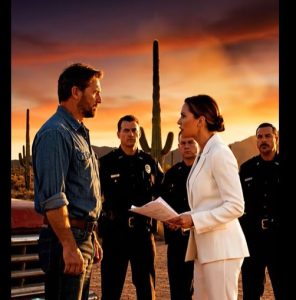
The man hesitated, then motioned for someone else. A woman approached, clipboard in hand, her expression tired but firm. “Sir,” she said, “this land is currently under emergency allocation. Presidential orders. We’re housing displaced families here temporarily.”
Ethan felt the words hit him harder than any explosion he’d survived. Presidential orders. Temporary. Displaced families. None of it explained why no one had called him. Why no letter had reached him overseas. Why the land his family had paid taxes on for decades had been taken without a word.
“I never signed anything,” Ethan said quietly. “My name is on that deed.”
The woman nodded as if she’d heard this before. “You can file a claim. But until further notice, the order stands.”
He walked past her before she could stop him.
Inside the house, the smell of unfamiliar cooking filled the air. His father’s old chair was gone. The photos that once lined the mantel were missing. In their place were cots, boxes, and donated supplies. A child looked up at him from the living room, wide-eyed, clutching a toy truck. Ethan stopped short, the anger in his chest colliding with something else—confusion, guilt, and a deep, aching sense of displacement.
That night, Ethan slept in his truck at the edge of his own land, staring up at the stars. He had slept in worse conditions, but never like this—not as a stranger on his own soil. The next morning, he went to the county office, then the state office, then called numbers that led to other numbers. Every answer sounded rehearsed. Emergency powers. National interest. Temporary use.
Word spread quickly through the town. Some people supported the decision, saying it was necessary, humane. Others were outraged on Ethan’s behalf. “You fought for this country,” one man told him at the diner. “Now they take your land?”
Ethan didn’t shout. He didn’t threaten. He did what he’d learned to do in uniform—he documented everything. He filed appeals. He spoke to reporters. He showed photos of his family standing in front of that house decades earlier. He spoke calmly, clearly, about service, sacrifice, and the quiet contract between a citizen and his nation.
When the last vehicle left, the land fell quiet again. Different, but still his. Ethan stood on the porch as the sun set, the same way he had as a boy. He realized then that coming home wasn’t just about reclaiming property. It was about reclaiming voice, dignity, and the right to be seen.