The restaurant was elegant but quiet, the kind of place where conversations stayed low and time seemed to slow. Crystal glasses caught the light from the chandeliers, and soft piano music floated through the air.
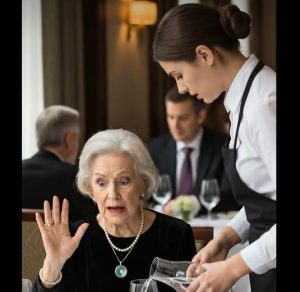
Eleanor Whitmore sat at her usual table by the window, her posture straight, her hands resting calmly on her handbag. At seventy-two, she was still impeccably dressed, her silver hair perfectly styled, her pearl earrings a subtle reminder of a life shaped by wealth and tradition.
She was known in the city as a formidable woman. A widow of a powerful businessman, a grandmother whose family name carried weight, and a philanthropist whose donations filled newspaper columns. People often assumed she had everything. Few knew how much she had lost.
Eleanor glanced up as the waitress approached. The young woman looked tired but polite, balancing plates with practiced ease. As she set down Eleanor’s tea, something caught Eleanor’s eye. At first, it was just a glint of gold beneath the sleeve of the waitress’s uniform. Then Eleanor saw the shape.
Her breath caught.
The bracelet around the waitress’s wrist was delicate, old-fashioned, with a tiny engraved lily clasp. Eleanor’s hand trembled as she lifted her teacup. That bracelet was not just jewelry. It was an heirloom. One that had disappeared decades ago.
The waitress smiled. “Is everything alright, ma’am?”
Eleanor couldn’t speak. Her eyes filled with tears as memories rushed in, vivid and painful. That bracelet had belonged to her daughter, Margaret. Eleanor had given it to her on her sixteenth birthday, a piece passed down from Eleanor’s own mother. Margaret had worn it every day, until the night she ran away.
Margaret had been nineteen, headstrong and in love with a man Eleanor disapproved of. Words were exchanged. Voices were raised. Eleanor had said things she could never take back. By morning, Margaret was gone, leaving behind only a note and an empty jewelry box. The bracelet had vanished with her.
Years passed. Eleanor searched. She hired investigators. She called shelters and hospitals. But Margaret never came home. Then came the call that broke what little hope Eleanor had left. Margaret had died young, alone, leaving no forwarding address, no family listed.
Eleanor had buried her grief under responsibility and appearances. She raised her grandson, expanded the family business, and learned to smile without feeling joy. But the bracelet had haunted her dreams, a symbol of love lost and pride that came too late.
Eleanor asked the manager for privacy, her status ensuring immediate compliance. They were ushered into a quiet corner of the restaurant. Lena sat across from her, nervous, twisting the bracelet around her wrist.
“My grandmother raised me,” Lena explained softly. “She said it was the only thing her mother left her. She told me to wear it so I’d remember where I came from.”
Eleanor closed her eyes, tears spilling freely now. “Your grandmother,” she said, “what was her name?”
Lena hesitated. “Margaret Whitmore. She changed her last name when she left home.”
The room seemed to spin.
Eleanor reached across the table and took Lena’s hands in hers. “I’m your great-grandmother,” she said, the words both terrifying and miraculous.
Lena stared at her, stunned. “That’s not possible,” she said. “My grandmother said her family disowned her.”
Eleanor’s voice broke. “I was wrong,” she said simply. “And I paid for it every day since.”
They talked for hours. Eleanor learned that Margaret had struggled but loved fiercely. That she had worked two jobs, never speaking ill of her mother, always saying she hoped one day Eleanor would forgive her. Margaret had died of illness, leaving Lena with little more than stories and that bracelet.
Lena learned about the family she never knew, the wealth that could have changed everything, the grandmother who had mourned her existence without ever knowing her name.
When they finally stood to leave, Eleanor embraced Lena tightly, sobbing into her shoulder. Decades of regret poured out in that moment, replaced by something Eleanor had thought she would never feel again: redemption.
News traveled fast. Within days, lawyers confirmed the connection through records and DNA tests. The Whitmore family was shaken. Some welcomed Lena. Others whispered. Eleanor didn’t care.
She moved decisively. Lena was offered a place in the family, not as a charity case, but as blood. Eleanor insisted Lena move into the guest house while she finished school. The restaurant job was optional now, but Lena chose to keep it, wanting to earn her own way.
One afternoon, as they sat together in Eleanor’s sunlit living room, Lena removed the bracelet and placed it gently in Eleanor’s palm.