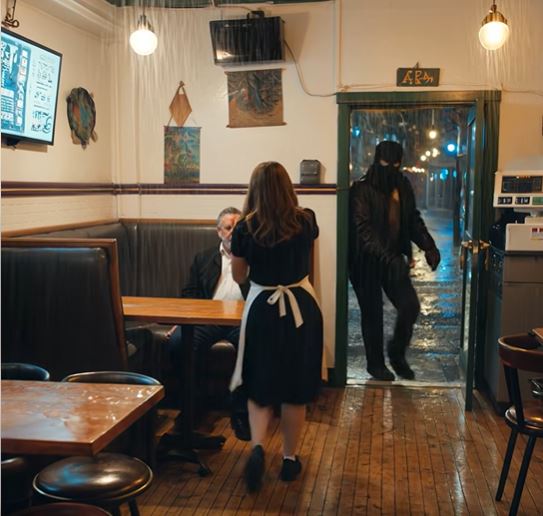
Rosalie Thornton wasn’t the kind of person who ended up in other people’s stories. She was the kind who brewed the coffee, wiped the counter, and remembered your order even when you didn’t remember her name.
Thirty-two years old, permanently tired, and quietly stubborn, Rosalie lived her life in the margins of a small Midwestern city that forgot people as easily as it paved over old buildings. She worked the early shift at Larkspur Café because mornings were predictable, and predictability felt like safety.
At 4:17 a.m. on a Tuesday that would later be replayed on news channels she never watched, Rosalie unlocked the café door and stepped inside, unaware that her life had already tilted off its axis.
The night before, just after closing, she had done something that still didn’t feel real.
It had started with a man shouting.
Rosalie had been counting the register when the bell over the door jingled and a stranger stumbled in, breathless, bleeding from a cut above his eyebrow. Behind him, another man followed—calm, deliberate, one hand buried deep inside his jacket. Rosalie didn’t need to see the weapon to know it was there. You don’t grow up with a volatile father and miss that kind of posture.
“Give me the bag,” the second man said quietly, eyes never leaving the first.
The injured man backed up, panic flooding his face. “I don’t have it,” he stammered. “I told you—”
Rosalie moved without thinking. She stepped between them.
For a second, the world froze. The hum of the refrigerator, the ticking wall clock, the faint smell of burnt espresso beans—it all sharpened into painful clarity. She felt the air shift as the man with the weapon adjusted his stance, surprised.
“Ma’am,” he said, almost politely, “this doesn’t concern you.”
Rosalie’s heart hammered so hard it made her lightheaded. She knew she should step aside. She knew she should call the police, scream, run—anything except stand there with her hands shaking and her spine locked in place.
But she thought about the injured man’s eyes. About the fear she recognized too well.
“I’ll give you the money in the register,” she said. Her voice cracked, but she didn’t stop. “All of it. Just… leave him.”
The man studied her. Calculated. The weapon never moved, but his attention shifted.
“How much?” he asked.
“Couple hundred,” she said. “Maybe more.”
Silence stretched thin.
Then he nodded once.
Rosalie handed over the cash, fingers numb, and the man backed away, never turning his back, before slipping out into the night. The injured stranger collapsed into a chair, shaking. Rosalie called an ambulance. She gave her statement to the police. She locked up and went home, convinced that would be the end of it.
It wasn’t.
At 5:02 a.m., the next morning, four black sedans rolled to a silent stop outside Larkspur Café.
Rosalie was still in the back, tying her apron, when she heard the knock. Not loud. Not aggressive. Controlled.
She opened the door to find four men in black suits standing in a line that was just a little too perfect. Earpieces. Polished shoes. The kind of stillness that didn’t belong to salesmen or cops.
“Ms. Thornton,” the man in front said. “May we come in?”
Her stomach dropped. “Is something wrong?”
“Yes,” he said evenly. “And also very right.”
They sat at a corner table while the coffee brewed, untouched. The man who spoke introduced himself only as Grant. He didn’t smile.
“The man you protected last night,” Grant said, “is a federal witness.”
Rosalie blinked. “I don’t—”
“He’s been cooperating in an investigation involving weapons trafficking and organized crime,” Grant continued. “The man who followed him into your café was sent to eliminate him.”
Rosalie’s knees felt weak. “I just… gave him money.”
Grant nodded. “You placed yourself between a firearm and a target. That decision gave our team enough time to intercept the suspect three blocks away.”
She stared at her hands. They were still trembling.
“You could have been killed,” one of the other men said, his voice low but not unkind.
“I didn’t think,” Rosalie whispered.
Grant leaned forward. “That’s exactly why we’re here.”
They told her what the papers would later call “unprecedented civilian intervention.” They told her her café had been flagged by surveillance after the witness fled inside. They told her they had footage of her stepping forward without hesitation.
“This is not payment,” Grant said carefully. “It’s compensation. For trauma. For risk. For doing what trained people hesitate to do.”