Dust curled into the burning air as the convoy rolled slowly across the deserted road. The heat shimmered over the cracked asphalt, turning the horizon into a wavering illusion. Sergeant Marcus Hale sat behind the wheel of the armored vehicle, his hands steady but his mind alert. War had taught him that silence was never truly silent. Danger often arrived without warning.
Beside him, resting calmly yet attentively, was Rex — a trained army dog whose intelligence had saved countless lives. Rex was not just a military asset; he was Marcus’s partner, his protector, and, in many ways, his closest friend.
That morning had begun like any other.
The unit had received orders to transport supplies to a nearby base. The route was familiar, considered relatively safe, and previously cleared. Soldiers joked quietly through their radios, trying to ease the tension that always lingered in hostile territory. Marcus even allowed himself a rare moment of calm.
But Rex did not.
From the moment they started the journey, the German Shepherd had been unusually restless. His ears twitched constantly, his sharp eyes scanning the road ahead. He shifted his weight, releasing low, uneasy growls.
Marcus glanced down.
“What is it, boy?” he murmured.
Rex did not respond with his usual calm obedience. Instead, he stood abruptly, placing his front paws against Marcus’s chest and barking sharply — once, twice, then again, louder each time.
Marcus frowned. Rex was trained never to panic without reason.
The barking grew more urgent. Rex began scratching at Marcus’s vest, then turned toward the vehicle door, whining intensely.
Something was wrong.
Marcus grabbed the radio.
“Control, this is Sergeant Hale. My dog is signaling a threat. Requesting permission to stop and check the vehicle.”
Static crackled.
“Route is confirmed safe, Sergeant. Continue moving.”
Marcus hesitated. Military protocol demanded obedience. But Rex’s behavior was impossible to ignore. The dog had detected explosives before, sensed ambushes, and even located injured soldiers buried under rubble. His instincts were rarely mistaken.
Rex suddenly lunged toward the door again, barking frantically.
That was enough.
Marcus slammed the brakes. The convoy behind him halted in confusion as he threw open the door.
“Out! Everyone out of the vehicle!” he shouted.
Some soldiers protested, confused by the sudden order. But Marcus’s voice carried authority born from experience. They scrambled out, spreading away from the armored truck.
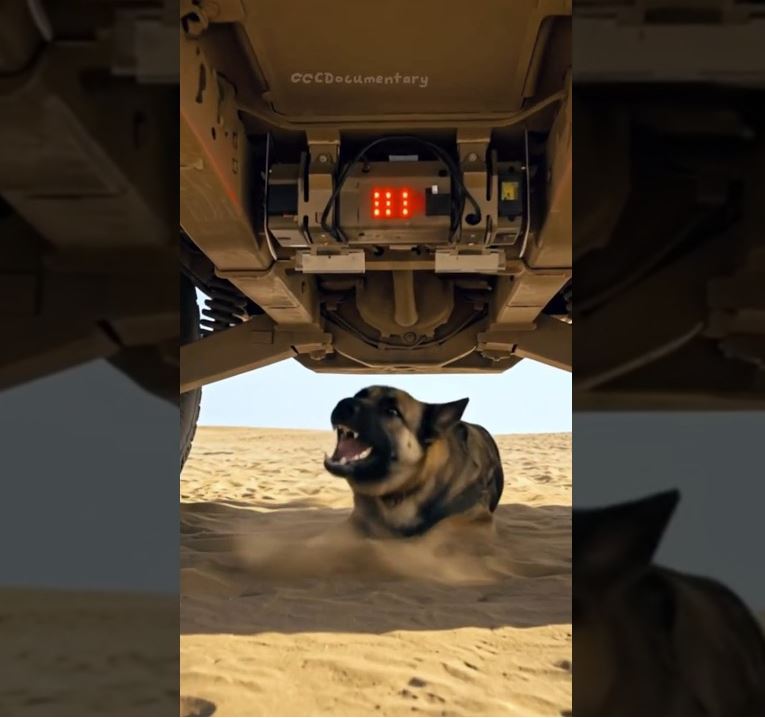
Rex leaped down beside Marcus, pulling him farther from the vehicle, still growling toward its underside.
Seconds passed.
Then the world exploded.
A deafening blast tore through the air as the vehicle erupted into flames. Metal twisted violently, smoke rising in a thick black column. The shockwave slammed into the soldiers, throwing them to the ground.
Marcus shielded his head, heart pounding violently in his chest. When the ringing in his ears faded, he realized something terrifying.
They would have all been inside.
He turned to Rex, who stood calmly beside him, alert but unharmed. The dog’s breathing was heavy, but his eyes remained focused, as if ensuring the danger had truly passed.
Marcus dropped to his knees and wrapped his arms around the animal.
“You saved us,” he whispered, voice trembling.
The unit later discovered an improvised explosive device planted beneath the vehicle’s frame — expertly hidden, nearly impossible for human inspection to detect. Yet Rex had sensed it instantly.
Word of the incident spread quickly through the base. Soldiers who had once viewed the dog as merely part of equipment now approached him with reverence. They offered him treats, gentle pats, and quiet thanks. To them, he was no longer just a trained animal — he was a hero.
But Rex did not understand praise or recognition. He simply stayed beside Marcus, as loyal and attentive as ever.
Weeks later, Marcus sat outside the barracks at sunset, watching the sky glow with fading light. Rex lay beside him, resting his head on Marcus’s boot.
War had changed Marcus in ways he could never fully explain. He had witnessed loss, fear, and destruction beyond imagination. Yet in the darkest moments, one constant remained — the silent loyalty of the dog beside him.
“You know,” Marcus said quietly, scratching Rex’s ears, “back home they’ll call you a hero.”
Rex lifted his head slightly, tail wagging once.
Marcus smiled faintly.
“But you don’t care about that, do you? You just do your job.”
He thought about how differently the day could have ended — the empty vehicle, the grieving families, the unbearable weight of guilt. Instead, they were alive because a dog had trusted his instincts and refused to stay silent.