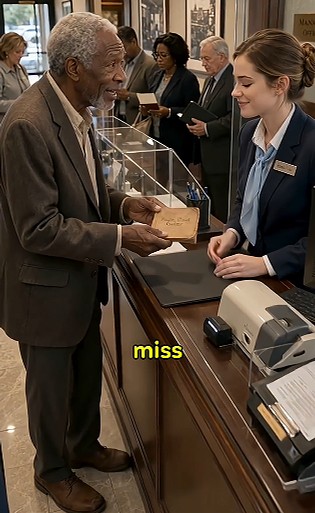
Thomas Miller carefully placed an old blue passbook on the marble counter.
The corners were bent, the cover had faded, and a thin piece of tape held the binding together.
Behind the counter, Emily Carter looked down at it with curiosity.
Most customers used debit cards, mobile apps, or printed account statements.
She had never seen a passbook that looked this old.
“Miss,” Thomas said quietly, “I’d like to withdraw the money from this account, assuming it still exists.”
Emily picked up the book carefully.
The name printed inside was nearly invisible.
Thomas Miller and Rose Miller.
The first handwritten deposit had been recorded in 1974.
“Sir, this is a very old passbook,” Emily said. “May I ask what the account was used for?”
Thomas smiled faintly.
“It was for my wife, Rose.”
Emily looked at the handwritten name again.
“Rose,” she repeated. “That’s a beautiful name.”
“She was a beautiful woman.”
Emily turned another page.
Small deposits had been entered almost every year.
Twenty dollars.
Fifteen dollars.
Sometimes fifty.
Beside several deposits, someone had written short notes in pencil.
Rose’s birthday.
Christmas gift.
For our future.
“Let me check this carefully,” Emily said. “Something like this deserves more than a quick answer.”
Thomas nodded gratefully.
Before Emily could begin searching, an impatient voice came from behind her.
“What’s going on?”
Mr. Wallace, the branch manager, walked toward the counter.
He glanced at the growing line of customers and then at the worn passbook in Emily’s hands.
“What’s holding up the line?” he asked.
“Mr. Wallace, this gentleman has an old savings passbook,” Emily explained. “I’m trying to find the account in our archived records.”
Mr. Wallace barely looked at it.
“Archived records?”
“The account may have been opened before the bank converted everything to a digital system.”
Mr. Wallace sighed.
“Emily, that thing belongs in a family drawer, not at a teller window.”
Thomas immediately stepped back.
“I’m sorry,” he said. “I didn’t mean to slow anyone down.”
He reached toward the passbook.
“I can come back another time.”
Emily gently moved the book away from the edge of the counter.
“You don’t need to leave, sir.”
Mr. Wallace looked at Thomas.
“Old paper doesn’t necessarily mean there is still money attached to it. This account probably hasn’t been valid in decades.”
Thomas looked down at the faded cover.
“I put money into it every year,” he said. “It was never very much, but I tried to add something on Rose’s birthday and every Christmas.”
Emily studied the final handwritten entry.
It had been made nearly ten years earlier.
“Is Rose with you today?” she asked.
Thomas was silent for a moment.
“She passed away nine years ago.”
Emily’s expression softened.
“I’m sorry.”
“Thank you.”
Thomas placed both hands on the counter to steady himself.
“Before Rose died, she had plans for the old community library on Oak Street.”
Emily knew the building.
It had been closed for repairs for more than a year.
“She volunteered there every Saturday,” Thomas continued. “She always talked about building a children’s reading room.”
He smiled at the memory.
“She believed every child deserved a quiet place where they could discover books.”
“Is that why you want the money?” Emily asked.
Thomas nodded.
“The library is finally reopening. I wanted to use whatever is left in this account to help finish the reading room.”
Mr. Wallace looked toward the waiting customers.
“Sir, this is a bank, not a memory center.”
Emily turned toward him.
“It will only take me a few minutes to check the legacy system.”
“And if you keep wasting customers’ time,” Mr. Wallace replied quietly, “those may be your final minutes working at the front desk.”
Emily looked at the line.
Another teller had already opened a second window.
The customers were moving again.
“I can handle this,” she said.
Mr. Wallace pointed toward her computer.
“Check the regular system once. If nothing appears, return the book and move on.”
Emily entered Thomas’s name and date of birth.
No active accounts appeared.
She tried Rose’s name.
Nothing.
Mr. Wallace tapped the counter.
“There. You have your answer.”
He turned toward the line.
“Next customer, please.”
Thomas reached for the passbook.
“Thank you for trying,” he told Emily.
He was about to walk away when she noticed a handwritten number on the final page.
It was not formatted like any modern account number.
Three digits appeared first, followed by a dash and a series of smaller numbers.
Emily had seen a similar format during a training session about the bank’s earliest records.
“Sir, please wait.”
Mr. Wallace stopped.
“Emily, I said we’re finished.”
She picked up the phone beside her computer.
“I’d like to call records management.”
“Step away from that phone.”
Thomas looked worried.
“Young lady, please don’t risk your job for an old man and an old book.”
Emily looked down at the passbook.
“Sir, this isn’t just an old book.”
She pointed to the handwritten deposits.
“It’s a promise with an account number.”
Before Mr. Wallace could stop her, Emily dialed the bank’s records department.
“Hello,” she said. “I need someone to check the pre-digital ledgers under Miller, Thomas and Rose. It may be a long-term savings account opened in the 1970s.”
Mr. Wallace’s face tightened.
“After today, you can take that patience of yours to the back office. You will no longer be working at a customer window.”
Emily covered the receiver.
“If that’s your decision, I understand.”
She returned her attention to the call.
The records employee asked her to read the handwritten number.
Emily read each digit slowly.
A few seconds later, the employee became silent.
“Can you repeat the first three numbers?” the employee asked.
“Zero, zero, one.”
Mr. Wallace’s head turned sharply.
“What did you say?”
Emily repeated it.
“Account number zero-zero-one.”
The employee asked Emily to wait while a supervisor joined the call.
Mr. Wallace stepped closer to the computer.
“There must be a clerical error,” he said. “Close the file. I’ll handle it from here.”
Emily kept the receiver in her hand.
“The records department hasn’t finished checking.”
Thomas looked between them.
“Is something wrong?”
Mr. Wallace did not answer.
One minute later, the records supervisor came onto the line.
Emily listened carefully and began writing notes.
Her eyes widened.
“Are you certain?” she asked.
She listened again.
“Yes, I understand. Please send the documents to the branch immediately.”
When Emily ended the call, the counter area had gone silent.
Even the customers standing in line were watching.
“Mr. and Mrs. Miller were among the first customers of this branch,” Emily said.
Mr. Wallace’s face had lost its color.
“That can’t be correct.”
“Their account was opened during the first week the branch operated.”
Emily looked toward Thomas.
“The bank later used their account as the model for its family savings program.”
Thomas appeared confused.
“Rose and I were only depositing a few dollars at a time.”
“The savings account itself is modest,” Emily explained. “However, it was connected to something called the Miller Family Memorial Trust.”
Thomas frowned.
“I’ve never heard of that.”
Mr. Wallace reached for the passbook.
“Give me the file. This needs to be reviewed privately.”
Emily moved the book closer to Thomas.
“The trust belongs to Mr. Miller. He has the right to hear what was found.”
The records department sent the original documents to Emily’s computer.
She opened the scanned file.
In 1974, Thomas and Rose had been selected for a special program created by the bank’s founder.
The bank matched deposits made by several early customers and invested the matching funds in a protected community trust.
Most participants had claimed their money years earlier.
The Millers had never been notified properly after the branch changed ownership.
The account remained untouched.
For decades, the trust had continued earning interest and investment returns.
“How much is in it?” Thomas asked.
Emily read the final balance twice before answering.
“The savings account contains a little over twelve thousand dollars.”
Thomas placed one hand over his mouth.
“Twelve thousand?”
Emily nodded.
“The linked memorial trust is worth considerably more.”
She turned the computer screen toward him.
The current value was $486,320.
Thomas stared at the number.
“That money can’t belong to me.”
“According to the original documents, it belongs to you and Rose’s estate.”
Thomas slowly sat in a chair beside the counter.
For several seconds, he could not speak.
Then he opened the passbook and touched Rose’s name with one finger.
“She saved every little bit she could,” he said. “Even when we barely had enough for ourselves.”
Mr. Wallace adjusted his tie.
“Mr. Miller, I would be happy to discuss investment options in my office.”
Thomas looked up at him.
“A moment ago, you said this book belonged in a drawer.”
Mr. Wallace said nothing.
Thomas turned to Emily.
“Can the money still be used for the reading room?”
“Once the ownership documents are confirmed, you may use it however you choose.”
Thomas smiled through the tears in his eyes.
“Then Rose is finally going to have her library.”
Several months later, the Rose Miller Children’s Reading Room opened inside the renovated Oak Street Library.
It included shelves filled with new books, comfortable reading chairs, tutoring tables, and a small fireplace surrounded by bright cushions.
Above the entrance was a framed copy of the first page of the old passbook.
Thomas donated most of the memorial trust to the library and used the remainder to create an annual literacy program for local children.
Emily attended the opening ceremony as his honored guest.
She had not been sent to the back office.
After a review of the incident, senior management promoted her to customer care supervisor.
Mr. Wallace was required to complete additional leadership training before returning to a management role.
At the ceremony, Thomas stood beside Emily as children entered the reading room for the first time.
“You could have returned the book and called the next customer,” he told her.
Emily watched a young girl pull a book from the shelf.
“It didn’t feel right to stop looking.”
Thomas smiled.
“Most people saw an old man holding an old piece of paper.”
He looked toward Rose’s name above the doorway.
“You saw a promise that had been waiting fifty years to be kept.”