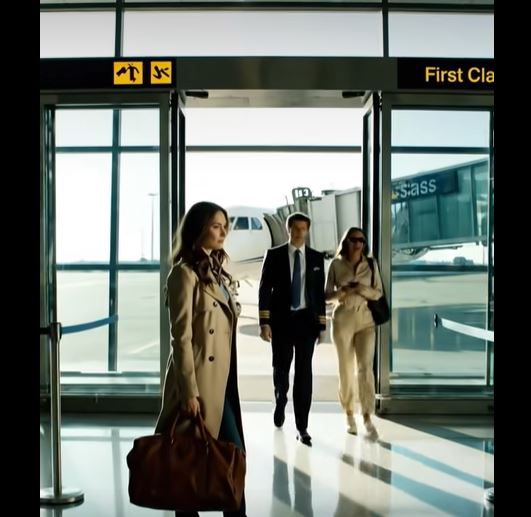
Airports always made me uneasy. Too much movement, too many voices, too many goodbyes and reunions happening all at once. That morning, the terminal buzzed with the usual chaos—rolling suitcases, crying children, boarding announcements echoing overhead. I stood beside my father near the departure gate, clutching my passport, already wishing the flight would be called so we could stop standing there.
My dad was in one of his moods.
He wore his confidence like armor, shoulders squared, chin lifted, scanning the room as if everything in it existed for his judgment. He had always been that way—loud opinions, sharp humor, and an unshakable belief that he was right about people the moment he looked at them.
That’s when he noticed her.
She stood a few rows away, alone except for a small carry-on bag at her feet. She wore a plain dress and worn sneakers, her hair pulled back loosely. There was nothing flashy about her. No phone in her hand. No headphones. Just quiet stillness, like she was trying not to take up space.
My dad leaned closer to me and smirked.
“Look at that,” he said under his breath. “You can always tell who doesn’t belong in a place like this.”
I felt my stomach tighten. “What do you mean?”
He nodded toward her. “Probably flying for the first time. Or worse—trying to look important. You see the shoes? Dead giveaway.”
I glanced at her again. She hadn’t done anything to deserve that kind of attention. She wasn’t bothering anyone. She wasn’t loud or rude or careless. She was just… there.
I should have said something.
Instead, I said nothing.
My dad chuckled, clearly enjoying himself. “Bet she’s sitting in economy and acting like it’s a luxury trip. People like that always do.”
The words stung, but I stayed silent. Years of growing up under his shadow had taught me how to do that well—how to swallow discomfort, how to avoid confrontation, how to pretend I didn’t hear things that felt wrong.
The girl shifted slightly in her seat, adjusting the strap of her bag. For a brief second, her eyes lifted, and I wondered if she had heard him. Our gazes met.
She smiled.
Not a forced smile. Not a defensive one. Just a soft, polite smile—like she had nothing to prove.
I looked away immediately, shame warming my cheeks.
Boarding was announced shortly after. As we lined up, my dad continued muttering observations about other passengers—someone dressed too casually, someone else “trying too hard.” I nodded absently, my thoughts stuck on that quiet girl and the way she had smiled despite being judged.
When we stepped onto the plane, I realized she was directly ahead of us.
She stopped at the first row of first class.
The flight attendant greeted her warmly. “Welcome back, Ms. Rivera. We’re happy to have you with us.”
She smiled again—the same calm smile—and took her seat by the window.
My dad froze.
I watched his face shift from confidence to confusion, then to something dangerously close to embarrassment.
A few minutes later, a man in a tailored suit boarded and walked straight toward her. He leaned down slightly, speaking softly, respectfully. She nodded as he spoke, listening with quiet authority.
The flight attendant returned, this time addressing her directly. “If there’s anything you need during the flight, please don’t hesitate to let us know.”
The flight took off smoothly. Clouds stretched endlessly outside the window, sunlight reflecting off their edges. I couldn’t relax. My mind kept replaying the moment at the gate, the sound of my father’s voice, the ease with which he had dismissed her worth.
Halfway through the flight, turbulence hit. Nothing serious, but enough to jolt the cabin. A few passengers gasped. Somewhere ahead, a child cried.
Then a voice came over the intercom—not the captain’s.
“Ladies and gentlemen, this is Dr. Rivera speaking. If there is a passenger in need of medical assistance, please notify a flight attendant immediately.”
I watched as Dr. Rivera moved confidently through the cabin, kneeling beside an elderly man who had collapsed. Her movements were precise, her voice steady. She reassured him, checked his pulse, gave instructions to the crew with authority that left no room for doubt.
Everyone watched.
The man stabilized quickly. Relief rippled through the cabin.
As she returned to her seat, passengers murmured words of gratitude. Someone clapped softly. Another whispered, “She saved him.”
My dad didn’t say a word.
After landing, we disembarked slowly. As we passed first class, Dr. Rivera stood to retrieve her bag. For a moment, she looked at us—at me.