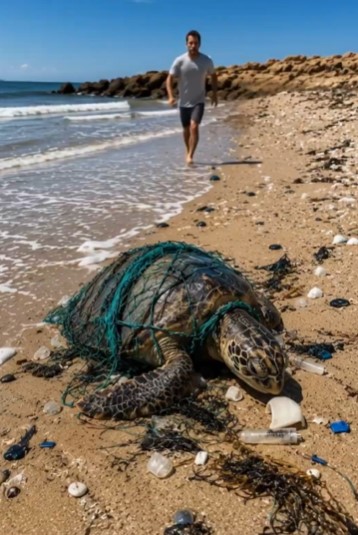
The sea turtle kept trying to crawl forward.
Each movement brought it only a few inches closer to the waves before something pulled it back again.
A discarded fishing net had wrapped tightly around its flippers and shell, leaving the exhausted turtle stranded on the sand.
The ocean was so close.
Yet completely out of reach.
Families walked along the beach enjoying the warm afternoon, unaware that just beyond the shoreline, a silent struggle was unfolding.
Then one child pointed toward the turtle.
“What happened to it?”
Several nearby beachgoers turned to look.
At first, they thought the turtle was simply resting.
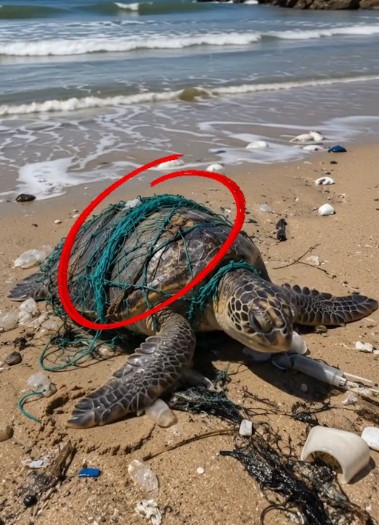
But as they walked closer, they saw the tangled fishing net wrapped around its body.
The turtle tried to move again.
It couldn’t.
Without hesitation, the group carefully kept a respectful distance while one person contacted the local marine wildlife rescue team.
Another beachgoer asked everyone nearby to give the turtle space and avoid surrounding it.
The frightened animal remained surprisingly calm, lifting its head occasionally toward the sound of the crashing waves.
The rescue team advised the group by phone to keep the turtle cool and avoid pulling forcefully on the net until trained responders arrived.
Fortunately, help was only minutes away.
When marine wildlife rescuers reached the beach, they quickly assessed the situation.
The net had become tightly wrapped around both front flippers and part of the turtle’s shell.
Using specialized rescue scissors, the team carefully began cutting away the fishing net.
Every strand was removed slowly.
The goal was to avoid causing additional stress or injury.
Minute by minute, the tangled net became smaller.
Finally, the last piece slipped away.
The turtle remained still for a moment.
Then it slowly stretched each flipper, testing its movement.
The rescuers performed a brief health check and found only minor abrasions where the net had rubbed against the shell and skin.
The turtle appeared tired but otherwise healthy.
With the path finally clear, the rescue team gently guided the turtle toward the shoreline while allowing it to move at its own pace.
Everyone watching stepped back.
No one wanted to disturb the special moment.
The turtle paused as the first wave reached its flippers.
Then another wave arrived.
Slowly, it continued forward until the water lifted its body.
Within seconds, the turtle began swimming into the gentle surf.
A quiet cheer spread across the beach.
Children smiled.
Adults applauded softly.
The turtle disappeared beneath the waves before surfacing once more farther offshore.
It was finally home.
Before leaving, the rescue team collected the remaining pieces of fishing net and other plastic debris scattered along the beach.
They explained that discarded fishing gear is one of the greatest threats to marine wildlife, often trapping turtles, seabirds, dolphins, and other ocean animals.
Removing litter from beaches can help prevent future rescues.
The beachgoers stayed behind for a few extra minutes, helping clean additional debris from the shoreline.
What had begun as an ordinary day at the beach became a reminder that small acts of care can protect the wildlife that shares our oceans.
As the sun slowly lowered toward the horizon, gentle waves erased the turtle’s tracks from the sand.
Only memories remained.
Somewhere beneath the blue water, the rescued sea turtle continued its journey through the ocean, free once again because a few strangers chose compassion over curiosity.
Sometimes saving a life begins with something as simple as stopping, paying attention, and working together.
Beachgoers Cut Fishing Net to Help Sea Turtle Back to the Ocean pic.twitter.com/y1alB20pBJ
— Animal Rescue Stories (@AnimalStory5) July 24, 2026
What should you do if you find a sea turtle tangled in fishing net?
If you discover a sea turtle caught in fishing net, keep a safe distance and contact local marine wildlife authorities immediately. Do not drag the turtle or pull forcefully on the net unless instructed by trained professionals. Following wildlife rescue safety tips helps protect both people and marine animals.
Can you rescue a wild sea turtle yourself?
Only if it is safe and you have guidance from wildlife professionals. Sea turtles are protected in many regions, and improper handling can cause additional stress or injury. The best approach is to report the situation, keep the area calm, and allow trained rescuers to assess the animal before it returns to the ocean.