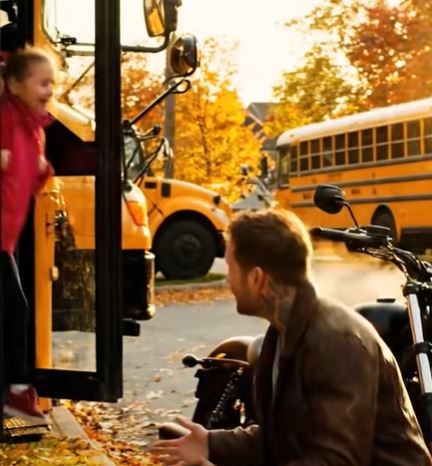
The engine of the old school bus groaned as it climbed the steep incline of Miller’s Hill. Elias, the driver, adjusted his rearview mirror. There he was again—the biker. Black helmet, black bike, and that unyielding presence. For forty-seven days, this man had been a permanent fixture in Elias’s morning routine.
Elias had been a bus driver for thirty years, and he knew when something felt off. He had already noted the license plate and shared it with the local sheriff, but the biker hadn’t broken a single law. He was just… there.
On the forty-eighth morning, a thick fog rolled off the river, reducing visibility to less than ten feet. Elias pulled the bus to a halt at the corner of Cedar and Main. As the stop sign extended from the side of the bus and the red lights began to flash, Elias looked in his side mirror.
The biker had stopped closer than usual. He had his visor up, and for the first time, Elias saw his eyes—they were bloodshot and filled with an intensity that made Elias’s grip tighten on the steering wheel. The atmosphere inside the bus grew tense as the older students in the back rows began to point and whisper.
“He’s got something in his hand,” one of the kids whispered.
Elias unbuckled his seatbelt and stood up. He opened the side window of the cab. “Hey! You’ve been following us for two months. What do you want?”
The biker didn’t shout back. He slowly reached into the breast pocket of his leather jacket. The students gasped, and Elias flinched, expecting a weapon. But what the biker pulled out was a small, laminated photograph and a handheld radar gun.
He held the photo up toward Elias. It was a picture of a young girl in a pink dress, laughing on a swing set. Across the bottom of the photo, a date was written: October 12th.
“This was my daughter, Maya,” the biker’s voice was a low, gravelly rasp that cut through the fog. “Two months ago, on this exact route, a distracted driver roared past a stopped bus just like this one. They didn’t see the stop sign. They didn’t see Maya.”
The air in the bus cabin turned cold. The students who had been mocking the “scary biker” suddenly went silent.
“The police can’t be everywhere,” the biker continued, holding up the radar gun. “So I decided I would be. Every morning for forty-seven days, I’ve been your rear guard. I track the speed of every car that approaches us. I record their plates. And if anyone tries to fly past those flashing lights… I make sure they don’t.”
Elias felt a lump form in his throat. The “overwhelmed” feeling he’d had about the biker shifted from fear to a profound, bone-deep respect. This man wasn’t a threat; he was a sentinel. He was using his grief to build a $150,000 infrastructure of safety that the town’s budget couldn’t cover.
“I’m sorry, brother,” Elias whispered, his voice cracking. “I didn’t know.”
“You don’t need to know,” the biker said, snapping his visor back down. “You just need to drive. I’ll handle the rest.”
As the last student boarded and Elias pulled the lever to close the doors, he looked at the children in his mirror. They weren’t just passengers anymore; they were a legacy being protected by a man who had lost everything.
The biker, whose name was Jax, became a local legend. He never accepted money, and he never spoke to the press. But the statistics in Oak Creek changed. Distracted driving on Route 12 dropped to zero. The “Iron Guardian” had turned a quiet winter road into the safest stretch of asphalt in the state.
The 47-day shadow wasn’t a haunting; it was a blessing. And every morning, when Elias looked in that mirror and saw the black bike trailing behind, he didn’t feel tense. He felt safe. He knew that as long as Jax was back there, no child in a pink dress would ever be a memory again.
The truth was revealed by a photograph, but the impact was felt by a whole community. The man with the tattoos wasn’t just a biker—he was the father they all needed, standing watch in the fog, ensuring that the light of the morning never went out.