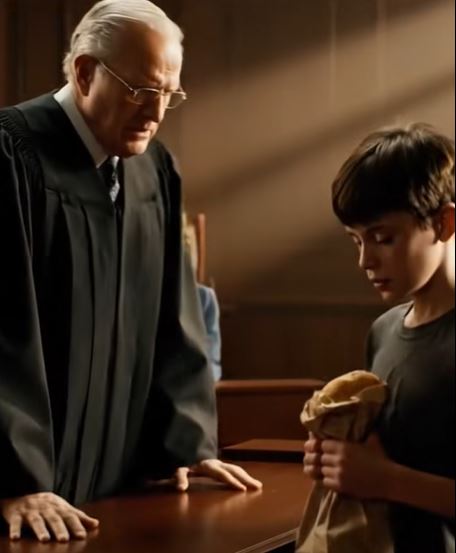
The marble pillars of the federal courthouse stood cold and imposing, a stark contrast to the small, trembling figure standing behind the defendant’s table.
His name was Leo, and at fourteen years old, he looked even younger in a tattered sweater that was two sizes too big. On the mahogany bench above him sat Judge Harrison, a man known for his strict adherence to the law and a face that rarely betrayed emotion.
The charge was simple: Petty Larceny. The evidence was a single, plastic-wrapped loaf of whole wheat bread, valued at three dollars and twenty-nine cents.
“Son,” Judge Harrison began, his voice echoing through the silent courtroom. “The store owner has provided video evidence of you taking this item without payment. Do you deny this?”
Leo looked down at his shoes, his voice barely a whisper. “No, Your Honor.”
“And why did you do it?” the judge pressed. “There are food banks. There are shelters. Why choose to break the law?”
Leo looked up then, and for the first time, the courtroom saw the hollow circles under his eyes—the kind that don’t come from lack of sleep, but from a lack of hope.
“I went to the food bank, sir,” Leo said, his lip quivering. “The line was three blocks long. By the time I got to the front, the crates were empty. I went to the shelter, but they said I was too young to be there without an adult, and my mom… she can’t walk anymore.”
Leo took a shaky breath, clutching the edge of the table. “My mom didn’t eat yesterday—and neither did I. I watched her crying because she thought I didn’t see her ribs showing through her shirt. I didn’t want to steal. I just wanted her to stop crying.”
A heavy, suffocating silence fell over the room. The court reporter stopped typing. The bailiff looked toward the window. Even the store owner, who had insisted on pressing charges to “set an example,” shifted uncomfortably in his seat.
Judge Harrison took off his glasses and rubbed the bridge of his nose. He didn’t look at his law books. He didn’t look at the sentencing guidelines. He looked at the gallery, filled with well-dressed lawyers and city officials.
“I am a judge of the law,” Harrison said, his voice suddenly sharp. “And the law says that theft is a crime. Therefore, I must find this young man guilty.”
A quiet gasp went through the room. Leo’s shoulders slumped.
“However,” the judge continued, standing up. “The law is a reflection of the society that creates it. If a fourteen-year-old boy in the wealthiest nation on earth has to steal a loaf of bread to keep his mother alive, then we are all guilty. We are guilty of negligence, we are guilty of indifference, and we are guilty of failing the very people we swear to protect.”
Judge Harrison reached into his robe and pulled out his wallet. He took out a ten-dollar bill and placed it on the bench.
“I am fining myself ten dollars for living in a city where this happens,” Harrison announced. “And I am fining every person in this courtroom fifty cents for the same reason. Mr. Bailiff, please collect the fines and give them to the defendant.”
One by one, the people in the room stood up. Lawyers in three-thousand-dollar suits, clerks, and even the store owner walked forward. They didn’t just give fifty cents; they gave fives, tens, and twenties. By the time the hat reached the front of the room, it was overflowing with nearly five hundred dollars.
“Case dismissed,” Harrison declared, striking his gavel with a sound that felt like a bell of justice. “Leo, take the money. Buy your mother a meal. Buy her medicine. And then, I want you to go to the back of this building. My clerk has a list of organizations that are going to make sure your fridge is never empty again.”
Leo didn’t leave the courtroom right away. He stood there, clutching the loaf of bread—the same loaf he had “stolen”—which the judge had ordered the store owner to let him keep.
The story of the “Three-Dollar Trial” spread across the city within hours. It forced the local government to increase funding for food programs and prompted a massive wave of donations to the local food bank.
Judge Harrison’s decision didn’t just change Leo’s life; it changed the way the city looked at its own reflection. It reminded everyone that while the law is written in ink, justice must be written in mercy.