In the quiet, coastal whispers of a foggy morning, where the salt spray meets the golden sands, a story of an unlikely bond and a heroic rescue unfolded. It wasn’t a story of human intervention initiated by technology or professional scouts, but rather a tale of primal intuition and the pure, empathetic heart of a Golden Retriever named Max.
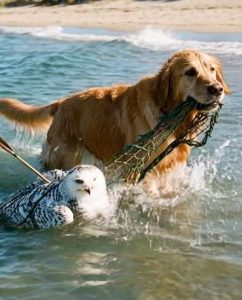
Max was a dog who lived for the shoreline. To him, the beach wasn’t just a place for a walk; it was a vast playground of scents, treasures, and the rhythmic music of the Atlantic. On this particular Tuesday, his owner, Thomas, a local fisherman known for his weathered hands and kind eyes, was busy unloading the morning catch. The docks were buzzing with activity, the smell of fresh sea bass and salt filling the air. Max, usually content to sniff around the crates for a stray scrap of fish, was acting differently.
His ears were perked, his tail held at a stiff, curious angle. He wasn’t looking at the fish; he was looking toward the secluded northern bend of the beach, a place where the tides often brought in debris from the deep. With a sudden, sharp bark that cut through the noise of the harbor, Max took off.
Thomas called out to him, but the dog didn’t stop. He ran with a purpose that Thomas had only seen when Max was chasing a favorite ball, but this was more urgent. Intrigued and a bit concerned, Thomas left his crates and followed the golden streak across the sand.
As Thomas rounded the bend, he saw Max standing knee-deep in the retreating surf. The dog wasn’t barking anymore. He was whining—a soft, whimpering sound that signaled distress. And then Thomas saw it.
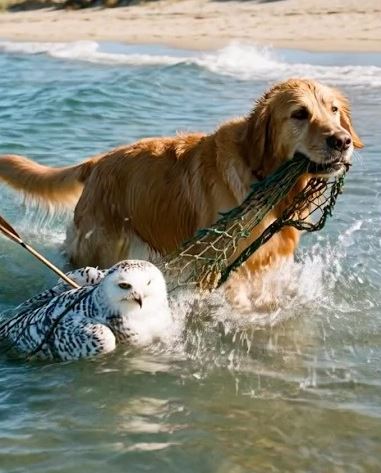
Tangled in a mess of discarded green nylon fishing netting and washed-up kelp was a creature that looked like a fallen cloud. It was a Snowy Owl. These birds were rare visitors to this part of the coast, usually staying much further north.
This one was exhausted, its majestic white feathers matted with seawater and sand. One of its wings was pinned at an awkward angle by a heavy piece of driftwood that had become snagged in the net.
The owl’s large, amber eyes were wide with a mixture of terror and resignation. It had clearly been fighting for hours. Every time the tide came in, the bird was at risk of being pulled under or crushed by the debris.
Max didn’t try to bite or play. In an incredible display of animal empathy, the dog began to gently nudge the driftwood with his nose, trying to shift the weight off the bird’s wing. He looked back at Thomas, his eyes pleading for help.
“Easy, boy. Easy,” Thomas whispered, kneeling into the cold water. He knew the dangers—an owl’s talons are incredibly sharp, and a panicked bird can be dangerous. But the owl seemed to sense the shift in energy. As Thomas reached out, the bird stopped fluttering. It lay its head back against the sand, its chest heaving.
Thomas reached into his pocket for his multi-tool. It was a delicate operation. The nylon was wrapped tight around the owl’s leg and wing. One wrong move could cause a permanent injury. For twenty minutes, as the sun began to break through the fog, the fisherman and his dog worked in tandem. Max stayed by the owl’s side, providing a warm, steady presence that seemed to keep the bird calm.
Slowly, the threads were snipped. The driftwood was moved. Finally, the last piece of netting fell away.
The owl didn’t fly away immediately. It was too weak. Thomas knew he couldn’t leave it there to be a target for predators. He carefully wrapped the bird in his flannel jacket, feeling the light, fragile frame beneath the feathers.
He carried it back to his truck, Max trotting proudly at his heels, occasionally jumping up to sniff the bundle in Thomas’s arms.
The next few days were a lesson in patience. Thomas contacted a local wildlife rehabilitator who instructed him on how to hydrate the bird and keep it in a dark, quiet space. Max never left the door of the shed where the owl was resting. He slept on the hard floor, guarding the “cloud bird” he had found.
By the fourth day, the owl began to show its true spirit. It was eating and, more importantly, its wing showed no signs of a break—just deep bruising. The time had come for the release.
They went back to the same spot on the beach. Thomas opened the crate. The Snowy Owl hopped out, its feathers now clean and brilliant white against the blue sky. It looked at Thomas, then turned its head nearly 180 degrees to look at Max.
For a long moment, there was a silent exchange between the predator of the sky and the protector of the land.