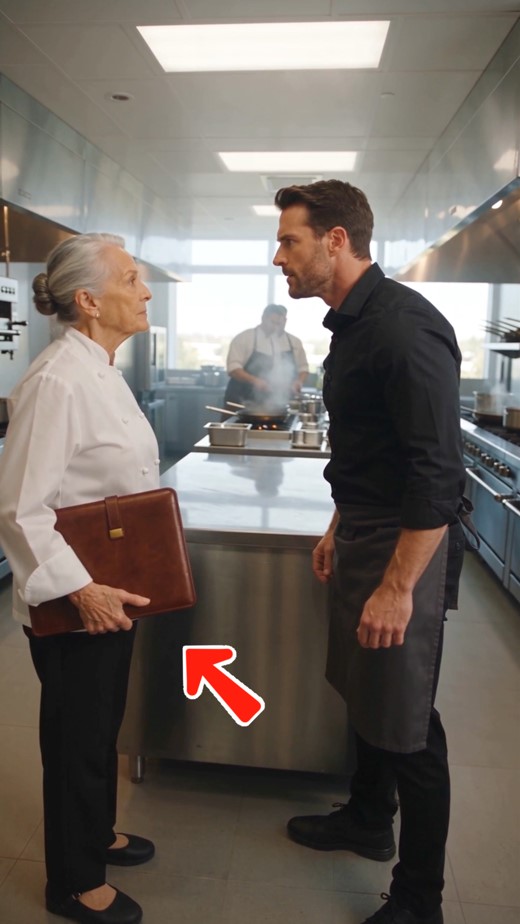
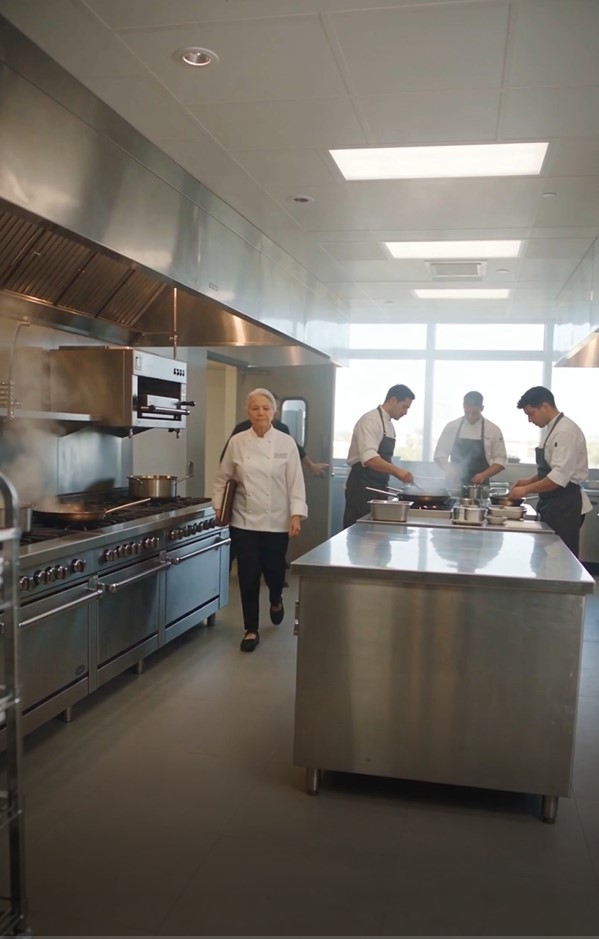
The lunch rush had barely begun when an elderly woman walked through the restaurant’s kitchen entrance wearing a slightly faded white chef coat.
Her silver hair was neatly tucked beneath a traditional chef’s hat, and a small leather bag hung from her shoulder.
She paused beside the stainless-steel preparation counter, quietly observing the cooks moving between sizzling pans and chopping boards.
The kitchen was immaculate, filled with the aroma of roasted garlic, fresh herbs, and simmering sauces.
At the center stood Victor Hayes, the restaurant’s head chef, issuing instructions with an impatient voice.
“Two salmon plates on the pass! And somebody fix that sauce before it goes out!”
He turned and noticed the elderly woman standing near the preparation area.
His eyebrows immediately drew together.
“Excuse me. This kitchen is restricted to authorized staff.”
The woman smiled politely.
“Of course. I was hoping to speak with whoever is overseeing the kitchen today.”
“That’s me,” Victor replied. “And I don’t have time for visitors.”
“My name is Margaret,” she said. “I was told I could stop by this morning.”
Victor barely acknowledged her introduction.
He noticed the worn edges of her coat and the small stains near one sleeve.
“You need to leave. We don’t allow people to wander around the kitchen dressed like that.”
Margaret looked down at her coat before meeting his eyes again.
“I understand the importance of kitchen standards.”
“Then you’ll understand why I’m asking you to leave.”
Several cooks exchanged uncomfortable glances.
Margaret remained calm, unaware that the young chef’s next decision would change the entire kitchen.
The Head Chef Refuses to Listen
Victor wiped his hands on a clean towel and stepped closer.
“Who gave you permission to enter this area?”
Margaret reached into her bag and pulled out a folded letter.
“I received this invitation from the restaurant.”
Victor glanced at the envelope without taking it.
“Anyone can bring a piece of paper into a restaurant.”
“The owner asked me to come before lunch service.”
That caught Victor’s attention, but only briefly.
“The owner is busy running a business. He doesn’t personally invite strangers into my kitchen.”
Margaret’s expression remained composed.
“Perhaps you should confirm the appointment with him.”
Victor gave a short, dismissive laugh.
“I’ve been running this kitchen for six years. I know how things work here.”
He turned toward a young sous-chef named Daniel.
“Daniel, please escort this woman back to the entrance.”
Daniel hesitated.
“Chef, maybe we should check with the office first.”
Victor’s face hardened.
“Did I ask for your opinion?”
“No, Chef.”
“Then get back to your station.”
Daniel returned to his preparation counter, visibly uncomfortable.
Margaret watched the exchange quietly.
She had spent decades working in professional kitchens, and she recognized the difference between firm leadership and unnecessary humiliation.
“I don’t want to interfere with your service,” she said. “I simply need a few minutes with the owner.”
Victor folded his arms.
“And I’m telling you that you won’t get them here.”
He pointed toward the swinging kitchen doors.
“Please leave before I have to call security.”
Margaret looked at the cooks, many of whom had stopped working.
She didn’t want anyone to lose their concentration because of an argument.
“All right,” she said softly. “I’ll wait outside.”
She turned toward the door.
Victor watched her leave with a satisfied expression, convinced he had protected his kitchen from an unwanted interruption.
He had no idea that the letter in her handbag contained an invitation he should have taken seriously.

A Difficult Afternoon for the Kitchen
Margaret had barely reached the corridor when the lunch service began falling behind schedule.
A supplier had delivered the wrong variety of mushrooms, two sauce preparations were running low, and an important private dining order needed adjustments.
Victor responded to every problem with increasingly sharp instructions.
“Why are these vegetables cut so unevenly?”
“Who prepared this stock?”
“I’m not paying people to stand around!”
The cooks hurried to keep up, afraid that asking questions would provoke another outburst.
Daniel, the sous-chef, tried to maintain order while checking the temperature of a simmering pot.
He had worked under Victor long enough to know that the head chef’s talent was real.
Unfortunately, so was his habit of treating disagreement as disrespect.
Outside the kitchen, Margaret sat quietly on a bench near the service corridor.
She could hear the raised voices through the swinging doors.
She recognized the sound of a team working under pressure without enough room to communicate.
It reminded her of the early years of her own career, when she had believed that a chef had to be the loudest person in the room to command respect.
Experience had taught her otherwise.
A great kitchen needed discipline, but it also needed patience, trust, and the willingness to listen.
Margaret took the folded invitation from her handbag and checked the time.
She had arrived early because she wanted to observe the restaurant before meeting its owner.
She hadn’t expected to be mistaken for an intruder.
Still, she didn’t feel the need to retaliate or demand immediate recognition.
She simply waited.
Meanwhile, Victor was preparing for a special evening event that would bring several influential restaurant critics and hospitality professionals through the doors.
He wanted everything to be perfect.
And that was precisely why the owner had arranged Margaret’s visit.

The Owner Calls Her Chef Margaret
At two o’clock, the restaurant’s owner, Richard Bennett, entered the kitchen through the main corridor.
He was speaking with the general manager when he noticed Daniel standing near the preparation counter.
“Have you seen Chef Margaret?” Richard asked. “She was supposed to arrive before lunch.”
Daniel looked toward the corridor.
“She arrived earlier, sir.”
Richard smiled.
“Wonderful. Where is she?”
Daniel hesitated.
“She’s waiting outside the kitchen.”
Richard’s smile disappeared.
“Waiting outside? Why?”
Before Daniel could answer, Victor approached with a towel over his shoulder.
“Sir, there was an unauthorized visitor in the kitchen earlier. I handled it.”
Richard turned toward him.
“An unauthorized visitor?”
“An elderly woman wearing a chef coat. She claimed she had an appointment with you.”
Richard stared at Victor.
“What did you say her name was?”
“Margaret, I think.”
For several seconds, the owner said nothing.
Then he walked straight toward the corridor.
Victor followed, suddenly uncertain.
Richard found the elderly woman sitting quietly on the bench and immediately extended both hands.
“Chef Margaret! I’ve been looking everywhere for you.”
Margaret stood and smiled warmly.
“Hello, Richard. I’m sorry I missed you when I arrived.”
“You haven’t done anything wrong,” Richard assured her. “I’m the one who should apologize for leaving you waiting.”
He turned toward Victor, who had stopped several feet away.
“Chef, I’d like you to meet Chef Margaret Ellis.”
Victor’s expression changed.
Richard continued, his voice filled with genuine respect.
“She helped establish our restaurant’s original kitchen program more than twenty years ago. She’s an award-winning chef, a mentor to generations of cooks, and the person who taught me what this business should stand for.”
Victor looked at Margaret’s white coat again.
Suddenly, the faded fabric and worn sleeves seemed far less important.
Richard placed a hand on Margaret’s shoulder.
“Chef Margaret, I hoped you could advise us before tonight’s event. Your experience would mean a great deal to this team.”
Margaret glanced toward the kitchen doors.
“I would be happy to help, Richard.”
Then she looked at Victor.
“But only if your head chef is comfortable with that.”
Victor felt every eye in the corridor turn toward him.
The Truth Behind the Invitation
Richard led Margaret into the restaurant’s private office, where he explained why he had invited her.
The restaurant had earned a strong reputation, but staff turnover had increased during the previous year.
Several promising cooks had left, and exit interviews had repeatedly mentioned an atmosphere of fear and poor communication.
Richard wanted Margaret to review the kitchen’s training culture and help the leadership team build a stronger environment.
He had specifically requested that she visit during a normal service, rather than receive a staged tour.
“I wanted you to see how the kitchen actually operates,” he explained.
Margaret nodded thoughtfully.
“Then I’m afraid you’ve already received part of your answer.”
Richard looked concerned.
“What happened?”
She described her conversation with Victor without exaggeration.
She explained that he had refused to check her appointment, dismissed her explanation, and ordered her out before verifying who she was.
Richard listened carefully.
“I’m very sorry,” he said. “That isn’t the way anyone should be treated here.”
Margaret rested her hands on her handbag.
“Victor may be an excellent cook. I haven’t tasted his food, so I won’t judge his abilities. But leadership requires more than technical skill.”
Richard agreed.
“Would you be willing to speak with him?”
“Certainly. But I don’t want this to become a public humiliation.”
She paused before continuing.
“If we want a better kitchen, the goal should be to correct the behavior, not simply embarrass the person responsible.”
Richard respected her answer.
Together, they returned to the kitchen.
Victor was waiting beside the pass, looking considerably less confident than before.
Richard asked the cooks to continue their preparations while he addressed the situation.
Elderly Woman in a Chef’s Coat Meets the Head Chef Before the Owner Recognizes Her https://t.co/Cpyvq95kZv
— Animal Rescue Stories (@AnimalStory5) October 14, 2026
A Lesson No Recipe Could Teach
Margaret spent the next hour observing the team without interrupting their work.
She watched Daniel coordinate the preparation stations and noticed how often cooks looked toward Victor before making even small decisions.
She saw talented employees hesitate to ask questions because they feared being criticized.
She also noticed that Victor’s standards for food quality were high.
His plates were carefully arranged, his sauces were balanced, and his attention to timing was impressive.
When service finally slowed, Margaret asked Victor to prepare a simple vegetable soup.
He looked puzzled.
“Soup?”
“Yes. Something you would serve to a family on an ordinary evening.”
Victor prepared a rich vegetable stock, added roasted onions, carrots, celery, and herbs, then adjusted the seasoning with careful precision.
He presented the bowl to Margaret.
She tasted it slowly.
“Excellent flavor,” she said. “You understand ingredients.”
Victor relaxed slightly.
“Thank you, Chef.”
“But tell me something. How did you teach Daniel to prepare this?”
Victor glanced toward the sous-chef.
“I demonstrated the process and corrected his mistakes.”
“Did you explain why you made those corrections?”
“Usually.”
Margaret nodded.
“That’s the difference between showing someone how to follow a recipe and teaching them how to become a chef.”
She invited Daniel to explain how he would adjust the soup if the vegetables were unusually sweet.
Daniel began cautiously, then offered several thoughtful suggestions.
Margaret listened and encouraged him to develop his own reasoning.
Victor watched as Daniel became more confident with every question.
“You have a capable team,” Margaret told him. “But people cannot grow if they’re afraid to think.”
Victor looked down at his hands.
He finally understood that the woman he had ordered out wasn’t merely someone with impressive credentials.
She was showing him a weakness he had refused to recognize.
“I should have checked your appointment,” he admitted. “And I shouldn’t have spoken to you that way.”
Margaret accepted his apology.
“Then start by doing better tomorrow. And the day after that.”
Richard announced that Victor would work with Margaret on a kitchen leadership plan, including staff mentoring and clearer communication standards.
His position would depend on whether he genuinely improved.
Victor agreed without arguing.
As the team returned to work, he approached Daniel and asked him to explain his ideas for the evening menu.