The restaurant was small, the kind of place people passed without a second glance—plastic chairs, a flickering neon sign, the smell of fried food soaked into the walls. By that hour, most customers were gone. Plates were being stacked, floors half-mopped, the day slowly folding in on itself. And that was when the little girl would appear.
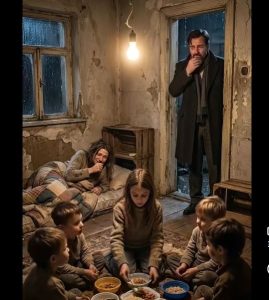
She couldn’t have been more than nine or ten. Her clothes were always clean but worn thin, sleeves a bit too short, shoes scuffed at the toes. Her dark hair was usually tied back in a loose ponytail, strands escaping around her face. She never caused trouble. Never asked for anything.
She would stand quietly near the counter, eyes lowered, hands clasped in front of her.
On the first night, when he asked if she needed something, she startled slightly and shook her head. “No, sir,” she said quickly. “I’m just waiting.”
A few minutes later, when a couple left behind half a plate of rice and chicken, she approached the trash bin. Carefully. Respectfully. As if she didn’t want to offend anyone. She picked up the plate, wrapped the food into a napkin, and slipped it into a small cloth bag she carried over her shoulder.
By the third night, he paid closer attention. She never touched fresh food. Never asked for money. She only took what had already been abandoned, what would have been thrown away.
By the fifth night, it was impossible to ignore.
“Hey,” he said gently one evening as she turned to leave, her bag a little fuller than usual. “Are you hungry?”
She looked at him, eyes wide, panic flashing across her face. For a second, he thought she might cry or run. Instead, she shook her head quickly.
“No, sir. Thank you,” she said. “I’m not hungry.”
It was the fastest lie he’d ever heard.
She left before he could say another word.
That night, long after the chairs were stacked and the lights were off, he couldn’t sleep. The image of her small hands folding leftovers into napkins kept replaying in his mind. Not greedily. Not desperately. Carefully. Like it mattered.
The next evening, when she came again, he made a decision.
He waited until she left the restaurant, then quietly grabbed his jacket and stepped outside a few moments later, keeping his distance as he followed her down the street.
She walked quickly, turning corners he’d never bothered to notice before. The city looked different from behind her—dimmer, quieter, heavier. They passed closed shops, dark windows, stray cats picking through bins. Eventually, she slowed near a cluster of old apartment buildings, paint peeling, lights flickering in a few windows.
Instead, she walked around to the back, where a narrow alley led to a stairwell entrance most people probably didn’t even know existed. He watched from across the street as she slipped inside.
The stairwell smelled of damp concrete and dust. One light buzzed overhead. He moved slowly, trying not to make noise. From above, he heard her small footsteps climbing.
He stepped back quietly and left the building without making a sound.
The next day, he arrived at the restaurant early.
That night, when the girl appeared at her usual time, he was ready.
As she stood near the counter, pretending not to look, he placed a small bag gently in front of her. Inside were two fresh meals, packed neatly, still warm. A piece of fruit. A small bottle of juice.
Her eyes widened. She looked up at him, fear and confusion mixing on her face.
“I can’t pay,” she said quickly.
“You don’t have to,” he replied softly. “It’s already paid for.”
She hesitated, hands trembling slightly. “I… I’m not supposed to take new food.”
“I know,” he said. “But this one’s different. This one’s a gift.”
She looked down at the bag for a long moment, then back up at him. “For my mom too?” she asked quietly.
He nodded.
Tears filled her eyes, and she bowed her head slightly, the way adults do when words aren’t enough. “Thank you,” she whispered.
From that night on, things changed.
She still came every evening—but she no longer waited by the trash. Instead, he had a small package ready for her, sometimes with an extra portion, sometimes with bread or soup. Sometimes, when business was slow, he’d sit with her for a few minutes and talk.
He learned her name was Lina.
He learned her father had passed away the year before.
He learned her mother worked during the day but was often too sick and tired to cook at night.