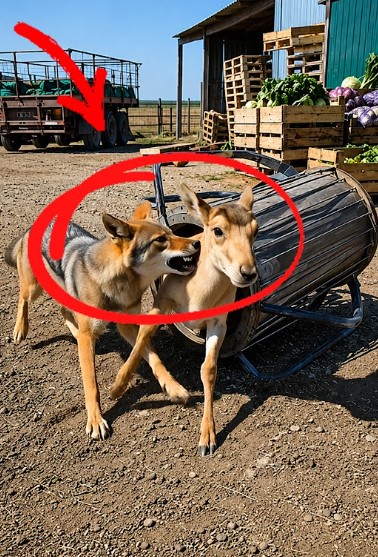
One moment, the farmland appeared completely peaceful. The next, a farmer noticed something unusual moving across the open field.
A young antelope was close to a jackal, and the distance between the two animals was quickly becoming smaller.
The farmer immediately understood that the situation needed attention.
He did not rush forward without thinking. Instead, he watched carefully, assessed the surroundings and looked for the safest way to create space between the animals.
Within moments, his calm response gave the antelope an opportunity to move toward a safer part of the field.
The encounter happened during an otherwise ordinary day. The farmer was going about his routine when movement near the edge of the property caught his attention. At first, it was difficult to see exactly what was happening. But after looking more closely, he recognized the shape of an antelope moving through the grass.
Then he noticed the jackal.
Jackals are naturally adaptable animals that can live in a wide range of environments, including areas close to farmland.
Seeing one near an agricultural property is not necessarily unusual, especially when natural habitats are nearby.
However, when a young animal is moving through the same area, a farmer may need to pay closer attention.
The farmer watched for several seconds before deciding to intervene.
His first priority was the antelope’s safety, but he also understood that the jackal was a wild animal behaving according to its natural instincts.
Instead of trying to approach the jackal directly, he focused on creating enough distance for the antelope to move away.
He remained alert to the animals’ movements and used his presence to make the jackal reconsider its direction.
The antelope began moving across the field.
For a brief moment, it appeared uncertain about which way to go. The farmer continued watching and positioned himself carefully, encouraging the animal toward a more open and protected part of the property.
The jackal eventually changed direction.
That small change created the opportunity the farmer needed.
The antelope began moving farther away, and the farmer continued to monitor the situation from a safe distance. He did not chase the wild animal or attempt to physically interfere with it. Instead, he allowed the jackal space while making sure the antelope had a clear route away from the area.
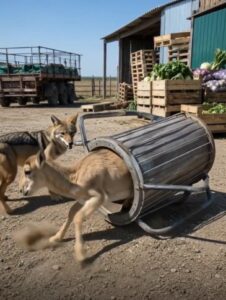
Slowly, the distance between the two animals increased.
The farmer remained patient.
Once the antelope had reached a quieter section of the field, he stopped moving and watched from a distance. The young animal appeared to settle down as the immediate situation became calmer.
The jackal eventually moved away from the farmland and disappeared into the surrounding landscape.
Only then did the farmer relax.
The entire encounter had lasted only a short time, but his ability to notice what was happening made a meaningful difference.
He had recognized the unusual situation before it developed further and responded without creating unnecessary confusion.
For people who live and work around wildlife, this kind of awareness can be extremely valuable.
Agricultural areas often exist close to natural habitats, which means encounters between domestic animals, wild animals and livestock can happen unexpectedly.
The best response is not always the most dramatic one. In many cases, patience, distance and careful observation can be more effective than rushing toward the animals.
The farmer’s approach also showed respect for wildlife. The jackal was not treated as an enemy that needed to be confronted.
Instead, the farmer simply created a safer environment for the antelope and allowed the wild animal an opportunity to leave the area naturally.
This balance between protection and respect is important.
Wildlife plays an important role in natural ecosystems, and wild animals should not be approached unnecessarily.
At the same time, farmers and landowners have a responsibility to care for animals under their supervision and respond appropriately when wildlife comes close.
After the antelope had moved to a safer location, the farmer checked the surrounding field.
He looked for possible entry points and considered whether changes to the property could make future encounters less likely.
Keeping young animals in protected areas, maintaining suitable fencing and monitoring areas near natural habitats can all help reduce unexpected encounters. Awareness is especially important during periods when wildlife may be more active.
Farmer Helps Antelope During a Close Encounter With a Jackal pic.twitter.com/JNjXzcjw2P
— Animal Rescue Stories (@AnimalStory5) August 10, 2026
What should you do if you find an animal/person in this situation?
Keep a safe distance, avoid approaching wild animals directly and contact qualified wildlife professionals if assistance is needed. If possible, create space without causing panic.
Should you try to help the animal/person yourself?
Only when it is safe and appropriate. Do not physically approach or handle wild animals such as jackals or antelope. Professional wildlife assistance is the safest option when direct intervention is necessary.