On the edge of a busy rural roadway, where speeding vehicles meet open pastureland, a frightening accident unfolded when a young horse foal became trapped in a section of sharp barbed wire fencing.
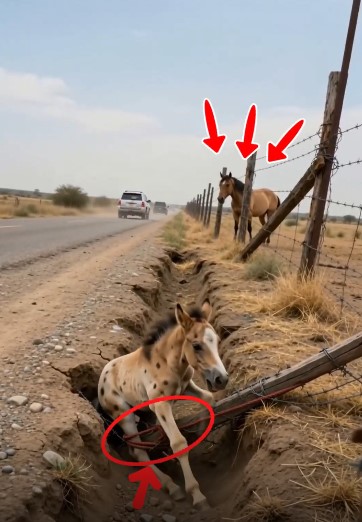
The incident turned an ordinary day into an urgent rescue operation, as the terrified young animal struggled helplessly while danger from both the fence and nearby traffic created a highly risky situation.
Foals are naturally curious and energetic, often exploring their surroundings while staying close to their mothers.
However, their lack of experience can sometimes lead them into dangerous situations. In this case, the foal had likely wandered too close to the boundary of its grazing area, where an old or damaged barbed wire fence separated the pasture from the roadside.
In a moment of confusion or sudden movement, the young animal became entangled, with wire wrapping around its legs and restricting its ability to move.
The sharpness of barbed wire makes it especially hazardous for wildlife and livestock.
Even small movements can tighten the grip of the wire, causing panic and increasing the risk of injury.
The foal, frightened and disoriented, struggled instinctively to break free, but each attempt only worsened the situation.
Its distress was visible as it repeatedly tried to pull away, only to be forced back by the tight hold of the fence.
Witnesses traveling along the busy road were the first to notice that something was wrong.
At first, they saw what appeared to be a horse standing unusually still near the fence line. But as they slowed down, they realized the foal was trapped and clearly in distress.
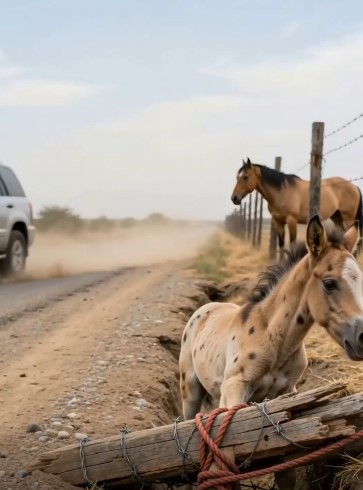
The situation was dangerous not only for the animal but also for passing vehicles, as slowing traffic near rural roads can sometimes lead to additional hazards.
One of the witnesses quickly pulled over and called for help, while others tried to assess the situation from a safe distance.
It was clear that immediate action was necessary, but also that the rescue had to be handled carefully.
Foals, like many young animals, can become highly frightened when approached by humans, and sudden movements could cause further injury from the barbed wire.
As the foal continued to struggle, the situation grew more urgent. The animal’s energy was beginning to fade, and its movements were becoming less coordinated.
The wire had caught around its leg and possibly part of its body, making it impossible for it to step away safely. Every instinct pushed it to escape, but the physical restraint made freedom impossible without intervention.
Local farmers and trained responders were soon contacted. People experienced in handling livestock understand the dangers of barbed wire entanglements and the importance of remaining calm during such incidents.
Upon arrival, the rescuers carefully evaluated both the animal’s condition and the structure of the fence. They needed to determine the safest way to free the foal without causing further injury.
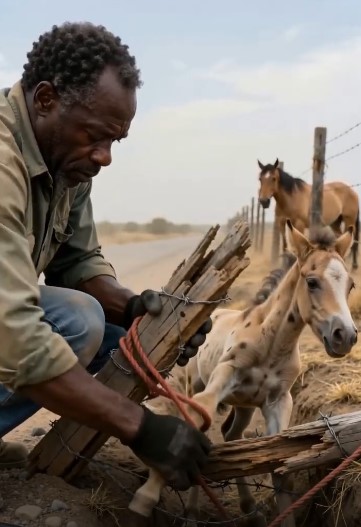
The first step was to calm the environment. Loud noises, fast movements, or crowding can increase stress in animals and make rescue more difficult.
The rescuers spoke softly and moved slowly, positioning themselves in a way that allowed the foal to see them without feeling completely surrounded.
This helped reduce panic slightly, although the animal remained visibly distressed.
Barbed wire is particularly difficult to handle in rescue situations because of its sharp edges and tendency to tighten when pulled. The rescuers knew that cutting the wire carelessly could cause it to snap back or press further into the animal’s skin.
For this reason, they carefully planned each step before acting.
One team member stabilized the foal by gently supporting its position, while another began working on the fence itself. Using specialized cutting tools, they carefully loosened sections of the wire rather than attempting to remove it all at once.
This gradual approach reduced tension and allowed small adjustments without sudden movement.
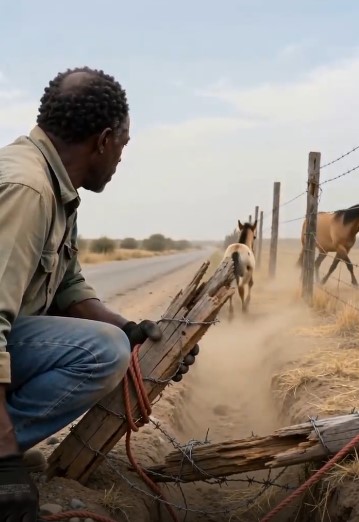
Throughout the process, the foal occasionally panicked and tried to pull away. Each time this happened, the rescuers paused, allowing the animal to settle before continuing.
Patience was essential, as rushing the process could have caused serious injury or made the situation worse. The goal was not only to free the foal but to ensure it could walk away safely afterward.
After several tense minutes, a critical section of the wire was finally cut and bent away from the foal’s leg.
This immediately reduced pressure and allowed a small amount of movement.
The animal hesitated, unsure whether it was still trapped, but the rescuers continued carefully loosening the remaining strands.
Bit by bit, the barbed wire was removed from around the foal’s legs.
Foal Found in Barbed Wire Near a Busy Road and Safely Helped pic.twitter.com/CoVQAqVpR4
— Animal Rescue Stories (@AnimalStory5) June 17, 2026
The process required extreme precision, as even slight contact with the sharp edges could cause additional cuts. The rescuers worked in coordination, ensuring that the wire was fully stabilized before each cut. Slowly, the foal began to regain mobility.