The shooting range was loud that Saturday morning, alive with the sharp cracks of gunfire and the steady murmur of conversation. The smell of gun oil and burned powder hung in the air, familiar and comforting to the regulars. Young men compared gear, bragged about groupings, and showed off rifles worth more than some used cars. It was a place where confidence was loud and respect was often measured in price tags and performance.
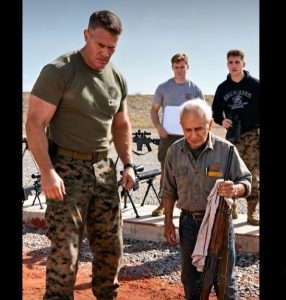
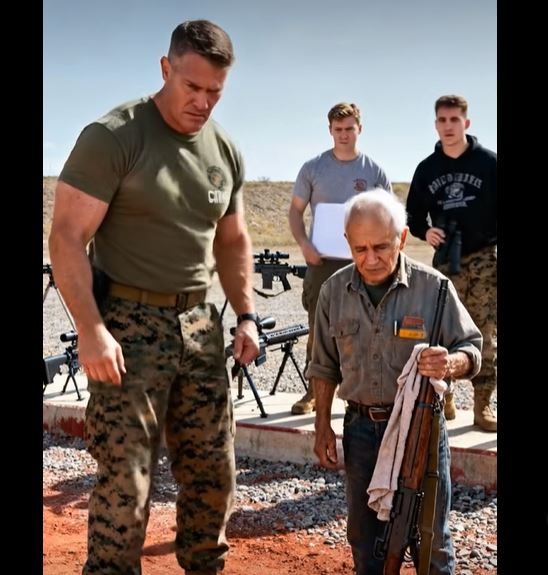
He arrived alone, moving slowly but deliberately, carrying a long, narrow case that looked like it belonged in a museum rather than a modern shooting range. His hair was silver, his hands weathered, and his posture straight in a way that suggested discipline rather than age. He nodded politely to the range officer, paid his fee without a word, and took a lane near the far end.
Inside was a wooden-stock rifle, its bluing worn thin in places, the wood darkened by decades of careful handling. It was clean, meticulously maintained, but undeniably old. No optics, no rails, no modern attachments—just iron sights and craftsmanship from another era.
A group of younger shooters nearby snickered.
“What is that, a wall decoration?” one of them muttered.
Another leaned closer, smirking. “Man brought a history lesson to a gunfight.”
Their friend Tyler laughed the loudest. Tyler was known at the range. Expensive rifle, tactical gear, loud opinions. He prided himself on being the best shot in the room, or at least the most confident. He glanced over at the old man and shook his head.
“Hey, old-timer,” Tyler called out, not bothering to lower his voice. “You know this isn’t a reenactment, right?”
A few people chuckled. Others looked uncomfortable but said nothing.
The old man didn’t react. He calmly laid the rifle on the bench, opened a small box of ammunition, and began loading with practiced ease. His movements were slow, but precise—no wasted motion, no hesitation.
“Seriously,” he continued, gesturing with his modern rifle. “You want to borrow something that actually hits what you aim at?”
More laughter.
The old man finally looked up. His eyes were calm, clear, and sharp. He studied Tyler for a brief moment, not with anger, but with something closer to curiosity.
“Enough for missing the target?” Tyler shot back. “That thing probably kicks harder than it shoots straight.”
The range officer glanced over, considering stepping in, but the old man simply nodded and turned back to his bench. He adjusted the rifle, checked the sights, and placed a small paper target at the far distance—farther than most people bothered with.
He raised his rifle and fired a tight group at a closer target, shots rapid and confident. He turned around, grinning. “That’s how it’s done.”
Applause followed. Phones came out. Someone clapped him on the shoulder.
The old man waited.
He rested the rifle against his shoulder, exhaled slowly, and took aim. The range, still noisy, echoed with shots from other lanes. He didn’t rush. He didn’t compete for attention. He waited for the right moment—when his breathing steadied, when the rifle felt like an extension of his body.
The sound was different. Deeper. Heavier. It cut through the noise in a way that made people glance over without knowing why.
The range began to quiet, not intentionally, but instinctively. Conversations faded. Laughter stopped. One by one, shooters lowered their rifles and looked downrange.
The range officer didn’t answer. He kept staring through the binoculars, then slowly lowered them and looked at the old man.
“Sir,” he said carefully, “may I bring the target back?”
Tyler stepped forward, his grin gone. “That’s… that’s not possible.”
The old man walked over, studying the target briefly, then nodded as if confirming something to himself.
“Still got it,” he murmured.
The range officer cleared his throat. “Sir,” he said, louder now, “what model is that?”
The old man smiled faintly. “Service rifle. Modified slightly. I carried one like it for a long time.”
“Military?” someone asked.
The old man didn’t answer immediately. He ran a finger along the worn stock.
“Sniper,” he said finally. “Back when scopes failed and iron sights had to be enough.”
The word landed like a weight.
People looked at the rifle again—not as a joke, not as a relic, but as a tool that had once decided life and death.
Tyler swallowed. “I didn’t know,” he muttered.
The old man met his eyes. “That’s usually the problem,” he said gently.