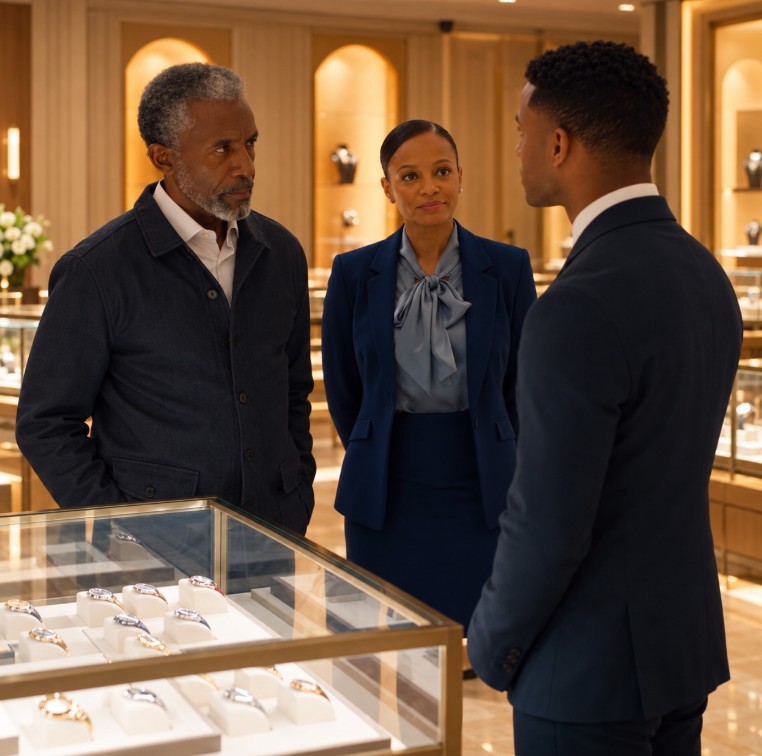
Mr. Reed stood quietly beside the glass display case, his hands resting loosely in front of him as he studied the watches arranged beneath the warm lights. The boutique was calm and immaculate, the kind of place where every surface gleamed and every movement seemed softened by money. Glass cases ran along the room in clean lines, polished wood framed the displays, and the low lighting gave each watch the appearance of something closer to art than merchandise.
He had been in the store for only a few minutes, but he had already noticed how carefully everything had been designed to communicate exclusivity. The silence was deliberate. The spacing between the displays was deliberate. Even the way the staff moved through the room felt practiced, measured, and polished.
Mr. Reed leaned slightly closer to the case, reading the details on a platinum watch with a deep blue dial.
That was when a young sales associate approached him.
He was sharply dressed, with an easy, confident smile and the smooth manner of someone who had learned how to sound helpful while deciding very quickly what kind of customer stood in front of him. His name tag read Cameron.
He stopped beside Mr. Reed and glanced at the watch he was viewing.
“Sir, that collection starts at forty thousand.”
Mr. Reed lifted his eyes from the display and looked at him.
“I can read the tag.”
Cameron smiled, but it was not the kind of smile that came from embarrassment. It was the kind that suggested he thought he was still in control of the conversation.
“Just making sure.”
Mr. Reed held his gaze for a moment.
“Why?”
The question landed more directly than Cameron expected. For the first time, the younger man hesitated, though only briefly.
“We get a lot of people just browsing,” he said.
Mr. Reed looked back down at the watch for a second, then at the rest of the collection.
“And browsing is a problem?”
“Not if you’re realistic.”
Mr. Reed’s expression did not change.
“About what?”
Cameron gave a slight shrug, as though the answer should already be obvious.
“What you can afford.”
The boutique remained quiet around them. Somewhere near the back, another display case closed with a soft click. A couple on the far side of the store were being shown a tray of watches by another associate. A soft instrumental track played low in the background, almost disappearing beneath the hush of the room.
Mr. Reed did not raise his voice. He did not appear offended in the dramatic way Cameron may have expected if the conversation had turned confrontational. Instead, he simply looked at him for a little longer.
“You decided that quickly,” he said.
Cameron’s posture straightened almost proudly.
“I’ve worked here a long time.”
Mr. Reed nodded once.
“Then you should know better.”
That finally shifted something in Cameron’s expression. The confidence remained, but now it was mixed with irritation.
“Know what?”
Mr. Reed could have answered in several ways. He could have told him exactly what kind of assumption he had made. He could have explained how familiar that assumption felt, how easy it was for some people to decide who belonged in rooms like this and who did not. He could have reminded him that experience in a luxury store should have taught him patience rather than certainty.
But before he spoke, another voice entered the room.
“Mr. Reed, your private collection arrived.”
Both men turned.
A professional-looking woman in a tailored suit was walking toward them from a doorway near the rear of the boutique. Her tone was warm, attentive, and entirely different from Cameron’s. She carried herself with the authority of someone who ran the room without needing to announce it.
Cameron looked from her to Mr. Reed.
“Private collection?”
The director reached them and smiled.
“Yes,” she said. “The six pieces he ordered.”
For a second, Cameron said nothing.
The confidence that had seemed so natural on him only moments earlier disappeared so completely that it was almost startling. His eyes moved back to Mr. Reed, then to the director, then toward the display case, as though he were trying to rearrange the last few minutes into something less damaging.
Mr. Reed said nothing.
He did not need to.
The director looked at him with quiet professionalism.
“We’ve placed them in the viewing room for you,” she said. “Would you like to see them now?”
Mr. Reed gave a small nod.
“In a moment.”
Cameron found his voice.
“Sir, I didn’t realize.”
Mr. Reed turned to him.
“That’s the problem.”
The words were calm, but they landed harder than anything louder could have.
The director looked at Cameron once, then back at Mr. Reed.
“Would you prefer another associate?”
Mr. Reed answered without hesitation.
“Yes.”
Cameron’s face tightened.
He looked as if he wanted to say more, perhaps to explain that he had misunderstood, or that he had only been trying to do his job, or that luxury retail required a certain kind of screening. But none of those explanations would have changed what had already happened, and somewhere in his expression he seemed to realize that.
The director inclined her head.
“Of course.”
She gestured toward a private section of the boutique set slightly apart from the main showroom by smoked glass panels and a dark wood partition. Through the opening, Mr. Reed could see a quieter room prepared with a table, leather chairs, and several presentation boxes resting on a velvet surface.
As he began to walk with the director, Cameron spoke again.
“Mr. Reed, I apologize.”
Mr. Reed stopped and looked back at him.
“Apologize to the next customer too.”
Then he turned and continued walking.
Inside the private viewing room, the difference in atmosphere was immediate. The space felt even more refined than the boutique outside, but it also felt more honest. There were no performative smiles here, no subtle posturing, no need for anyone to guess who mattered. The room had been prepared for him because the store knew exactly who he was.
The director closed the door partway behind them and motioned toward the table.
“We unpacked them only a few minutes ago,” she said. “I wanted to make sure everything was ready before your appointment.”
Mr. Reed took a seat.
“I appreciate that.”
She sat across from him and opened the first presentation box with careful hands. Inside rested a beautifully finished watch in white gold, its face understated, elegant, and deliberate in every detail.
“The Geneva piece arrived this morning,” she said. “The others came from our London and Dubai allocations.”
Mr. Reed looked down at the six watches as the boxes were opened one by one. He had spent months selecting them. Some were for his own collection. One was intended as a gift for his eldest daughter, who had recently become partner at her law firm. Another was for his son, who had just turned forty. The final two were investment pieces, limited and difficult to secure, the kind serious collectors waited years to obtain.
The director noticed the way his eyes rested on one of the models.
“That one turned out beautifully,” she said.
“It did.”
For a moment, the quiet in the room became comfortable.
Then the director exhaled lightly.
“I want to apologize for what happened out there.”
Mr. Reed looked up.
“You don’t need to apologize for another person’s choices.”
“I’m still responsible for what happens in my store.”
He regarded her for a moment and then nodded once.
“That’s fair.”
She folded her hands.
“Cameron is talented in some ways, but clearly he still has something important to learn.”
Mr. Reed glanced back at the watches.
“So do many people.”
The director did not argue with that.
She had worked in luxury retail long enough to understand that beautiful surroundings did not make people better. Expensive stores did not automatically create refined judgment. Sometimes they did the opposite. They gave people just enough borrowed status to make them careless with it.
“I’ll address it,” she said.
Mr. Reed leaned back slightly in his chair.
“I hope you do.”
She hesitated.
“If I may ask, was this the first time he’s assisted you?”
Mr. Reed almost smiled.
“No. It was the first time he looked at me long enough to decide I wasn’t worth assisting properly.”
The director lowered her eyes for a second.
That answer seemed to confirm what she had already begun suspecting. Cameron had likely seen Mr. Reed before, perhaps more than once. But because Mr. Reed did not arrive displaying his wealth in an obvious way, because he wore a modest jacket instead of a designer label meant to announce itself across the room, Cameron had made the oldest mistake in business.
He had confused appearance with value.
The director said quietly, “That shouldn’t happen here.”
Mr. Reed looked at her.
“It shouldn’t happen anywhere.”
She nodded.
For the next twenty minutes, the conversation stayed on watches. They discussed movement finishing, limited production numbers, archival pieces, and delivery timing. Mr. Reed examined each item carefully, lifting them one at a time, checking the weight, the crown action, the balance of the bracelet, the details of the dial. He asked informed questions, the kind only a serious buyer or long-time collector would ask, and the director answered with the ease of someone who respected knowledge when she heard it.
When they reached the final piece, Mr. Reed smiled faintly.
“This one was harder to secure than you made it sound.”
The director allowed herself a small laugh.
“It was harder than I made it sound.”
“I assumed as much.”
She carefully placed the watch back in its box.
“We wanted to make sure it was worth the wait.”
“It was.”
A few minutes later, after the paperwork had been reviewed and the arrangements confirmed, the director stood.
“I’ll have these prepared for transport exactly as requested.”
Mr. Reed rose as well.
“Thank you.”
She walked him back toward the front of the boutique.
The main showroom was much as it had been before—quiet, warm, polished—but something had changed in the air, at least for Cameron. He was standing near one of the side displays, speaking to another associate in a lower voice than before. The moment he saw Mr. Reed and the director approaching, he straightened.
The director paused a few feet from him.
“Mr. Reed is leaving,” she said.
It was a simple statement, but the associate understood immediately that it also meant this moment had not been forgotten.
Cameron turned fully toward Mr. Reed.
“Sir,” he said, more carefully this time, “I am sorry for how I spoke to you.”
Mr. Reed stopped.
A younger version of Cameron might have hoped that a formal apology would cleanly end the matter. But age had likely taught Mr. Reed what apologies could and could not do. Some repaired. Some only acknowledged damage after the fact.
He looked at the young man and saw, beneath the embarrassment, a flicker of something potentially useful—discomfort deep enough to become reflection, if allowed.
“Do you know why your apology matters less than you think?” Mr. Reed asked.
Cameron swallowed.
“No, sir.”
“Because you only found respect after information.”
The younger man lowered his eyes.
Mr. Reed continued.
“You didn’t speak differently to me because your values changed. You spoke differently because you discovered I was a customer you considered important.”
Cameron’s face flushed.
The director said nothing. She let the lesson stand on its own.
Mr. Reed’s voice remained calm.
“The customer who walks in tomorrow may not have a private order waiting in the back. He may not know the director. He may never spend what I spend here. That doesn’t give you permission to measure his worth in the first ten seconds.”
Cameron nodded slowly.
“I understand.”
Mr. Reed studied him for a moment.
“No,” he said gently. “You understand that you were wrong. Whether you learn from it is something else.”
The words seemed to settle heavily between them.
Then Mr. Reed gave a small nod to the director.
“Thank you for your time.”
“Thank you, Mr. Reed.”
He turned and walked toward the entrance. The director accompanied him to the door, where the boutique’s warm light gave way to the cooler brightness of the shopping arcade outside.
Before he stepped out, she spoke once more.
“I do appreciate your honesty.”
Mr. Reed paused.
“That depends on what you do with it.”
Then he left.
The door closed softly behind him.
Outside, the corridor was busier than the quiet world he had just stepped out of. Shoppers moved between storefronts carrying bags, light from display windows reflected across polished floors, and somewhere nearby a child laughed at something unseen. Mr. Reed walked at an unhurried pace, neither triumphant nor bitter.
He had long ago learned that moments like the one inside the boutique were never really about watches, hotel lounges, conference rooms, or reserved spaces. They were about judgment. About how quickly some people decided they understood others. About the confidence people placed in conclusions they had not earned.
As he continued down the corridor, he thought about Cameron’s face at the moment the director mentioned the six watches. It was not the embarrassment that stayed with him. It was the surprise. The surprise revealed everything. It revealed how impossible the truth had seemed to him just seconds earlier.
And that, more than the insult itself, was the problem.
Back inside the store, the director remained standing near the entrance for a moment after he left. Then she turned to Cameron.
“Come with me,” she said.
He followed her into the office near the rear of the boutique.
The conversation there was not loud, but it was direct.
She asked him what had led him to approach Mr. Reed the way he had. Cameron tried, at first, to frame it as caution, professionalism, and retail instinct. But each explanation sounded weaker once spoken aloud. Eventually he admitted what the director had already understood.
“I assumed he wasn’t serious.”
“Based on what?”
Cameron hesitated.
“I don’t know.”
“That’s not true,” she said. “You do know. You just don’t like the answer.”
He sat in silence.
The director continued, “Luxury service is not about protecting expensive objects from ordinary people. It’s about treating every person with enough respect to learn who they are before deciding anything.”
Cameron nodded faintly.
“You were more interested in being certain than being correct,” she said. “That’s a dangerous habit in any business.”
He looked down.
“I see that now.”
“I hope so,” the director replied. “Because if you only learn to be polite after discovering someone has money, influence, or status, then you haven’t learned service. You’ve learned self-protection.”
The words hit harder than he expected.
For the rest of the afternoon, Cameron moved through the boutique differently. He still greeted customers. He still answered questions and opened display cases and spoke about craftsmanship and waiting lists. But each interaction now carried an awareness that had not been there earlier.
A middle-aged man in simple clothes asked to compare two watches, and Cameron did not assume he was wasting time. A young woman came in wearing jeans and sneakers and paused at a display, and he did not redirect her toward “entry pieces.” An older couple lingered longer than usual over a price tag, and he did not offer them the patronizing smile he might once have used.
By closing time, the boutique looked exactly as it always did. The lights still glowed warmly against the glass. The cases still shone. The quiet luxury remained untouched.
But something had shifted, however slightly, in the mind of one young associate.
And elsewhere, in the back of a car carrying six carefully arranged watches, Mr. Reed looked out the window and let the day pass without anger.
He did not need the apology for himself.
He only hoped the next person would benefit from it.
Because dignity should not depend on purchase history.
Respect should not arrive only after a title, an invoice, or a private collection.
And no customer should have to prove their worth before being treated like they belong.