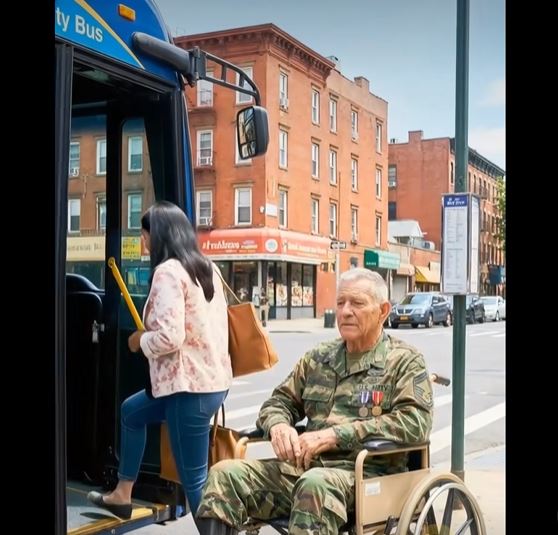
The bus stop on Maple Street was chaotic, like it always was on weekday mornings. People pushed and shoved, commuters tapped impatiently on their phones, and the rhythmic squeal of bicycle tires added to the urban symphony of noise. Among the crowd, a man sat quietly in a wheelchair, his hands resting on the wheels, his gaze fixed straight ahead. He wasn’t shouting. He wasn’t waving. He wasn’t trying to compete with the chaos. He simply waited.
His name was Thomas Reed. A veteran of life and circumstance, Thomas had lost the use of his legs in an accident years ago, but he refused to be invisible. Every day, he came to this stop to catch the 42 bus to the community center where he volunteered as a mentor for teenagers. He carried with him a quiet dignity, the kind that only comes from enduring hardship without bitterness.
Yet, today, he was being overlooked.
Commuters darted past, stepping too close, their eyes glued to their screens, headphones blocking the world. Someone bumped his chair, muttered an apology without looking, and moved on. Thomas remained patient, accustomed to being ignored. He had learned that life often treated those who were different as background scenery—until someone chose otherwise.
The bus pulled up, squealing as it braked. The crowd surged forward, forming a tide of elbows and briefcases. Thomas maneuvered to the side, allowing others to board first, as he always did. The driver, a middle-aged woman named Carla, noticed him immediately. She had seen Thomas at this stop many times and had come to respect his quiet composure. But she also knew the world around him often did not.
As the crowd pushed and shoved, Carla stepped out from behind the wheel. “Sir,” she called, her voice cutting through the din. “Let me help you.”
Heads turned, some irritated, some curious. A few muttered complaints about delays, but Carla ignored them. She wheeled the ramp down, giving Thomas a safe path onto the bus. The sudden attention made some passengers uncomfortable; many had simply walked past, pretending he wasn’t there.
Once aboard, Thomas found his usual seat near the front. He had a view of the entire bus, from the weary commuters to the toddlers squirming in their parents’ laps. But today, he noticed something he hadn’t before. A young boy, no older than ten, sat quietly with a backpack, glancing nervously at the floor. His mother was chatting with a friend in the back, unaware of her child’s discomfort. The boy’s shoelaces were untied, his coat buttoned wrong, his expression anxious.
Thomas recognized that look immediately—the look of someone trying to navigate a space that feels too large, too fast, too overwhelming. He smiled, reached into his bag, and pulled out a small notebook. Scribbling a few words and a sketch of how to tie shoelaces properly, he handed it to the boy without drawing attention.
The boy looked up, eyes widening in astonishment, then grinned shyly. He whispered, “Thank you,” and carefully followed the instructions. Thomas simply nodded, turning his attention back to the window.
It was a small moment, unnoticed by most, but it carried the weight of compassion that could not be measured. And it had only been possible because Carla, the bus driver, had stepped in when the world refused to see him.
By the time the bus reached the community center, passengers had settled into their routines, many still unaware of the quiet exchanges that had occurred. Thomas wheeled off the bus, greeted by the volunteers and teens who respected him not for his disability, but for his patience, wisdom, and quiet guidance. He had lived much of his life unseen, but every once in a while, someone stepped in—just like Carla had—and reminded him that he, too, mattered.
That day, Thomas didn’t just get on the bus. He reminded everyone around him that attention, respect, and small acts of kindness could ripple far beyond a single moment. The bus driver had simply done her job. But by noticing him, she allowed the invisible to become visible, teaching a subtle but powerful lesson to everyone present: that waiting quietly does not mean being powerless—and that one small intervention can change someone’s world.
As Thomas wheeled into the community center, he looked back at the bus and saw Carla waving. He waved back. The acknowledgment was brief but enough. In a world that often ignored those on the margins, the gesture meant more than anyone could measure.