The forest edge was calm that afternoon, with soft sunlight filtering through the trees and falling across a quiet stretch of wooden fencing.
It was the kind of place where wildlife often moved unseen, slipping between woodland and open field as they followed familiar paths. Birds chirped lightly above, and the wind brushed gently through tall grass. Nothing suggested that anything was wrong—until a sudden sound broke the stillness.
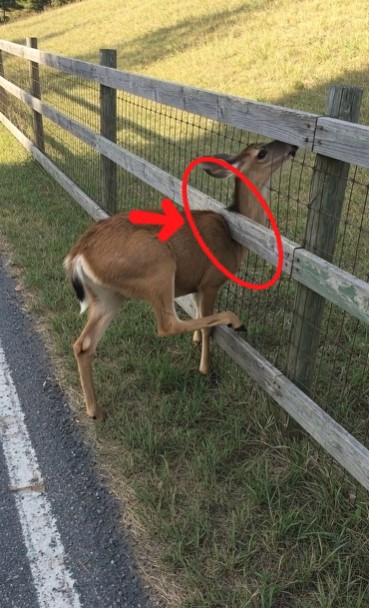
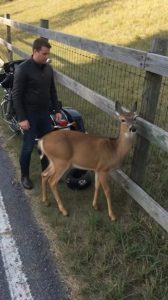
A young deer had become trapped in the wooden fence.
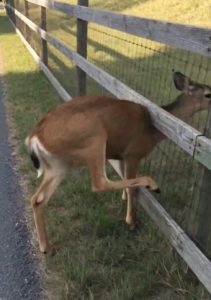
It had likely tried to jump through a narrow gap between two panels, misjudging the space in its panic or haste. Now its body was caught awkwardly between the wooden slats, its legs trembling as it struggled to free itself.
Each attempt only made the situation worse. The rough edges of the wood held firm, and the more the deer pulled, the more exhausted and frightened it became.
Its breathing was fast and uneven. Its eyes were wide with panic, scanning every direction as it searched for escape. The peaceful surroundings had turned into a scene of fear and confusion in its mind. The deer kicked again, but the fence did not move.
Moments like this are especially dangerous for wild animals. Panic can quickly lead to injury, and exhaustion can set in faster than expected. The deer’s strength was slowly fading as it continued to struggle against something it could not understand.
Then, footsteps approached.
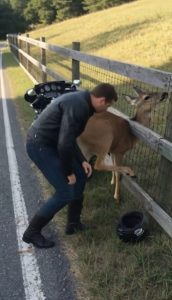
A stranger walking nearby heard the unusual noise and followed it through the brush. As he got closer, he saw the trapped deer and immediately stopped. For a brief moment, he stayed still, taking in the situation carefully. He could see the animal was frightened and vulnerable, and any sudden movement might cause it to injure itself further.
He slowly began to approach, speaking softly to avoid startling it.
The deer reacted instantly, pulling harder against the fence. Its fear of humans was stronger than its understanding that help was coming. The man stopped again, lowering his hands and giving the animal a moment to calm down.
He knew he had to be patient.
Step by step, he moved closer, watching the deer’s reactions carefully. The animal continued to struggle, but its energy was clearly beginning to run low. The man could see the exact point where the body was stuck between the wooden slats. The gap was too tight for the deer to pull back safely without assistance.
He examined the fence quickly, looking for a way to loosen the pressure without causing harm. The wood was old but still sturdy, and there was just enough flexibility to work with.
Using both hands, he carefully pressed the slats apart, trying to create a little more space. The deer reacted again, kicking and twisting in fear. The man paused immediately, stepping back slightly to avoid worsening the panic.
He waited.
After a few seconds, the deer’s movements slowed just a little. Its breathing was still heavy, but it was no longer fighting with the same intensity. That small change was enough for the man to try again.
He returned to the fence, this time moving even more gently. Slowly, he widened the gap, inch by inch, careful not to apply sudden force. The wood creaked slightly but held.
The deer trembled but remained in place.
Then, with one final careful adjustment, there was just enough space.
The deer suddenly pulled free.
For a moment, it stumbled forward, unsteady on its legs after the struggle. It paused, disoriented, breathing heavily as it tried to understand what had just happened. The man immediately stepped back, giving it space.
The deer stood still, its body tense but no longer trapped. It turned its head briefly toward the stranger, as if unsure whether to run or stay. Then instinct took over.
With a sudden burst of energy, it ran toward the trees.
Its hooves disappeared into the undergrowth within seconds, blending back into the forest where it belonged. The sound of movement faded quickly, replaced once again by the calm of the woods.
The man remained where he stood for a moment, watching the place where the deer had vanished. The situation had been tense, but it had ended before lasting harm occurred.
Encounters like this are a reminder of how easily wildlife can become trapped by human-made structures. Wooden fences, though ordinary to people, can become serious obstacles for animals simply trying to move through their territory. In moments of panic, even familiar paths can turn into dangerous traps.
Helpless Deer Struggles to Escape From Wooden Fence, Stranger Rushes to Help… pic.twitter.com/DmNS7V4WsZ
— Animal Rescue Stories (@AnimalStory5) May 15, 2026
Deer are strong and agile animals, but they are also highly sensitive to stress. When frightened, they can injure themselves trying to escape tight spaces. That is why calm, careful intervention is often essential in situations like this.