The nest should have been empty.
Hidden beneath tall grass near the edge of a quiet farm pond, a clutch of duck eggs rested alone in the morning sunshine. Their mother had disappeared for a short time in search of food, leaving the nest vulnerable to cooling temperatures and curious predators.
Then something unexpected happened.
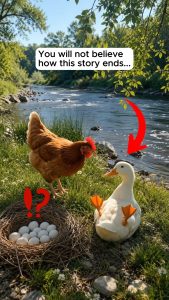
A nearby hen slowly walked toward the abandoned-looking nest.
She paused.
Looked around.
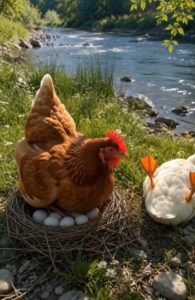
Then carefully settled herself on top of the duck eggs as though they were her own.
The unusual sight caught the attention of a farmer working nearby.
At first, he couldn’t understand what he was seeing.
The hen wasn’t pecking at the eggs.
She wasn’t disturbing the nest.
Instead, she calmly tucked the eggs beneath her feathers and remained perfectly still, keeping them warm while the mother duck was away.
The farmer quietly watched from a distance, careful not to interrupt the remarkable moment.
Minutes passed.
The hen never moved.
She simply continued protecting the eggs with surprising patience.
Eventually, the mother duck returned from the pond.
Rather than reacting aggressively, she cautiously approached the nest.
For a brief moment, both birds looked at one another.
The hen slowly stood up.
The duck quietly climbed back onto her nest.
Without a single sign of conflict, the hen stepped aside and calmly walked away.
The farmer smiled.
It was a simple act that seemed to show an unexpected moment of cooperation between two very different birds.
Over the following days, the farmer noticed something even more remarkable.
Whenever the mother duck left the nest for short periods to eat or drink, the loyal hen often wandered back and settled gently onto the eggs again.
She never stayed long.
Only until the duck returned.
Then she quietly left without hesitation.
The unusual routine continued throughout the incubation period.
It became part of the peaceful rhythm of the farm.
The farmer began checking the nest each morning, curious to see whether the faithful hen would appear again.
She almost always did.
Whether guided by instinct or simple curiosity, the hen seemed determined to help however she could.
Finally, after several weeks, tiny cracks began appearing across the eggshells.
The farmer watched from a respectful distance as the first duckling slowly pushed its way into the world.
Soon another followed.
Then another.
Soft peeping filled the air around the pond.
The mother duck gently gathered her newly hatched ducklings beneath her wings.
Standing only a few feet away, the faithful hen quietly observed the growing family.
She made no attempt to claim the ducklings.
Instead, she seemed content simply watching the successful ending to a story she had quietly helped make possible.
The farmer often reflected on those peaceful mornings beside the pond.
Nature has a way of surprising us.
While every species follows its own instincts, unexpected moments of care sometimes remind us that kindness can appear in remarkable forms.
The little ducklings quickly grew stronger.
Within a day, they eagerly followed their mother toward the water for their very first swim.
The hen remained behind near the barnyard, returning to her own daily routine as though nothing extraordinary had happened.
The farmer never forgot what had been witnessed.
Sometimes the smallest acts require no attention.
No reward.
No recognition.
Just quiet care offered at exactly the right moment.
As spring continued, the pond filled with the sight of healthy young ducklings exploring the water together.
The nest that had once seemed uncertain was now empty.
Its purpose had been fulfilled.
And somewhere nearby, a gentle hen scratched peacefully through the grass, completely unaware that her simple kindness had become one of the farm’s most unforgettable stories.
Hen Takes Over a Duck’s Nest to Care for the Chicks pic.twitter.com/fFbwQbFjZV
— Animal Rescue Stories (@AnimalStory5) July 22, 2026
What should you do if you find a wild bird’s nest?
If you discover a bird’s nest, observe it from a distance and avoid touching the eggs or disturbing the area. Parent birds often leave temporarily to find food and usually return. Keeping pets and people away gives the best chance for successful hatching.
Can you move or care for bird eggs yourself?
In most situations, no. Bird eggs should be left where they are unless wildlife professionals advise otherwise. Human interference can reduce the chances of successful hatching, so the safest approach is to observe from a respectful distance and allow nature to take its course.