The call came on a gray morning, the kind of day when the sky seemed heavy with secrets. My sixteen‑year‑old daughter was in the hospital, her body failing, her life hanging by a thread. The doctors said she needed an emergency kidney transplant. Without it, she wouldn’t survive.
I remember gripping the phone so tightly that my knuckles turned white. The nurse’s voice was calm, professional, but it might as well have been a scream: “We need to know immediately if a donor is available. Her match is urgent.”
I didn’t hesitate. I was her father—or at least, that’s what I had always believed. Every scraped knee, every broken heart, every late-night homework session had cemented the role I thought I was born to play. I would do anything to save her. Anything.
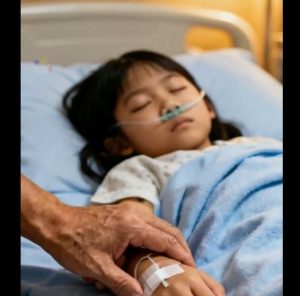
When I arrived at the hospital, the sterile scent of antiseptic hit me first. It always smelled the same—clean, clinical, suffocating. I saw her lying in the bed, pale and fragile, tubes snaking from her arms, her chest rising and falling in a shallow rhythm. Her eyes fluttered open as I approached, and she tried to smile.
“Daddy?” she whispered. The word was thin, almost fragile.
“Yes, sweetheart,” I said, brushing the hair from her forehead. “I’m here.”
The transplant team ran tests immediately. Blood samples, tissue typing, every measurement that could determine compatibility. Hours passed like eternities. And then came the news: I was a match. Perfect. My kidney could save her life.
I didn’t think about anything else. Not the risks to myself, not the recovery, not the months of limitations I would face. All that mattered was her. The surgery was scheduled, and I signed the consent forms without hesitation. Every signature, every medical acknowledgment, felt like a promise—a promise that I would give her my life if it meant saving hers.
The night before surgery, I sat by her bedside, holding her small hand in mine. She was weak, feverish, but she smiled faintly.
“You’ll be okay,” I whispered, more to myself than to her. “I’ve got you. Always.”
Surgery came early the next morning. The operating room was bright, almost blinding, filled with the hum of machines and the steady voices of the medical team. I felt a strange calm as I was prepped, a sense of certainty that this was the right thing. The anesthesia took me under, and I drifted into unconsciousness with her face in my mind.
When I woke, the first thing I heard was her cry—a sound I had been waiting for. She was alive. They had done it. My kidney was inside her, and her body had begun to accept it. Relief flooded me in waves, tears streaming down my face. I had saved her. I had done what no one else could.
But the relief was short-lived.
A few days later, after I had recovered enough to sit in the hospital room, the doctor returned with a sober expression.
“There’s something we need to discuss,” she said. Her tone made my stomach twist. “During the tissue matching process, we discovered something unusual.”
I frowned, leaning forward. “Unusual? What do you mean?”
She took a deep breath. “The results indicate that you are not genetically related to her. You are not her biological father.”
The room spun. The words didn’t compute at first. My mind refused to catch up. “I… what?” I whispered, my voice barely audible.
“You donated a kidney to save a child,” she continued carefully. “A child to whom you are not biologically related. Your tissue was compatible, but the genetic link… it’s not there. She shares no DNA with you.”
The world collapsed around me. Every memory, every moment I had believed proved our bond, suddenly felt fragile and uncertain. How could I have been wrong? How had I not known? And yet, as I looked at her lying there, pale but alive, I felt an unexpected wave of clarity.
I was still her father—not in the genetic sense, not in the medical charts, not in the science of blood and tissue—but in every way that mattered. I had loved her from the moment she drew her first breath, guided her through every fear, celebrated every small victory. I had fought for her, bled for her, sacrificed for her. That could not be erased by a single revelation.
Still, I had questions, and I needed answers. Later that day, I confronted her mother, who had been oddly silent throughout my recovery. Her face fell, shame and fear intertwining in her eyes.