The words echoed across the vast sugarcane fields, carried by the dry morning wind that swept through rows of tall, rustling stalks. The sun had barely risen, yet the heat was already pressing down like an unforgiving hand. Workers moved in silence, their machetes slicing through the thick green stems in a steady, exhausting rhythm.
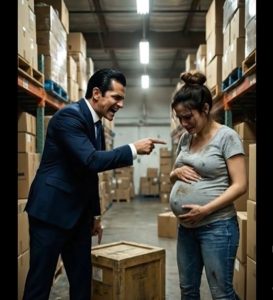
María lowered her head, her trembling hands resting protectively on her swollen belly. She was eight months pregnant, her back aching with every breath, her feet swollen from standing since before dawn. But rest was not an option here—not under Don Raúl’s watchful eyes.
The plantation stretched endlessly beyond the horizon, a kingdom of soil and sweat ruled by one man’s iron will. Don Raúl stood atop his horse near the dirt path, his shadow long against the golden earth. His presence alone commanded fear. His voice, sharp as a whip, allowed no argument, no mercy.
“Did you hear me?” he barked, his eyes fixed on María. “This is not a hospital. This is work.”
The other laborers avoided looking at her. They knew better than to interfere. On this land, compassion was a luxury no one could afford.
María nodded silently and returned to cutting the cane. Each swing of the machete sent a jolt of pain through her body. Her child shifted inside her, restless, as if sensing her distress. She whispered softly to her belly between breaths, words of comfort meant as much for herself as for the life she carried.
“I’m sorry,” she murmured. “Just a little longer.”
She had arrived at the plantation two years earlier with her husband, Mateo, dreaming of saving enough money to build a small home of their own. But Mateo had died in a machinery accident the previous year, leaving her alone, grieving, and desperate. With no family nearby and no other means to survive, she had continued working, hiding her pregnancy for as long as she could.
But nothing remained hidden forever.
By midday, the sun blazed mercilessly overhead. The air shimmered with heat, and the scent of crushed cane filled María’s lungs, making her dizzy. Her vision blurred as she tried to keep pace with the others. The machete slipped from her grasp and fell to the ground with a dull thud.
Don Raúl noticed immediately.
From across the field, his voice thundered, “Pick it up! I will not repeat myself!”
María bent slowly, her hands shaking, but as she reached for the machete, a sharp pain tore through her abdomen. She gasped and collapsed to her knees, clutching her belly. A low cry escaped her lips before she could stop it.
The workers froze.
For a moment, the only sound was the whisper of the wind through the cane. Then murmurs spread quietly among them.
“She’s in labor,” someone whispered.
Don Raúl rode forward, his expression cold, his gaze fixed on María as if she were a broken tool rather than a human being.
“I warned you,” he said flatly. “If you cannot work, you leave.”
María looked up at him, tears streaking her dust-covered face. “Please,” she pleaded, her voice barely audible. “Just… a little help.”
But Don Raúl turned his horse away.
“Anyone who stops working will lose their pay,” he announced to the field. “We are not here to solve personal problems.”
His words struck harder than the sun’s heat. The laborers hesitated, torn between fear and compassion. Finally, an older woman named Rosa stepped forward, ignoring the threat.
“She needs help,” Rosa said firmly. “She’ll die out here.”
One by one, others followed. A young man brought water. Another spread a worn blanket on the ground. Despite Don Raúl’s orders, the workers formed a protective circle around María, shielding her from the harsh sun.
Something unexpected happened in that moment—fear gave way to solidarity.
María’s cries grew louder as the pain intensified. Rosa held her hand, whispering encouragement, guiding her through each breath. Hours seemed to pass within minutes as life and death hovered on the same fragile thread.
As the sun began its slow descent, a newborn’s cry pierced the heavy air.
A baby boy had been born.
The sound of his voice carried across the fields, strong and defiant, a declaration of life in a place built on suffering. Tears filled the workers’ eyes as Rosa gently placed the child in María’s arms.
María wept, holding her son close, her exhaustion mingling with overwhelming relief. In that instant, the cruelty of the world seemed to fade, replaced by something fragile yet powerful—hope.