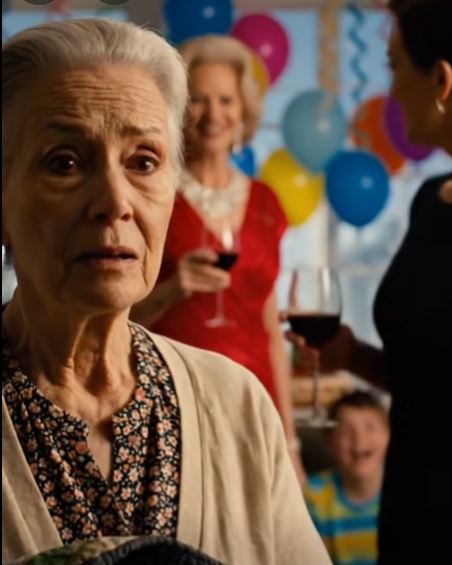
The backyard of my daughter’s modest suburban home buzzed with the cheerful chaos of a seventh birthday party. Brightly colored balloons bobbed in the gentle breeze, tethered to folding chairs and the wooden fence, while children darted across the grass in a frenzy of tag and laughter.

The air smelled of grilled hot dogs, fresh-cut watermelon, and the faint sweetness of sunscreen mixed with sweat. Streamers in every shade of blue—the birthday boy’s favorite color—fluttered from the porch railing, and a handmade banner proclaimed “Happy 7th Birthday, Lucas!” in wobbly crayon letters.
I had spent the morning helping my daughter, Jessica, set everything up: arranging snack tables, inflating balloons until my fingers ached, and carefully wrapping the mountain bike I had saved for months to buy.
At sixty-eight, my back protested the bending and lifting, but I did it gladly, the way I had done everything for the past seven years.
I had stepped into the role of surrogate parent when Jessica’s marriage collapsed and her ex-husband disappeared into a haze of new girlfriends and unpaid child support.
My daughter, then twenty-eight and overwhelmed, had turned to me with tears in her eyes. “Mom, I can’t do this alone. The kids need stability.” So I had sold my quiet little condo by the lake, moved into the spare bedroom of her house, and poured my heart, my savings, and my remaining energy into raising Lucas and his older sister, Mia, who was now twelve.
I cooked their meals, helped with homework, attended every school play and soccer game, stayed up through fevers and nightmares, and gave up retirement dreams of travel and gardening to be the constant in their chaotic young lives.
They called me Nana, hugged me goodnight, and sometimes said “I love you” in the casual way children do. I told myself it was enough.
That afternoon, as the party reached its peak, I stood near the gift table, watching Lucas tear into presents with the wild excitement only a seven-year-old can muster. His friends cheered each new toy, and Jessica beamed from the sidelines, her phone out to capture every moment.
Mia hovered nearby, helping hand out party hats. I felt a quiet swell of pride—this was the life I had helped build for them. But as the sun climbed higher and the call went out for everyone to gather for cake, something shifted inside me like a slow, painful crack in ice.
Jessica clapped her hands. “Okay, everyone! Time for cake! Lucas, come blow out your candles!” The children swarmed toward the picnic table where the large chocolate cake waited, decorated with racing cars and seven bright candles.
I started to move forward, my usual place at the edge of the family circle, ready to sing along and take photos. But then I heard it—Jessica’s voice, light and laughing, directed at her new boyfriend, a pleasant enough man named Ryan who had been dating her for only a few months.
“Ryan, can you light the candles? You’re taller and the wind is picking up.” Ryan obliged with a grin, striking the match while Jessica adjusted the cake. Then she turned to the group and said, “Alright, let’s sing! And after cake, Ryan promised to take the kids for ice cream later this week as a special treat.”
The words landed like a stone in still water. No mention of me. No “Nana helped pick out the cake” or “Nana stayed up late wrapping presents.” Just Ryan, the newcomer, being woven seamlessly into the celebration.
I stood frozen as the happy birthday song began, the children’s voices rising in off-key enthusiasm. Lucas blew out his candles in one dramatic breath, cheered by everyone.
Jessica hugged him tightly, kissing the top of his head, while Ryan snapped pictures and high-fived the boy. Mia laughed at something Ryan said, her eyes sparkling in a way I hadn’t seen directed at me in a long time.
A painful realization washed over me, cold and sharp. I was the helper, the reliable background support, the one who made everything run smoothly so Jessica could work, date, and rebuild her life.
I had been there through the sleepless nights when Lucas had colic as a baby, through Mia’s bullying phase in third grade, through doctor visits and school conferences and endless loads of laundry.
I had given up my own social life, my hobbies, and my financial security. But in that moment, watching the family I had sacrificed for celebrate without truly including me, I understood the brutal truth: I was appreciated for my help, but never truly valued or loved as an irreplaceable part of their hearts.