The supermarket was louder than usual that afternoon. Shopping carts clattered against each other, children begged their parents for sweets near the candy aisle, and the constant beeping of checkout scanners echoed through the store like a relentless reminder of time and money. I stood in line clutching my small basket, trying not to notice the impatient customers behind me.
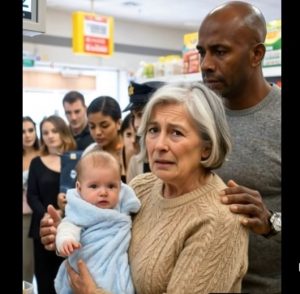
Beside me stood my seven-year-old granddaughter, Emma, holding tightly onto the edge of my coat. She had insisted on coming with me that day, proudly helping me pick out eggs, bread, milk, and a small chocolate bar she hoped we could share later. Since her parents passed away three years earlier, she had grown more sensitive to my moods than any child her age should be.
I was all she had. And she was all I had.
Living on a small pension while raising a child was never easy, but that month had been especially difficult. The heating bill had increased, medicine prices had risen, and every coin suddenly carried the weight of survival. Still, I tried to keep my worries hidden from Emma. Children deserve peace, not burdens.
But that day, my strength began to fail.
When it was finally our turn at the checkout, the young cashier greeted us politely and began scanning our items.
Beep.
Beep.
Beep.
Each sound tightened the knot in my stomach.
I opened my worn wallet and carefully counted the money inside. I had calculated everything before coming to the store, but as the total climbed higher and higher on the screen, I realized I had made a mistake.
I was short.
My hands trembled slightly as I cleared my throat. “Could you please remove the chocolate and the cheese?” I asked quietly.
Emma immediately looked up at me, her eyes wide with confusion. “But Grandma,” she said softly, “we picked the chocolate together.”
Her voice was gentle, but the disappointment in it pierced my heart.
I forced a smile. “We don’t need it today, sweetheart. Maybe next time.”
The woman behind us sighed loudly. A man further back muttered something about people wasting time. I could feel their eyes on me, judging, impatient, waiting for me to hurry up.
My face burned with embarrassment.
Emma stared at the items being removed from our purchase. She looked at my trembling hands, then at the few coins left in my wallet. Suddenly, her small face crumpled, and tears began streaming down her cheeks.
“I’m sorry, Grandma,” she sobbed loudly. “I don’t want you to be sad. We don’t need anything. I promise.”
Her words shattered the fragile wall I had built around my dignity.
The entire line fell silent.
In that moment, I wished the ground would swallow me whole. I had never felt so exposed, so helpless, so painfully aware of my limitations.
Then a calm voice spoke from behind us.
“Please don’t remove anything.”
I turned slowly. A middle-aged man stood there holding a small basket of groceries. He was dressed simply, but there was something dignified about his posture and the kindness in his eyes.
Before I could respond, he handed his card to the cashier.
“I’ll pay for their groceries,” he said gently.
I was shocked. “No, no, sir, I cannot accept that,” I protested, my voice shaking. “You are very kind, but we will manage.”
He smiled warmly. “You’re not accepting charity,” he said softly. “You’re allowing someone to help. There’s a difference.”
The cashier hesitated, then completed the transaction. The screen displayed PAID, and my heart raced with overwhelming emotion.
Emma wiped her tears and looked at the man with innocent gratitude. “Thank you,” she whispered.
The man knelt beside her and smiled. “Take care of your grandmother,” he told her kindly. “She’s very brave.”
Emma nodded seriously, still holding my hand.
Outside the supermarket, I stopped him near the entrance.
“Please,” I said, struggling to find words, “why would you do this for strangers?”
He paused, his expression softening.
“When I was a child,” he explained quietly, “my mother raised me alone. There were days we stood in lines like this one, counting coins and hoping they would be enough. One day, a stranger helped us when we had nothing left. That moment stayed with me my entire life.”